
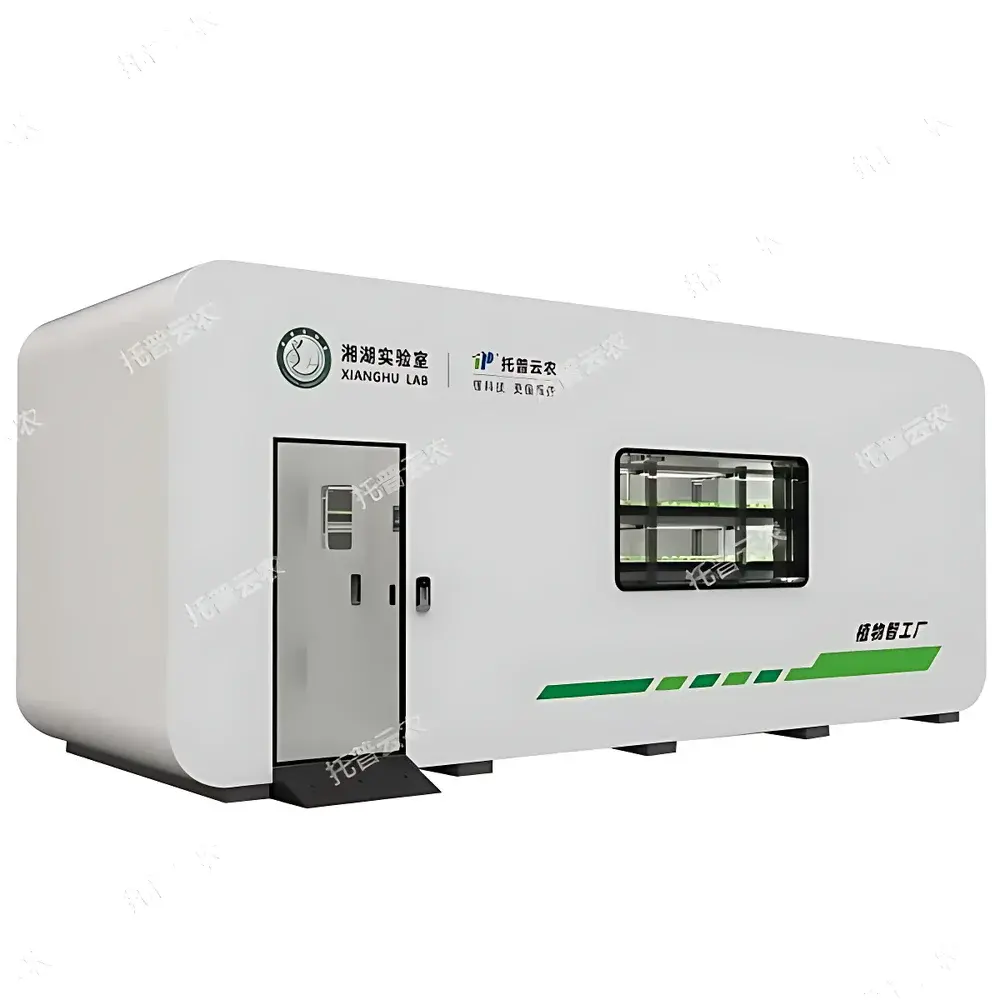
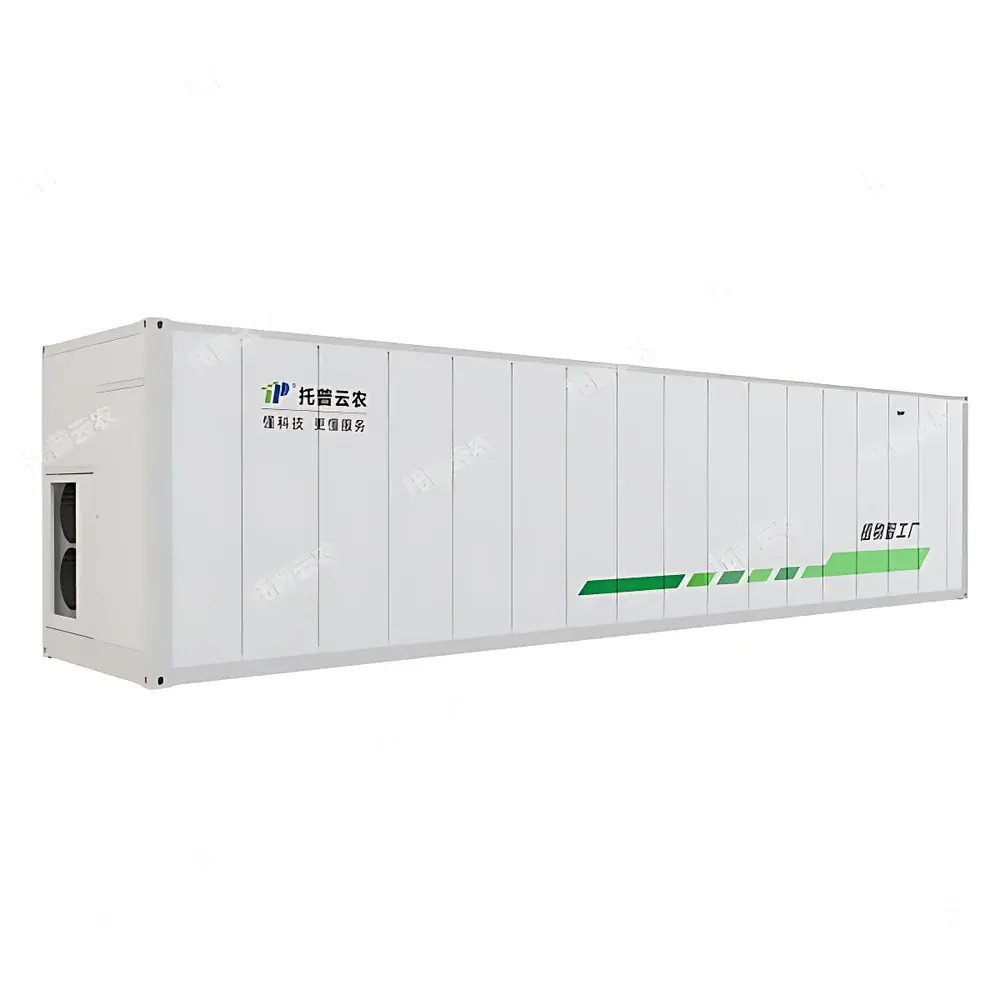
Top Cloud-agri TP-ZWGC-1 Containerized Smart Plant Factory System
| Brand | Top Cloud-agri |
|---|---|
| Origin | Zhejiang, China |
| Manufacturer Type | Direct Manufacturer |
| Product Origin | Domestic (China) |
| Model | TP-ZWGC-1 |
| Pricing | Upon Request |
Overview
The Top Cloud-agri TP-ZWGC-1 Containerized Smart Plant Factory System is a modular, fully enclosed controlled-environment agriculture (CEA) platform engineered for precision plant cultivation under laboratory and research-grade conditions. Built upon a standardized ISO shipping container chassis—available in 20-foot and 40-foot configurations—the system integrates AI-driven environmental control, multi-spectral LED lighting, hydroponic/aeroponic/substrate-based cultivation modules, and real-time biophysical data acquisition. Its core operational principle relies on closed-loop feedback regulation of climatic variables—including air temperature (±0.3 °C control accuracy), relative humidity (±3% RH), CO2 concentration (400–2,000 ppm range), photosynthetic photon flux density (PPFD: 0–1,200 µmol·m−2·s−1), and nutrient solution parameters (pH 4.0–8.0, EC 0.5–5.0 mS/cm)—to emulate diverse ecological niches and support reproducible plant phenotyping across developmental stages. Designed for use in biosafety-compliant indoor environments, the system eliminates dependence on ambient weather, seasonal variability, or external pest pressure—enabling year-round, high-fidelity crop production for scientific validation, germplasm evaluation, and functional genomics studies.
Key Features
- Industrial-grade thermal envelope: Stainless steel-faced polyurethane sandwich panels (R-value ≥ 3.2 m²·K/W) with Class B1 flame retardancy and structural load capacity ≥ 15 kPa.
- Dual-redundant environmental sensing network: Distributed array of calibrated NDIR CO2 sensors, capacitive humidity transducers, Pt100 temperature probes, and quantum PAR meters—sampling at 10-second intervals with automated drift compensation.
- Tunable spectral LED lighting system: Full-spectrum white + narrow-band red (660 nm), blue (450 nm), far-red (730 nm), and UV-A (385 nm) channels; dimmable via PWM with spectral output programmable per growth phase using LUT-based light recipe libraries.
- Modular vertical cultivation architecture: Galvanized steel and electropolished stainless steel racking systems; adjustable inter-layer spacing (300–900 mm); compatible with NFT, deep water culture, fogponics, and peat-perlite substrate trays.
- Intelligent fertigation management: Peristaltic dosing pumps with integrated pH/EC flow-through cells; closed-loop nutrient replenishment logic based on real-time uptake rate modeling and conductivity drift thresholds.
- Unified AI orchestration layer: Edge-deployed inference engine running crop-specific physiological models (e.g., tomato ontogeny, lettuce photomorphogenesis); supports ONNX-compatible neural networks trained on multi-year phenotypic datasets.
Sample Compatibility & Compliance
The TP-ZWGC-1 accommodates a broad spectrum of botanical specimens—including dicotyledonous vegetables (e.g., Solanum lycopersicum, Lactuca sativa), monocots (Oryza sativa seedlings), medicinal herbs (Salvia miltiorrhiza, Angelica sinensis), edible fungi (Agaricus bisporus, Lentinula edodes), and ornamental species (Rosa hybrida, Chrysanthemum morifolium). All internal materials comply with ISO 8573-1:2010 (compressed air purity), NSF/ANSI 51 (food equipment), and GB/T 19001–2016 (equivalent to ISO 9001). Environmental data logging meets GLP audit requirements, with timestamped, tamper-evident records stored locally (industrial SSD) and optionally synced to cloud-hosted repositories compliant with GDPR and HIPAA-aligned encryption standards.
Software & Data Management
The embedded control firmware runs on a Linux-based real-time OS with deterministic scheduling (PREEMPT_RT patchset). The web-accessible PlantOS™ interface provides role-based access control (RBAC), configurable dashboards, and exportable CSV/NetCDF datasets. All sensor readings, actuator states, and algorithmic decisions are archived with SHA-256 checksums and support 21 CFR Part 11-compliant electronic signatures when deployed in regulated research settings. API endpoints (RESTful + MQTT) enable integration with LIMS platforms (e.g., LabVantage, Thermo Fisher SampleManager) and third-party analytics tools (Python/Pandas, MATLAB, R).
Applications
- Controlled-environment phenotyping for QTL mapping and CRISPR-edited line validation
- Abiotic stress simulation (drought, heat, elevated CO2) under repeatable boundary conditions
- Growth chamber qualification per ASTM E1826–22 (Standard Practice for Performance Testing of Plant Growth Chambers)
- Microbial community dynamics studies in rhizosphere-mimicking hydroponic systems
- Pre-commercial scale-up trials for novel crop varieties prior to greenhouse deployment
- Education and training modules for agri-biotech curricula requiring ISO-standardized experimental infrastructure
FAQ
What power supply specifications are required for full-system operation?
A stable three-phase 380 V ±10%, 50 Hz supply with dedicated 63 A circuit breaker is recommended; single-phase 220 V configuration available for reduced-capacity deployments.
Can the system be validated for ISO/IEC 17025-accredited testing laboratories?
Yes—full IQ/OQ documentation packages, sensor calibration certificates traceable to NIM (National Institute of Metrology, China), and uncertainty budgets for all critical measurements are provided upon request.
Is remote firmware update capability supported?
Firmware updates are delivered via signed OTA packages with dual-boot recovery partition; updates require manual approval through authenticated admin console.
How is condensation managed within the sealed growth volume?
Active dew-point control is achieved through synchronized dehumidification cycles, chilled mirror condensate collection, and low-velocity air recirculation paths designed to minimize laminar disruption across canopy zones.
Does the platform support integration with external climate databases (e.g., WorldClim, PRISM)?
Yes—geospatial climate profile import functionality enables automatic derivation of target setpoints for geographic origin-matched cultivation protocols.






