
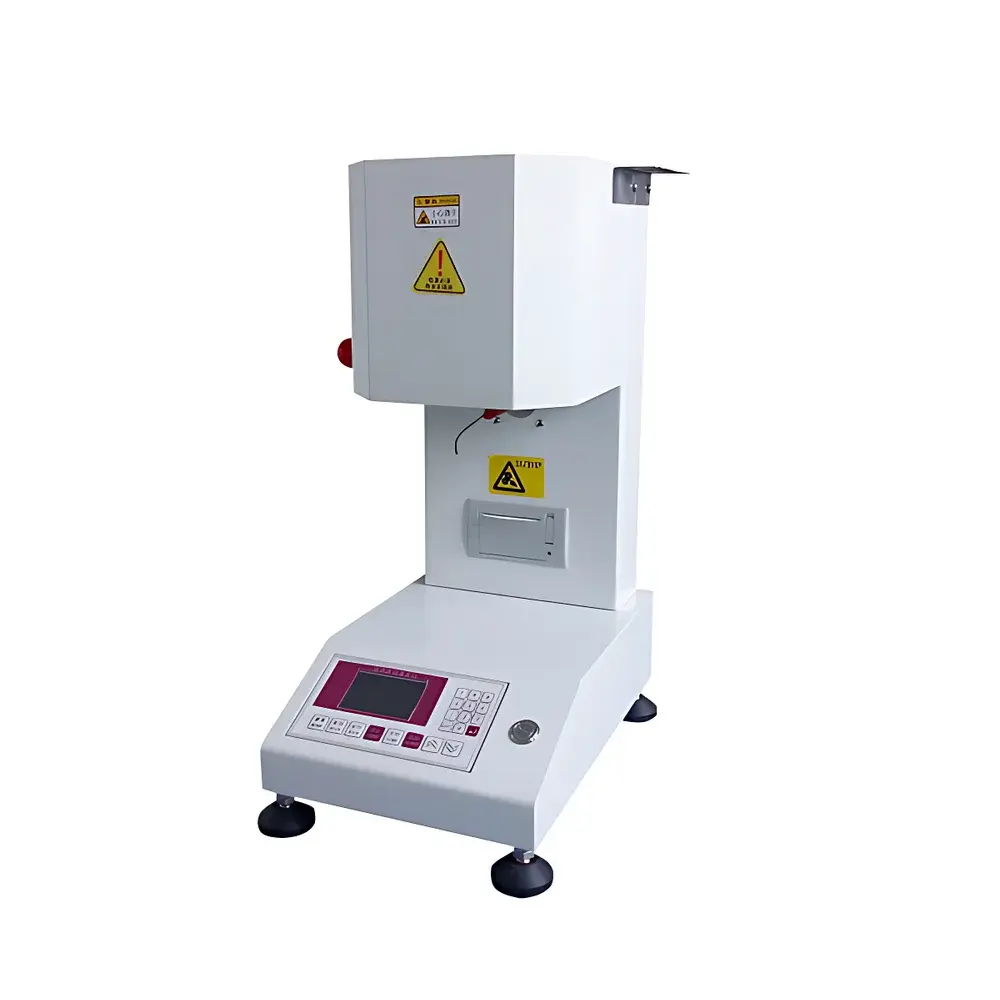
Hengyi HY(RZ)rt Melt Flow Indexer
| Brand | Hengyi / Hengyitest |
|---|---|
| Origin | Shanghai, China |
| Manufacturer Type | Direct Manufacturer |
| Country of Origin | China |
| Model | HY(RZ)rt |
| Quotation | Available upon Request |
| Standards Compliance | GB/T 3682-2018, JB/T 5456-2005 |
| Max Operating Temperature | ≥400 °C |
| Temperature Control Accuracy | ≤±0.2 °C |
| Temperature Stabilization Time (to max temp) | ≤30 min |
| Temperature Recovery Time (after loading) | 2–4 min |
| Timing Resolution | ≥0.1 s |
| Piston Displacement Resolution | ≥0.01 mm |
| Load Levels | 8 standard weights (0.325 kg to 21.600 kg |
| Die Dimensions | Ø2.095 ± 0.005 mm × 8.000 ± 0.025 mm |
| Barrel Dimensions | Ø9.550 ± 0.025 mm × 152.0 ± 0.1 mm |
| Piston Head | Ø9.475 ± 0.015 mm × 6.350 ± 0.100 mm |
| Test Modes | Mass Flow Rate (MFR) and Volume Flow Rate (MVR) |
| Control Interface | Full-color PLC touchscreen with embedded control software |
| Safety Features | Thermal insulation and anti-scald protection for high-temp components |
| Packaging & Transport Compliance | GB/T 13384, GB/T 191, GB/T 6388 |
Overview
The Hengyi HY(RZ)rt Melt Flow Indexer is a precision-engineered instrument designed for the standardized determination of melt mass flow rate (MFR) and melt volume flow rate (MVR) of thermoplastic polymers under controlled temperature and load conditions. Based on the fundamental principle of capillary rheometry—where molten polymer is extruded through a standardized die under a defined compressive force—the HY(RZ)rt delivers repeatable, traceable, and standards-aligned measurements essential for quality control, material specification verification, and R&D validation in polymer manufacturing and compounding facilities. Its operational framework adheres strictly to GB/T 3682-2018 (equivalent in scope to ISO 1133-1:2011 and ASTM D1238) and meets the mechanical and metrological requirements specified in JB/T 5456-2005. The system operates across a wide thermal range up to 400 °C, enabling characterization of high-temperature engineering resins including polyetherimide (PEI), polyphenylene sulfide (PPS), and fluoropolymers such as PEEK and PVDF.
Key Features
- Dual-mode measurement capability supporting both MFR (g/10 min) and MVR (cm³/10 min), with automatic calculation and unit conversion integrated into the control logic.
- Eight-grade calibrated weight set (0.325 kg to 21.600 kg), traceable to national metrological standards, covering all common test loads referenced in ISO 1133 and ASTM D1238—including 2.16 kg, 5.00 kg, 10.00 kg, and 21.60 kg configurations.
- High-stability temperature control system with ±0.2 °C accuracy over the full 50–400 °C operating range; achieves thermal equilibrium within ≤30 minutes and recovers to setpoint within 2–4 minutes after sample loading.
- Full-color industrial PLC touchscreen interface providing real-time visualization of temperature profiles, piston displacement, cut timing events, and calculated MFR/MVR values.
- Automated cutting mechanism synchronized with programmable time intervals or piston displacement thresholds, minimizing operator intervention and inter-test variability.
- Thermally insulated barrel assembly with surface shielding and ergonomic handling design to prevent accidental contact with heated zones (>60 °C).
- Compliant mechanical geometry: precision-ground die (Ø2.095 ± 0.005 mm × 8.000 ± 0.025 mm), hardened steel barrel (Ø9.550 ± 0.025 mm × 152.0 ± 0.1 mm), and metrologically verified piston head (Ø9.475 ± 0.015 mm).
Sample Compatibility & Compliance
The HY(RZ)rt is validated for use with a broad spectrum of thermoplastic materials, including but not limited to polyethylene (PE), polypropylene (PP), polystyrene (PS), acrylonitrile-butadiene-styrene (ABS), polyoxymethylene (POM), polycarbonate (PC), nylon (PA6, PA66), and fluoropolymers (PTFE, FEP). All hardware dimensions conform to the dimensional tolerances mandated by GB/T 3682-2018 and ISO 1133-1. The instrument supports routine calibration using certified reference materials (e.g., NIST-traceable HDPE or PP standards) and includes provisions for periodic verification of temperature uniformity, die geometry, and load application accuracy—key elements required for GLP-compliant testing environments. While not inherently 21 CFR Part 11 compliant out-of-the-box, the system’s deterministic control architecture and audit-ready parameter logging facilitate integration into validated workflows when deployed with qualified third-party data management software.
Software & Data Management
Embedded firmware enables complete test configuration via the PLC HMI: users define test temperature, load class, preheat duration, cut interval, and measurement duration. Real-time temperature curves are plotted and stored alongside raw timing and displacement data. Each test record includes metadata such as date/time stamp, operator ID (manually entered), load applied, barrel temperature, and ambient conditions (if external sensors are interfaced). Data export is supported via USB storage in CSV format, ensuring compatibility with LIMS, Excel-based QA reporting, and statistical process control (SPC) platforms. Firmware updates are delivered via secure offline package, preserving system integrity during regulatory audits. No cloud connectivity or remote telemetry is implemented—ensuring full data sovereignty and alignment with internal IT security policies.
Applications
- Quality assurance of incoming polymer resin batches against contractual MFR specifications.
- Process optimization in extrusion and injection molding, correlating MFR shifts with molecular weight distribution changes.
- Stability assessment of recycled polymer streams subjected to thermal degradation during reprocessing.
- Comparative evaluation of polymer blends, filler-loaded composites, and flame-retardant formulations.
- Supporting technical documentation for ISO 9001, IATF 16949, and AS9100-certified production lines.
- Academic and industrial research on shear-thinning behavior, thermal stability, and long-term viscosity drift under sustained load.
FAQ
What standards does the HY(RZ)rt comply with?
It fully conforms to GB/T 3682-2018 and JB/T 5456-2005, and its mechanical and thermal specifications align with ISO 1133-1:2011 and ASTM D1238 Class B requirements.
Can the instrument perform both MFR and MVR measurements without hardware modification?
Yes—MVR is calculated in real time using piston displacement data from the integrated linear encoder and melt density input (either fixed or user-defined), eliminating the need for separate volumetric collection apparatus.
Is calibration certification included with delivery?
A factory calibration report is provided, documenting verification of temperature uniformity, die geometry, and load application at three representative points (200 °C, 300 °C, and 400 °C); NIST-traceable calibration certificates are available as an optional add-on.
How is maintenance access designed for wear-prone components?
The die, barrel liner, and piston are modular and tool-free replaceable; spare parts kits—including O-rings, die cleaning tools, and thermal insulation sleeves—are supplied with each unit per GB/T 3682’s serviceability clause.
Does the system support automated reporting for regulatory submissions?
Raw data export (CSV) enables integration with validated report-generation tools; however, electronic signature, audit trail, and user-role management require supplementary software validated per 21 CFR Part 11 or Annex 11 guidelines.



