
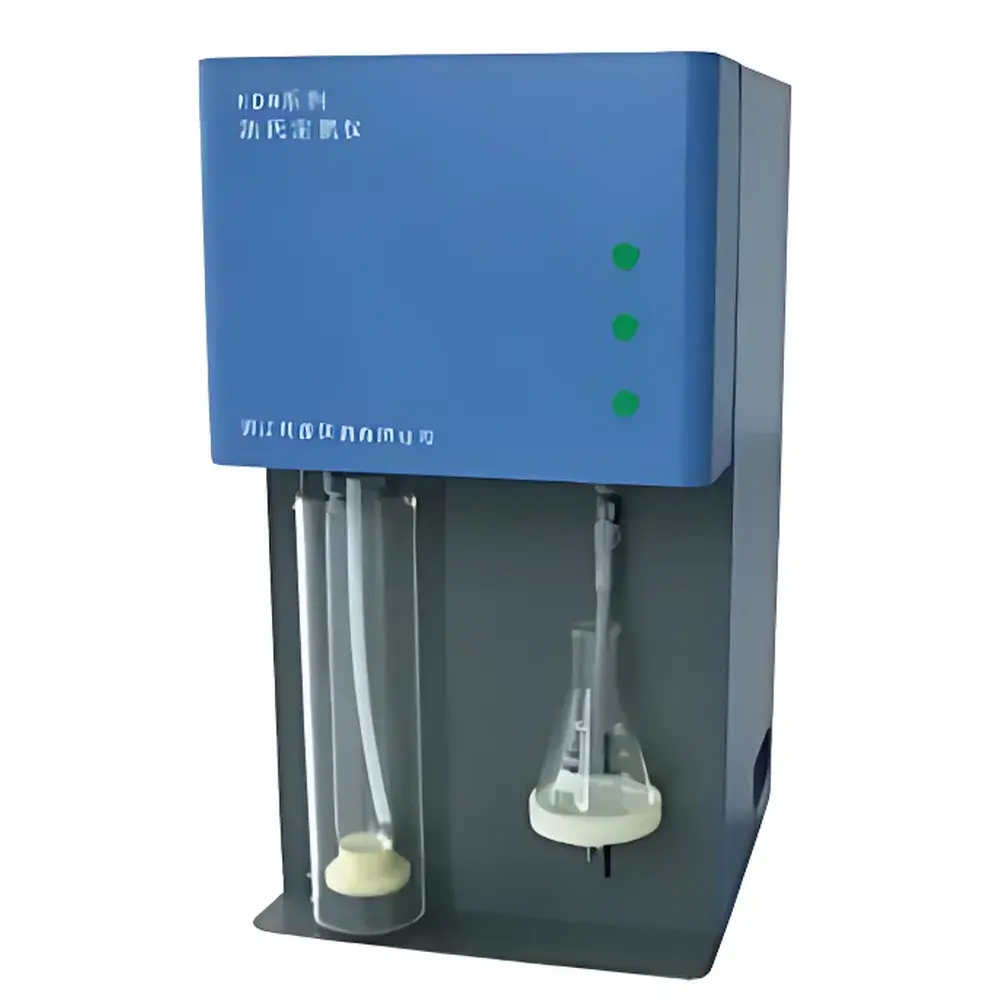
Top Cloud-agri KDN-08A Semi-Automatic Kjeldahl Nitrogen Determinator
| Brand | Top Cloud-agri |
|---|---|
| Origin | Zhejiang, China |
| Manufacturer Type | Direct Manufacturer |
| Country of Origin | China |
| Model | KDN-08A |
| Instrument Type | Kjeldahl Nitrogen Determinator |
| Automation Level | Semi-Automatic |
| Nitrogen Determination Range | 0.1–200 mg N per sample |
| Distillation Time | <5 min per sample |
| Repeatability | RSD < ±1% |
| Sample Weight | 5 g (solid) or 15 mL (liquid) per sample |
| Nitrogen Recovery Rate | 100 ±1% (including digestion step) |
| Dimensions (L×W×H) | 430 × 360 × 760 mm |
Overview
The Top Cloud-agri KDN-08A Semi-Automatic Kjeldahl Nitrogen Determinator is engineered for precise, reproducible quantification of total nitrogen content in organic and inorganic samples via the classical Kjeldahl method. This technique relies on acid digestion to convert organically bound nitrogen into ammonium sulfate, followed by alkaline distillation to liberate ammonia, which is then trapped and titrated or measured photometrically. As a core tool in nutritional analysis, quality control, and regulatory compliance laboratories, the KDN-08A supports standardized workflows aligned with AOAC Official Method 984.27, ISO 8968-1, and GB/T 6423—2022 for feed, food, soil, and agricultural commodities. Designed for routine high-throughput operation, it delivers consistent performance across diverse matrices—including cereals, dairy products, meat, forage, fertilizers, and environmental samples—without requiring deionized water or complex infrastructure.
Key Features
- 8-position parallel distillation system enabling batch processing of up to eight samples per cycle, significantly improving laboratory throughput compared to single- or four-channel alternatives.
- Microprocessor-controlled distillation sequence with automated water filling, real-time water level monitoring, and fail-safe shutdown upon low water pressure (<0.15 MPa) or overheating.
- Dual-layer corrosion-resistant construction: exterior housing of electrostatically sprayed steel; working chamber lined with ABS anti-acid/alkali panels and stainless-steel base plate to withstand prolonged exposure to concentrated H₂SO₄, NaOH, and boric acid solutions.
- Integrated safety interlocks including digestion tube safety door sensor, steam generator dry-run alarm, and overtemperature cutoff to ensure operator protection during extended runs.
- Optimized thermal efficiency design reduces average distillation time to under 5 minutes per sample while maintaining strict adherence to AOAC-recommended steam flow and condensation parameters.
- Universal water supply compatibility: operates directly from municipal tap water (≤20 °C, ≥0.15 MPa), eliminating dependency on external chillers or purified water systems.
Sample Compatibility & Compliance
The KDN-08A accommodates standard 100–500 mL Kjeldahl digestion tubes and accepts sample masses of up to 5 g (dry solids) or 15 mL (liquids), covering nitrogen concentrations from 0.02% to 95% w/w (equivalent to 0.1–200 mg N per determination). Its validated recovery rate of 100 ±1%—inclusive of digestion efficiency—meets the acceptance criteria specified in USP , FDA Guidance for Industry on Protein Assays, and ISO 5983-1 for feed analysis. The instrument’s mechanical architecture and procedural logic are fully compatible with GLP-compliant documentation practices, supporting traceable audit trails when integrated with LIMS or electronic lab notebooks.
Software & Data Management
While the KDN-08A operates as a semi-automatic benchtop unit without embedded touchscreen or cloud connectivity, its deterministic control logic ensures full repeatability and minimal operator intervention. All process parameters—including distillation start/stop timing, water fill volume, and thermal ramp profiles—are fixed per AOAC protocols and factory-calibrated. For laboratories implementing 21 CFR Part 11 compliance, external data capture is achieved via RS-232 or USB-to-serial interfaces (optional accessory), enabling integration with validated titration systems (e.g., Metrohm 809 Titrando) or custom SCADA platforms that enforce user authentication, electronic signatures, and immutable audit logs.
Applications
- Food & Beverage QA/QC: Crude protein estimation in flour, soybean meal, whey powder, infant formula, and plant-based meat analogs.
- Agricultural Testing: Total nitrogen assessment in soil extracts, compost, manure, and biofertilizers per ASTM D5142 and ISO 11261.
- Feed & Forage Analysis: Compliance testing against EU Regulation (EC) No 152/2009 and AAFCO nutrient profiles.
- Environmental Monitoring: Quantification of organic nitrogen in wastewater sludge and sediment cores per EPA Method 351.2.
- Academic & Research Labs: Teaching Kjeldahl methodology and method validation studies requiring robust baseline instrumentation.
FAQ
What digestion system is compatible with the KDN-08A?
The KDN-08A is designed for use with standard Kjeldahl digestion blocks (e.g., 4–12 position electric heaters) and accepts conventional borosilicate glass digestion tubes (250–500 mL). It does not include digestion functionality.
Does the instrument support automatic titration?
No—the KDN-08A performs only the distillation step. Titration must be conducted separately using manual burettes or automated titrators connected via optional serial interface.
Is calibration required before each use?
No routine recalibration is needed; however, daily system verification using certified nitrogen standards (e.g., ammonium sulfate reference material) is recommended to confirm recovery and precision per ISO/IEC 17025 Clause 7.7.
Can the KDN-08A be used for non-protein nitrogen (NPN) analysis?
Yes—when combined with appropriate pre-digestion or fractionation steps (e.g., trichloroacetic acid precipitation), the system enables selective quantification of NPN in dairy and feed matrices per IDF Standard 122.
What maintenance intervals are recommended?
Monthly inspection of steam lines, gaskets, and water inlet filters; annual replacement of silicone tubing and periodic verification of temperature sensors against NIST-traceable references.





