
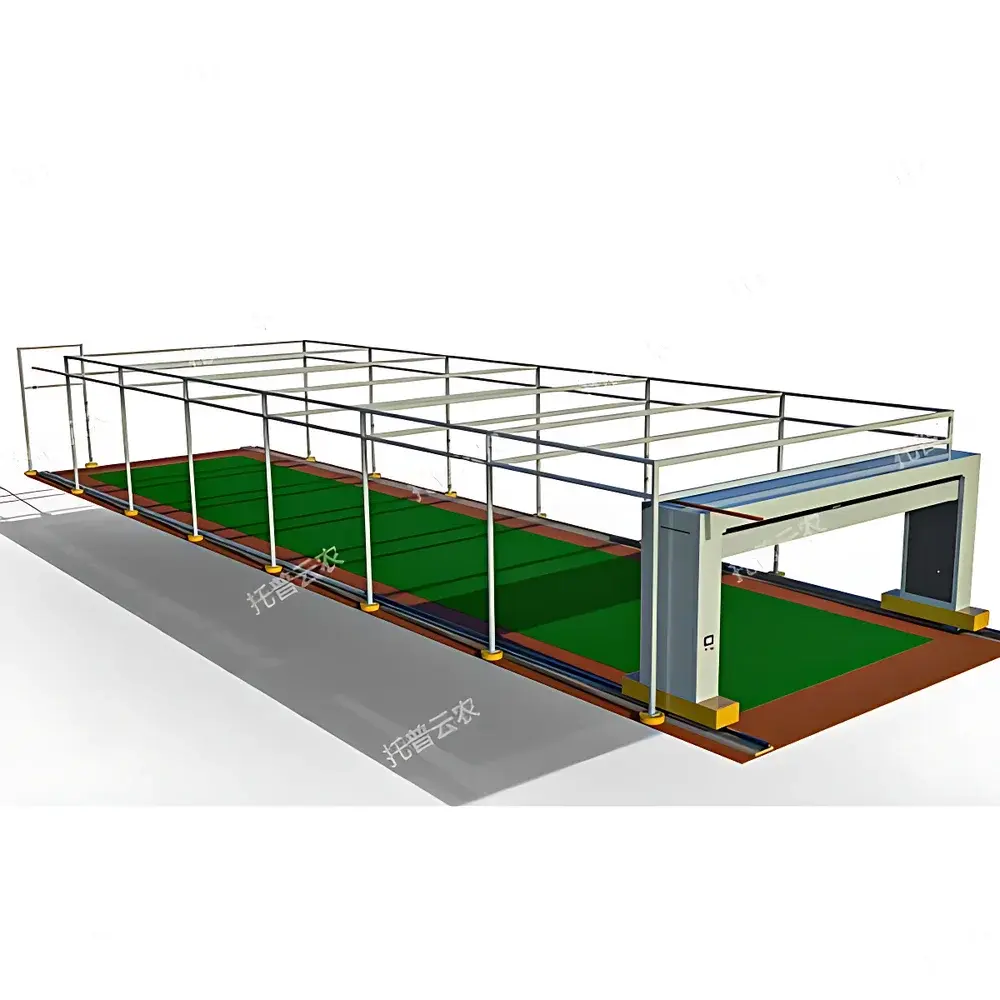
Top Cloud-agri TPN-GTL-GT2 Gantry-Type High-Throughput Plant Phenotyping Platform (Upright Column Configuration)
| Brand | Top Cloud-agri |
|---|---|
| Origin | Zhejiang, China |
| Manufacturer Type | Manufacturer |
| Regional Category | Domestic |
| Model | TPN-GTL-GT2 |
| Pricing | Upon Request |
Overview
The Top Cloud-agri TPN-GTL-GT2 Gantry-Type High-Throughput Plant Phenotyping Platform is an engineered field-deployable phenotyping system designed for long-term, non-destructive, and spatially resolved monitoring of plant phenotypic dynamics under genotype × environment (G×E) interactions. Based on a rigid upright column gantry architecture, the platform operates along fixed rail tracks installed directly in agricultural fields or controlled-environment growth facilities. Its core measurement principle integrates multi-modal optical sensing—visible-light imaging, hyperspectral reflectance spectroscopy, 3D structured-light or LiDAR-based volumetric reconstruction, and infrared thermography—within a synchronized acquisition framework. This enables quantitative, time-series characterization of morphological, physiological, structural, and thermal traits at organ- and canopy-level resolution. The system is purpose-built for longitudinal studies in crop improvement programs, including drought tolerance screening, photosynthetic efficiency mapping, stress response phenotyping, and high-resolution growth trajectory modeling under real-world agronomic conditions.
Key Features
- Gantry Architecture with Upright Column Design: Modular steel frame with adjustable-height upright columns ensures stable deployment across heterogeneous field topographies—including uneven terrain, raised beds, and greenhouse benches—without requiring permanent foundation construction.
- Multi-Sensor Payload Flexibility: Central imaging carriage accommodates interchangeable sensor modules: RGB cameras (≥12 MP, global shutter), push-broom hyperspectral imagers (400–1000 nm, 5 nm spectral resolution), time-of-flight or structured-light 3D scanners (±1 mm depth accuracy), and uncooled microbolometer thermal cameras (640 × 480 px, ±2 °C absolute accuracy).
- Synchronized Multi-Dimensional Data Capture: Hardware-triggered acquisition ensures temporal alignment across modalities; all sensors acquire co-registered data at user-defined intervals (from minutes to days), preserving spatiotemporal integrity for downstream fusion analysis.
- Onboard AI-Powered Phenotype Quantification: Pre-trained deep learning models—optimized for major cereal, legume, and brassica species—automatically segment plants, extract geometric features (height, volume, projected area), compute vegetation indices (NDVI, GVI, PRI, CIred-edge), estimate chlorophyll and nitrogen content from spectral signatures, and derive canopy temperature differentials.
- Field-Robust Operational Safety: Integrated mechanical end-stop limit switches, emergency stop circuitry, and IP55-rated enclosure protection ensure reliable operation in outdoor environments subject to rain, dust, and temperature fluctuations (−10 °C to +50 °C operating range).
Sample Compatibility & Compliance
The TPN-GTL-GT2 supports phenotyping of herbaceous and semi-woody plants up to 2.5 m in height and 1.8 m in canopy width. It is compatible with standard field plot layouts (0.5–3 m row spacing) and modular growth chamber configurations. While not certified to ISO/IEC 17025 or ASTM E2923 for metrological traceability, the platform’s sensor calibration protocols align with best practices outlined in FAO’s *Guidelines for Field-Based Phenotyping* and follow principles consistent with GLP-compliant data generation—particularly regarding audit trails, version-controlled algorithm parameters, and raw-data immutability. All thermal and spectral outputs are calibrated against NIST-traceable reference standards prior to deployment.
Software & Data Management
The integrated PhenotypeStudio software suite provides a unified interface for remote task scheduling, real-time status monitoring, and automated batch processing. Users define acquisition protocols via graphical workflow builder, including sensor activation sequences, exposure settings, and georeferenced sampling grids. Processed outputs—including trait time series, 3D point cloud archives (.las/.ply), hyperspectral cube files (.bil), and thermal video streams (.avi)—are stored in a PostgreSQL-backed relational database with role-based access control. The system supports export to standardized formats (CSV, NetCDF, TIFF) and interoperability with external analytics platforms (R, Python, MATLAB) via RESTful API. Audit logs record every hardware command, software update, and data-processing step—meeting documentation requirements for internal QA review and regulatory readiness (e.g., FDA 21 CFR Part 11 compliant metadata tagging available upon configuration).
Applications
- Longitudinal growth phenotyping across breeding cycles (e.g., daily height increment, leaf area expansion rate)
- High-throughput abiotic stress screening: drought-induced stomatal closure (via thermal signature), heat stress (canopy temperature rise), nutrient deficiency (spectral reflectance anomalies)
- Photosynthetic performance mapping using chlorophyll fluorescence proxies derived from RGB+hyperspectral fusion
- Root-shoot allometric modeling through correlated aboveground biomass (3D volume) and belowground proxy metrics (soil moisture correlation, NDVI trends)
- Validation of remote-sensing algorithms using ground-truthed, sub-meter-resolution phenotypic ground truth datasets
FAQ
What types of crops are supported by the TPN-GTL-GT2 platform?
The system is validated for maize, wheat, rice, soybean, tomato, and Arabidopsis thaliana; custom model training is available for additional species upon request.
Can environmental sensors be integrated directly into the gantry system?
Yes—optional meteorological modules (air temperature/humidity, PAR, soil moisture/temperature, rainfall) mount directly onto the gantry frame and synchronize timestamps with imaging data.
Is raw sensor data accessible for custom algorithm development?
All unprocessed image cubes, point clouds, and thermal sequences are stored locally and fully exportable in open scientific formats without vendor lock-in.
What is the typical installation timeline for field deployment?
Standard field installation—including rail anchoring, gantry assembly, sensor calibration, and software commissioning—requires 5–7 working days under favorable weather conditions.
Does the platform support night-time imaging operations?
Yes—equipped with programmable LED illumination arrays optimized for spectral neutrality across visible and NIR bands, enabling consistent diurnal and nocturnal data collection.





