
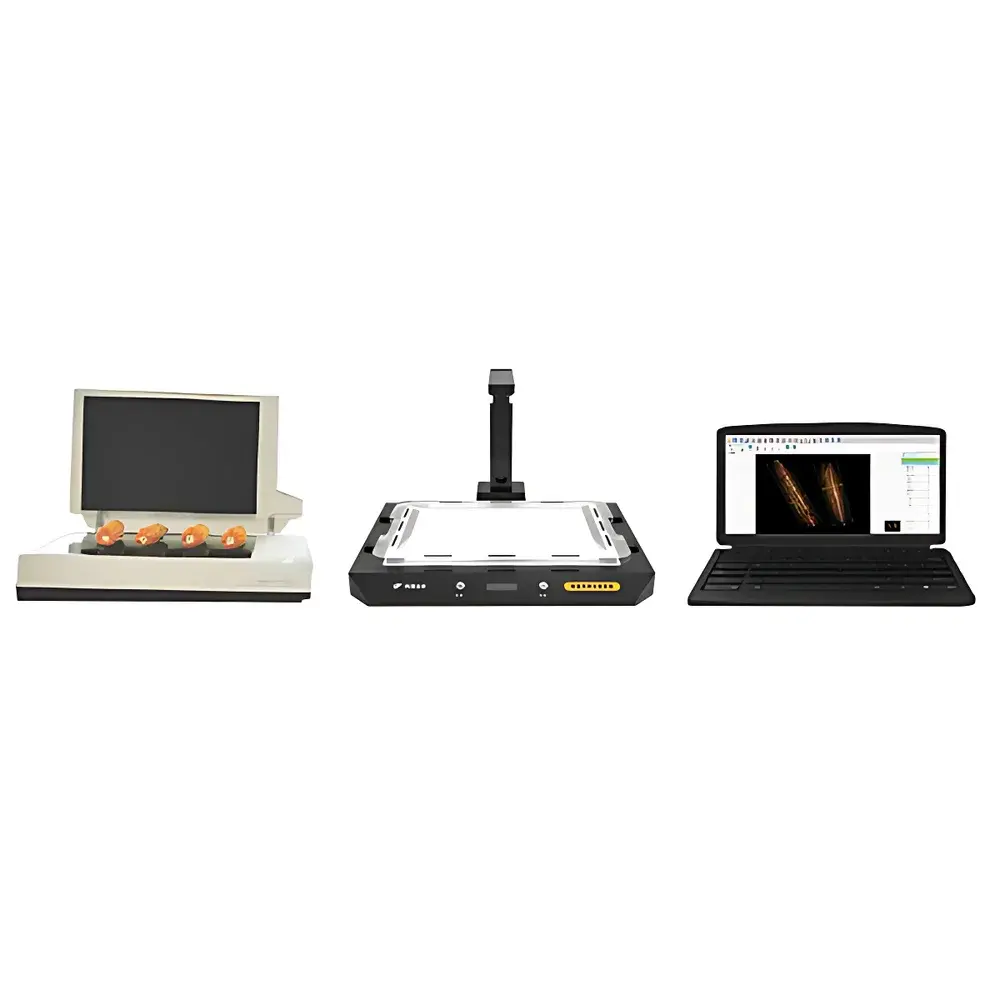
Top Cloud-agri TPKZ-1-GK Full-Parameter Intelligent Seed Phenotyping & Analysis System
| Brand | Top Cloud-agri |
|---|---|
| Origin | Zhejiang, China |
| Manufacturer Type | Direct Manufacturer |
| Country of Origin | China |
| Model | TPKZ-1-GK |
| Pricing | Upon Request |
Overview
The Top Cloud-agri TPKZ-1-GK Full-Parameter Intelligent Seed Phenotyping & Analysis System is a laboratory-grade, image-based phenotypic quantification platform engineered for high-throughput, non-destructive morphometric and physiological assessment of agricultural seeds and reproductive organs. It operates on the principle of high-resolution digital imaging coupled with calibrated backlight illumination, geometric feature extraction algorithms, and supervised machine learning–enabled classification models. Designed specifically for plant breeding programs, seed quality control laboratories, and academic agronomy research, the system delivers standardized, traceable, and audit-ready measurements aligned with international seed testing guidelines (ISTA, AOSA, and ISO 20964:2020 for seed morphology). Its modular architecture supports concurrent analysis across multiple biological structures—including intact cobs, cross-sections, pods, fruit slices, germinating seeds, and root systems—within a single software environment.
Key Features
- Automated seed counting and germination assessment: Detects and classifies germinated vs. non-germinated seeds in controlled incubation trays using adaptive thresholding and contour-based segmentation; outputs germination rate, mean coleoptile/embryonic axis length, and root length distribution.
- Rice spikelet fertility analysis: Computes filled vs. unfilled grain count via bounding-box fitting and pixel-intensity discrimination; calculates fertility percentage, individual grain dimensions (length, width, aspect ratio, area, perimeter), and supports user-defined training of japonica/indica-specific fertility models.
- Maize ear phenotyping: Measures ear length, ear diameter, barren tip length, husk angle, row angle, kernel rows per ear, kernel thickness, cob diameter, and color metrics (RGB channel values) from both whole-ear and transverse-section images.
- Dual-mode black maize imaging: Includes dedicated optical calibration and illumination hardware optimized for low-reflectance kernels, enabling robust feature extraction without manual exposure adjustment.
- Comprehensive grain morphometrics: Supports quantitative analysis of ≥30 crop species (rice, wheat, maize, soybean, sorghum, millet, rapeseed, vegetables, ornamentals); computes per-kernel and population-level statistics including thousand-kernel weight (TKW), hundred-kernel weight (HKW), color histograms, coefficient of variation (CV) for shape parameters, and size-rank distribution plots.
- Legume pod phenotyping: Quantifies morphological traits of ≥5 legume species (soybean, broad bean, pea); extracts >20 parameters per pod—including pod length, pedicel length, convex/concave arc length, chord height, curvature angle, cross-sectional area, and seed number—using edge-detection and spline-fitting algorithms.
- Watermelon fruit section analysis: Measures flesh-to-rind ratio, cavity area, slice diameter/height, shape index, peel thickness, and RGB-based tissue color mapping; configurable for circular or custom fruit geometries.
- Integrated weighing and backlit imaging station: Combines a 0–5 kg precision scale (±0.1 g resolution) with uniform LED backlighting; enables real-time TKW/HKW calculation synchronized with image capture and automatic unit conversion.
- Moisture integration interface: Accepts external moisture meter inputs (certified per OIML R76) to compute moisture-corrected TKW and adjust viability thresholds.
Sample Compatibility & Compliance
The TPKZ-1-GK accommodates dry, dormant, and germinating seeds (diameter range: 1.0–20.0 mm), intact ears (up to 30 cm length), fresh or scanned pod specimens (≥50 pods per batch), and fruit cross-sections (diameter ≤40 cm). All measurement protocols adhere to ISTA Rule 5 (Seed Morphology), AOSA Seed Vigor Testing Handbook, and GB/T 3543.3–1995 (Chinese national standard for seed purity and germination testing). The system’s calibration workflow includes NIST-traceable reference standards for length (10 mm stage micrometer), area (ISO 12233 resolution chart), and mass (OIML Class M2 weights). Data export formats comply with FAIR principles (Findable, Accessible, Interoperable, Reusable), supporting CSV, XLSX, and TIFF metadata embedding.
Software & Data Management
The proprietary TPKZ Analysis Suite features dual-language UI (English/Chinese toggle with certified screenshots), GLP-compliant audit trails (user login, timestamped operations, parameter change logs), and 21 CFR Part 11–ready electronic signatures for regulated environments. Raw images and derived metrics are stored locally with SHA-256 checksum validation and optionally synced to the Top Cloud-agri AgriPheno™ Cloud Platform—a secure, ISO 27001-certified SaaS infrastructure. The cloud portal supports role-based access control, time-series trend analysis, cross-device data federation (up to 20 instrument types, including chlorophyll meters, soil sensors, canopy analyzers, and root scanners), and RESTful API integration with LIMS or Breeding Management Systems (BMS). Mobile functionality includes offline data capture via iOS/Android apps with encrypted local storage and auto-resume sync upon network restoration.
Applications
This system serves core functions in quantitative trait locus (QTL) mapping studies, genome-wide association studies (GWAS), marker-assisted selection (MAS), and speed breeding pipelines. Typical use cases include: evaluating grain yield components under abiotic stress (drought, heat, salinity); validating CRISPR-edited lines for altered seed size or pod architecture; monitoring hybrid purity via morphometric fingerprinting; certifying seed lot quality per national regulatory frameworks; and generating high-fidelity phenotypic datasets for deep learning model training (e.g., ResNet-50 fine-tuning for species-specific kernel classification). Its reproducibility (CV <1.2% for TKW across 10 replicates) meets OECD GLP requirements for pre-commercial variety trials.
FAQ
What imaging modalities does the system support?
It accepts high-resolution scans (≥600 dpi) from flatbed scanners and live captures from USB-connected high-speed document cameras (≥5 MP, global shutter), with automatic perspective correction and dynamic range optimization.
Can the system be validated for regulatory submissions?
Yes—full IQ/OQ documentation packages, calibration certificates, and raw data audit reports are available upon request; software versioning follows ICH GCP Annex 11 guidelines.
Is third-party instrument integration supported?
The system provides open CSV/JSON import/export and optional OPC UA gateway configuration for integration with environmental chambers, automated seed sorters, or greenhouse control systems.
How is model retraining performed for novel cultivars?
Users upload annotated image sets (minimum 50 samples per class) through the cloud platform; the system trains custom CNN classifiers with transfer learning and returns accuracy metrics, confusion matrices, and deployment-ready inference models.
What is the maximum throughput for maize kernel counting?
Up to 3,000 kernels per minute with ≤±0.5% counting error; verification mode allows real-time mouse-driven merge/split corrections to achieve 100% accuracy prior to report generation.






