
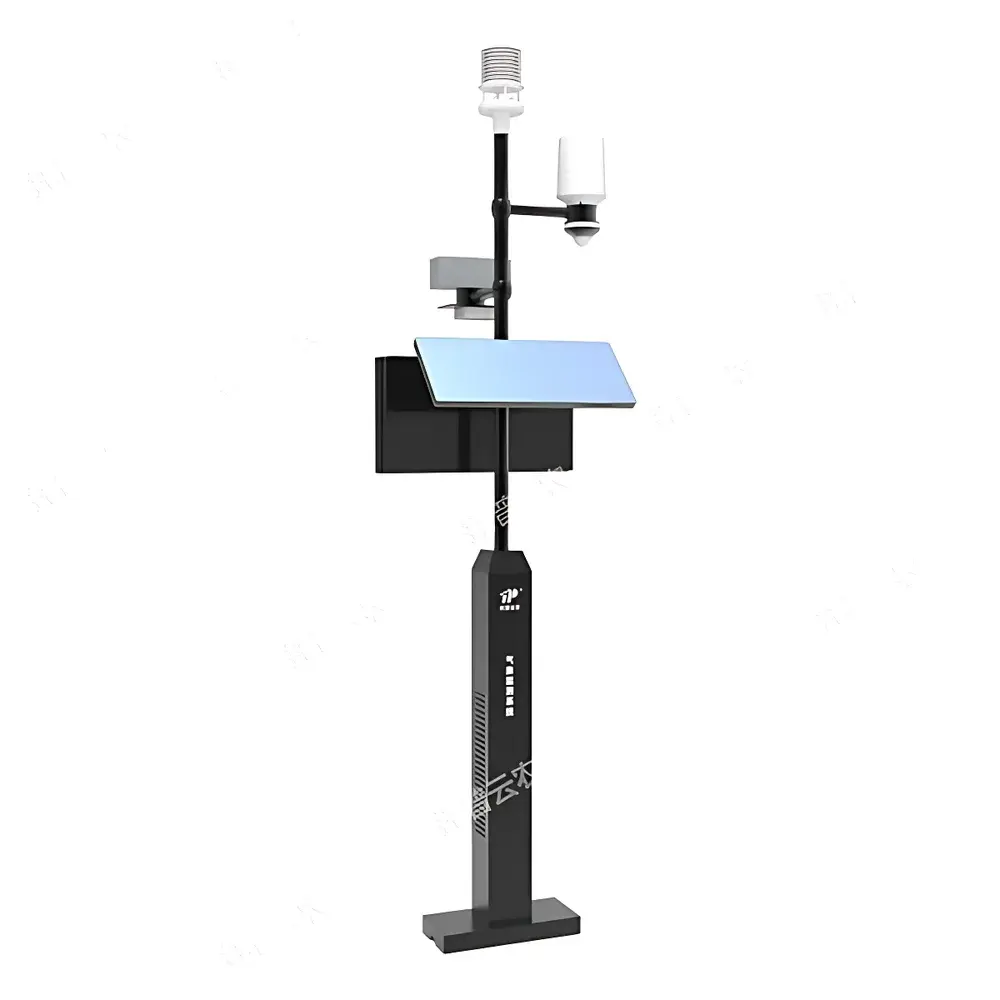
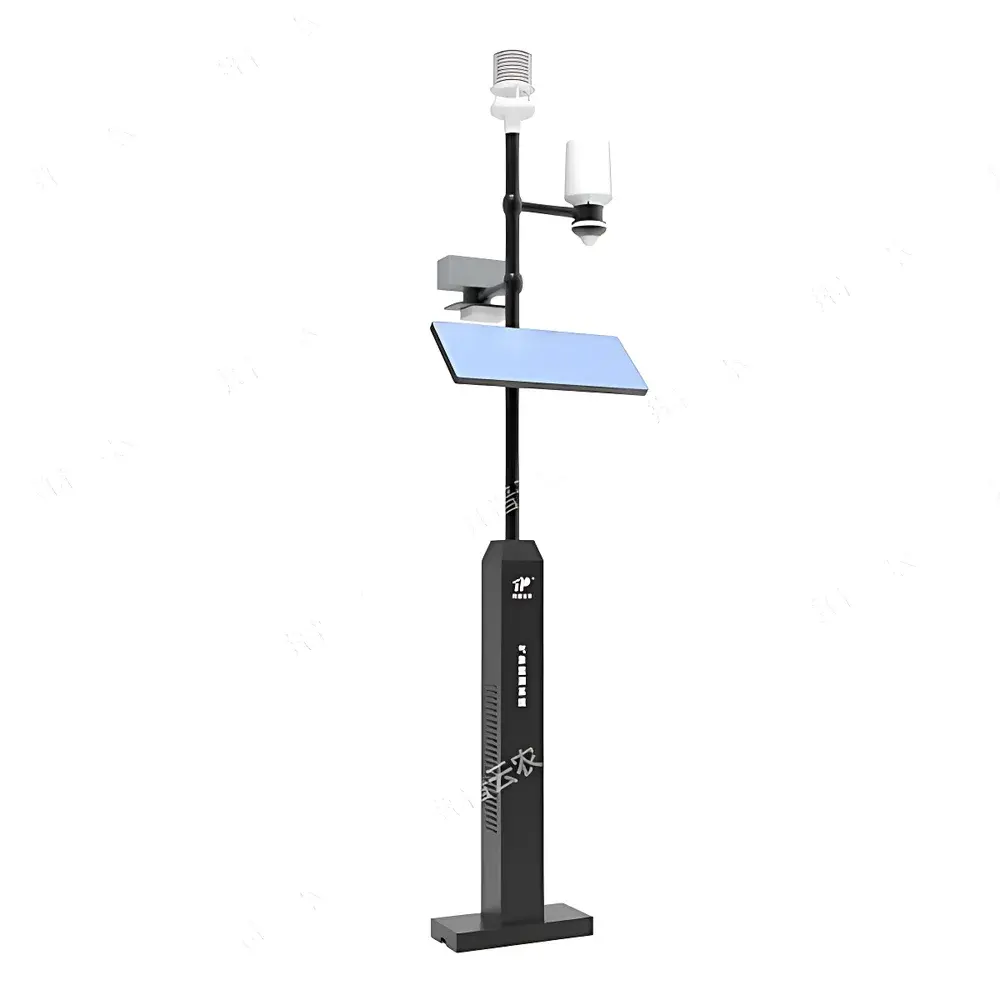
Top Cloud-agri TP-WMS-1H Agricultural Microclimate Monitoring Station
| Brand | Top Cloud-agri |
|---|---|
| Origin | Zhejiang, China |
| Manufacturer Type | Direct Manufacturer |
| Product Category | Domestic |
| Model | TP-WMS-1H |
| Instrument Type | Multi-parameter Environmental Monitoring Station |
| Communication | 4G/5G/NB-IoT/GPRS/CDMA |
| Power Supply | Solar-powered (≥15 days autonomy in overcast conditions) |
| Camera Resolution | 1920×1080 (2 MP), 4 mm focal length, 89.1° FoV |
| LED Display (Optional) | P5 outdoor monochrome, 128×64 pixels, 720×400×120 mm, 35 W |
| Air Temp Range | −40 to +120 °C, ±0.3 °C accuracy (−40 to 90 °C) |
| RH Range | 0–100 %RH, ±2.5 %RH accuracy (0–90 %RH) |
| Soil Moisture | 0–100 %, ±3 % (0–50 % range) |
| Soil Temp | −40 to +70 °C, ±0.5 °C |
| Wind Speed | 0–60 m/s, ±2 % of reading |
| Wind Direction | 0–360°, ±3° |
| Rainfall | 0–9999 mm total, 0–4 mm/min intensity, ±0.1 mm |
| Illuminance | 0–200,000 lux, ±2 % FS |
| Negative Air Ions | 0–50,000 ions/cm³, ±15 % of reading |
| PM2.5 | 0.0–999.9 µg/m³, ±15 % (25 °C, 50 %RH) |
| Positioning | Integrated GPS/BeiDou/Galileo |
| Sensor Interface | RS485 & LoRa compatible |
| Data Logging Interval | Remotely configurable via cloud platform |
Overview
The Top Cloud-agri TP-WMS-1H Agricultural Microclimate Monitoring Station is a fully integrated, solar-powered environmental observatory engineered for long-term, unattended operation in remote agro-ecological zones—including forest margins, orchards, ecological reserves, and marginal farmland. It implements multi-layered, multi-physics sensing architecture grounded in standardized meteorological and pedological measurement principles: air temperature and humidity are acquired using capacitive polymer sensors calibrated per ISO 11785; soil moisture employs frequency-domain reflectometry (FDR) at 100 MHz, compliant with ASTM D5778; wind speed and direction utilize ultrasonic time-of-flight measurement (IEC 61000-4-3 validated), enabling zero-threshold detection and omnidirectional response; rainfall is measured via tipping-bucket mechanism conforming to WMO Guide to Meteorological Instruments and Methods of Observation (CIMO Guide, Chapter 8); and atmospheric particulate mass concentration (PM2.5) follows light-scattering photometric detection aligned with EN 15267-3. The system delivers synchronized, timestamped measurements across 14 physical parameters—spanning atmospheric, edaphic, biotic, and optical domains—enabling holistic assessment of microclimatic drivers influencing plant phenology, water stress, pest pressure, and ecosystem service provisioning.
Key Features
- Multi-tier sensor architecture: Simultaneous acquisition of 4-layer soil moisture and temperature profiles, dual-height air temperature/humidity, and full-spectrum solar irradiance.
- Ultrasonic anemometry: Contactless wind sensing with no moving parts, operational from 0 m/s, ±2% accuracy up to 60 m/s, and 1° directional resolution across 360° azimuth.
- Integrated high-fidelity imaging: 2 MP HD camera (1920×1080) with fixed 4 mm lens and 89.1° horizontal field of view, programmable snapshot scheduling and on-demand live streaming.
- Multi-constellation GNSS positioning: Concurrent support for GPS, BeiDou, and Galileo systems, delivering sub-5 m horizontal accuracy and automatic altitude derivation—critical for elevation-corrected evapotranspiration modeling.
- Intelligent edge diagnostics: Real-time monitoring of battery voltage, solar input, device tilt/vibration, and positional drift—with configurable thresholds and automated SMS/email alerts.
- Dual-interface sensor compatibility: Native support for both RS485 Modbus RTU and LoRaWAN protocols, enabling seamless integration of legacy and next-generation field sensors.
- Adaptive power management: Solar-charged LiFePO₄ battery system rated for ≥15 days continuous operation under sustained overcast conditions—validated per IEC 61215 for outdoor energy harvesting reliability.
Sample Compatibility & Compliance
The TP-WMS-1H is designed for deployment across heterogeneous land-use contexts: temperate orchards, subtropical bamboo forests, alpine meadows, and semi-arid agroforestry belts. Its ingress protection rating (IP65 enclosure) ensures resilience against dust, rain, and thermal cycling in −40 to +70 °C ambient extremes. All environmental sensors comply with traceable calibration hierarchies referenced to NIM (China National Institute of Metrology) standards. Data integrity mechanisms—including cyclic redundancy checks (CRC-16), secure TLS 1.2 encrypted transmission, and immutable cloud-side write-once storage—support adherence to GLP-aligned data governance frameworks. The platform accommodates regulatory reporting requirements for national networks including the China National Crop Pest & Disease Digital Early-Warning System and the National Soil Moisture Monitoring Network, with metadata tagging supporting FAO WaPOR-compatible data exchange protocols.
Software & Data Management
The station interfaces exclusively with the Top Cloud-agri Smart Agriculture Cloud Platform—a browser-based (B/S) SaaS environment compliant with ISO/IEC 27001 information security standards. The platform provides role-based access control, audit-trail logging per FDA 21 CFR Part 11 Annex 11 expectations, and granular permission settings for multi-site farm cooperatives or provincial forestry bureaus. Time-series data are stored in a columnar time-series database optimized for sub-second query latency across decades of records. Analytical modules include: reference evapotranspiration (ET₀) calculation using FAO-56 Penman-Monteith equations; canopy coverage estimation via CNN-based segmentation (trained on >200k labeled vegetation images); and anomaly detection using seasonal-trend decomposition (STL) coupled with dynamic thresholding. All visualizations—trend curves, heatmaps, comparative scatter plots—are exportable as SVG/PDF/CSV. Historical data remain permanently accessible with version-controlled schema evolution and backward-compatible API endpoints (RESTful JSON v2.1).
Applications
- Microclimate-driven irrigation scheduling: Correlating real-time soil moisture gradients with atmospheric vapor pressure deficit (VPD) to optimize drip timing and volume.
- Forest health surveillance: Tracking diurnal patterns in negative air ion concentration and PM2.5 as proxies for biogenic VOC emissions and wildfire smoke intrusion.
- Crop phenology validation: Synchronizing time-lapse imagery with thermal time accumulation (GDD) models to refine planting/harvest windows.
- Ecological restoration monitoring: Quantifying establishment success of native species through multi-year trends in soil water retention, light penetration, and canopy closure rates.
- Climate resilience assessment: Aggregating 5-day forecast-integrated ET₀ projections with historical percentile analysis to identify drought-prone growth stages.
- Regulatory compliance reporting: Automated generation of monthly summary reports aligned with China’s “Green Development Index” indicators for county-level ecological performance evaluation.
FAQ
Does the TP-WMS-1H meet international metrological traceability requirements?
Yes—temperature, humidity, and rainfall sensors are factory-calibrated against NIM-certified reference standards, with calibration certificates available upon request. Uncertainty budgets are provided per ISO/IEC 17025 guidelines.
Can the system operate without cellular coverage?
Local data logging persists onboard for up to 30 days (15-minute intervals). When connectivity resumes, buffered data auto-syncs with time-stamp preservation. LoRaWAN gateways may be deployed as offline alternatives.
Is firmware update capability supported remotely?
Yes—over-the-air (OTA) updates are delivered via signed binary packages authenticated using ECDSA-256, ensuring integrity and origin verification before installation.
How is image metadata handled during upload?
Each JPEG retains EXIF tags embedding GPS coordinates, UTC timestamp, sensor status flags, and exposure parameters—preserved end-to-end without compression artifacts.
What level of cybersecurity is implemented for cloud data access?
Two-factor authentication (TOTP), session timeout enforcement (<15 min idle), encrypted at-rest storage (AES-256), and quarterly third-party penetration testing reports are standard components of the platform’s SOC 2 Type II compliance posture.
Related Products







