
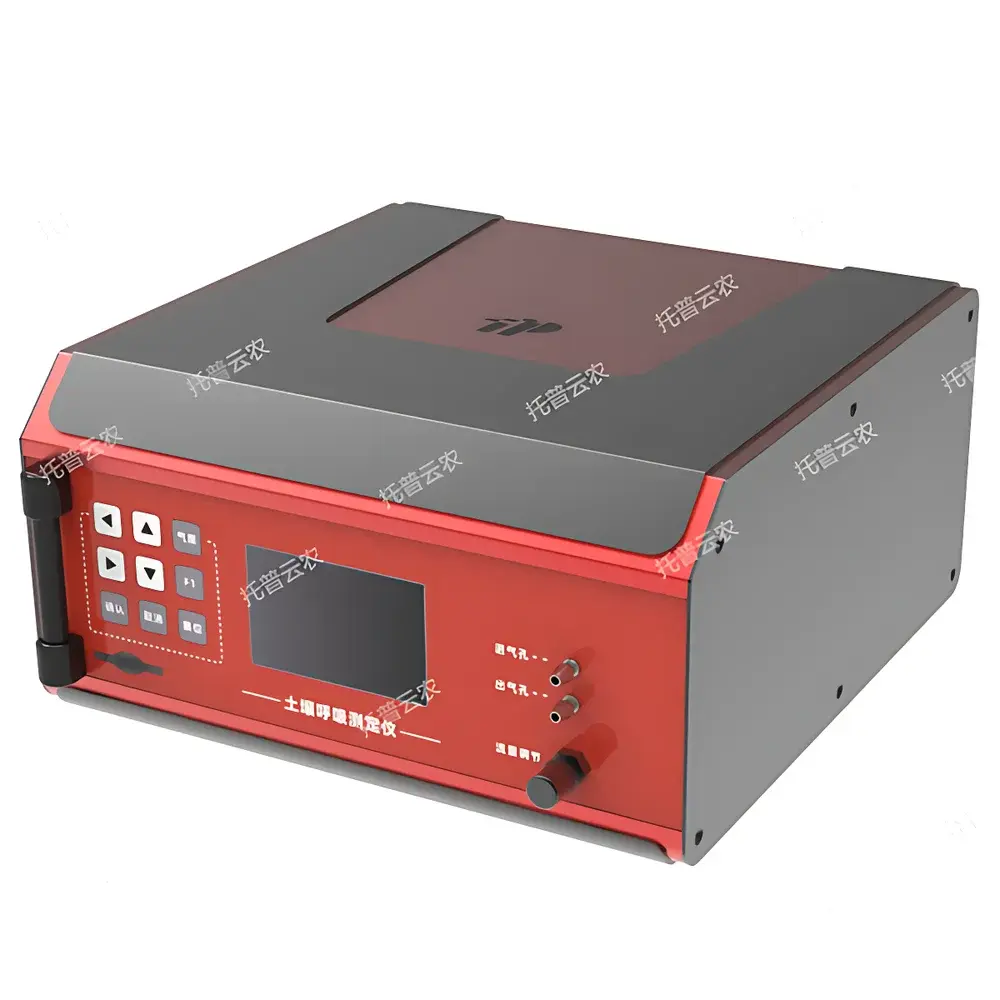
Top Cloud-agri 3051T Portable Soil Respiration Monitoring System
| Brand | Top Cloud-agri |
|---|---|
| Origin | Zhejiang, China |
| Manufacturer Type | OEM/ODM Producer |
| Country of Origin | China |
| Model | 3051T |
| Power Supply | DC 8.4 V Li-ion Battery (10 h continuous operation) |
| Operating Temperature | 0–50 °C |
| Storage Temperature | −20–60 °C |
| Relative Humidity Range | 0–100 % RH (non-condensing) |
| CO₂ Measurement Range | 0–5000 ppm |
| CO₂ Resolution | 0.1 ppm |
| CO₂ Accuracy | ±3 ppm |
| Temperature Range | −20–80 °C |
| Temperature Resolution | 0.1 °C |
| Temperature Accuracy | ±0.2 °C |
| Humidity Range | 0–100 % RH |
| Humidity Resolution | 0.1 % RH |
| Humidity Accuracy | ≤ ±1.8 % RH |
| PAR Range | 0–3000 µmol·m⁻²·s⁻¹ |
| PAR Resolution | 1 µmol·m⁻²·s⁻¹ |
| PAR Accuracy | < ±5 µmol·m⁻²·s⁻¹ |
| Spectral Response | 400–700 nm |
| Flow Rate Range | 0–1.5 L·min⁻¹ |
| Flow Resolution | 0.01 L·min⁻¹ |
| Flow Accuracy | ±2 % |
| Chamber Volume | 1 L (standard) |
| Chamber Material | Outer shell — UPVC |
| Display | 256 × 160 dot-matrix LCD (Chinese interface) |
| Data Storage | 2 GB SD card (≥1,000,000 records) |
| Communication | USB data export to PC for post-processing |
Overview
The Top Cloud-agri 3051T Portable Soil Respiration Monitoring System is a field-deployable, closed-chamber gas exchange instrument engineered for high-reproducibility measurement of soil CO₂ efflux—the primary indicator of heterotrophic and autotrophic respiration in terrestrial ecosystems. Based on the non-steady-state closed-chamber principle, the system dynamically tracks temporal changes in CO₂ concentration within a sealed headspace over a defined integration period (typically 60–120 s), while concurrently logging chamber-internal temperature, relative humidity, and photosynthetically active radiation (PAR) at the soil surface. Its modular design supports interchangeable chamber volumes (standard 1 L, optional configurations available), enabling cross-comparative studies across soil types, land-use gradients, and non-soil biological samples—including seeds, insects, and detached plant organs—under controlled or ambient field conditions.
Key Features
- Integrated multi-sensor array featuring NDIR-based CO₂ detection (Swiss-made optical module), capacitive humidity sensing, platinum RTD temperature transduction, and silicon photodiode PAR measurement—calibrated traceably to NIST-traceable references.
- Intelligent flow control architecture with micro-electromechanical (MEMS) mass flow metering and automatic pump shutdown upon pressure anomaly detection, preventing sample disturbance and ensuring consistent chamber pressurization.
- Dual-layer chamber construction: corrosion-resistant UPVC outer housing and food-grade AISI 304 stainless steel inner reaction volume—optimized for thermal stability, chemical inertness, and minimal adsorption artifacts during low-concentration CO₂ monitoring.
- Onboard real-time data visualization via 256 × 160 monochrome LCD with intuitive Chinese-language menu navigation, parameter configuration (sampling interval, user ID, clock settings), and immediate diagnostic feedback.
- Robust embedded data logger with 2 GB removable SD card supporting timestamped storage of >1 million records (CO₂, T, RH, PAR, flow rate) with configurable sampling intervals from 10 s to 24 h.
- Battery-powered operation (DC 8.4 V Li-ion, 10 h nominal runtime) enables autonomous deployment in remote locations without grid access—ideal for long-term ecological transects and eddy-covariance validation campaigns.
Sample Compatibility & Compliance
The 3051T accommodates standardized 1 L soil chambers (insertion depth: 50 mm; effective measurement height: 145 mm; internal diameter: 94 mm), conforming to ASTM D5098-22 guidelines for soil respiration chamber geometry and sealing protocols. Optional chamber sizes support comparative respiratory assays per ISO 17403:2019 (soil microbial activity) and OECD 207 (earthworm respiration). All sensors comply with IEC 61260-1:2014 (class 2 accuracy for environmental monitoring) and meet CE marking requirements for electromagnetic compatibility (EN 61326-1) and safety (EN 61010-1). While not certified for GLP/GMP environments, its audit-ready data export format (CSV/Excel-compatible) supports traceability in academic and governmental carbon accounting frameworks aligned with IPCC Tier 2 methodologies.
Software & Data Management
Data retrieval occurs via standard USB 2.0 interface; no proprietary drivers required. Exported CSV files contain fully annotated columns: UTC timestamp, CO₂ (ppm), air temperature (°C), relative humidity (% RH), PAR (µmol·m⁻²·s⁻¹), volumetric flow (L·min⁻¹), and calculated respiration rate (µmol CO₂·m⁻²·s⁻¹) using standard ideal gas law correction and linear slope regression (R² ≥ 0.98 threshold enforced). The system supports batch processing and metadata tagging—enabling integration with R, Python (Pandas/NumPy), or MATLAB for time-series decomposition, diel cycle modeling, Q₁₀ temperature response analysis, and spatial interpolation across heterogeneous plots. Raw sensor outputs are stored unprocessed, preserving full fidelity for retrospective recalibration or uncertainty propagation studies.
Applications
- Quantification of soil carbon flux under varying land management practices (tillage vs. no-till, cover cropping, biochar amendment).
- Validation of eddy covariance tower measurements through spatially distributed chamber networks.
- Assessment of rhizosphere priming effects and root exudation dynamics in controlled mesocosms.
- Monitoring post-disturbance recovery in degraded soils (e.g., post-mining reclamation, wildfire burn scars).
- Standardized respiratory phenotyping of crop germplasm under drought or nutrient stress.
- Baseline characterization of soil microbial metabolic activity in long-term ecological research (LTER) sites.
FAQ
What chamber volume options are supported beyond the standard 1 L configuration?
The 3051T host electronics are compatible with user-supplied chambers ranging from 0.25 L to 5 L, provided flow calibration and pressure compensation parameters are adjusted accordingly in firmware.
Does the system support automated multi-point measurements across a transect?
No built-in GPS or robotic actuation is included; however, the lightweight design (≤3.2 kg with battery) facilitates manual relocation between pre-marked locations with synchronized time stamps.
Can CO₂ sensor drift be corrected in-field?
Yes—zero-point calibration is performed using ambient air (verified <500 ppm CO₂) prior to each deployment session; span calibration requires external certified gas (e.g., 1000 ppm CO₂ in N₂) and is recommended quarterly.
Is the data output compliant with FAIR principles (Findable, Accessible, Interoperable, Reusable)?
All exported datasets include ISO 8601 timestamps, SI units, sensor model identifiers, and measurement uncertainty estimates—fully compatible with DataCite metadata schemas and institutional repositories.
How is temperature gradient error minimized during insertion into soil?
The chamber’s double-walled insulation and thermally equilibrated stainless-steel base reduce conductive heat loss; simultaneous internal/external temperature logging allows post-hoc correction using Arrhenius-based thermal offset models.




