
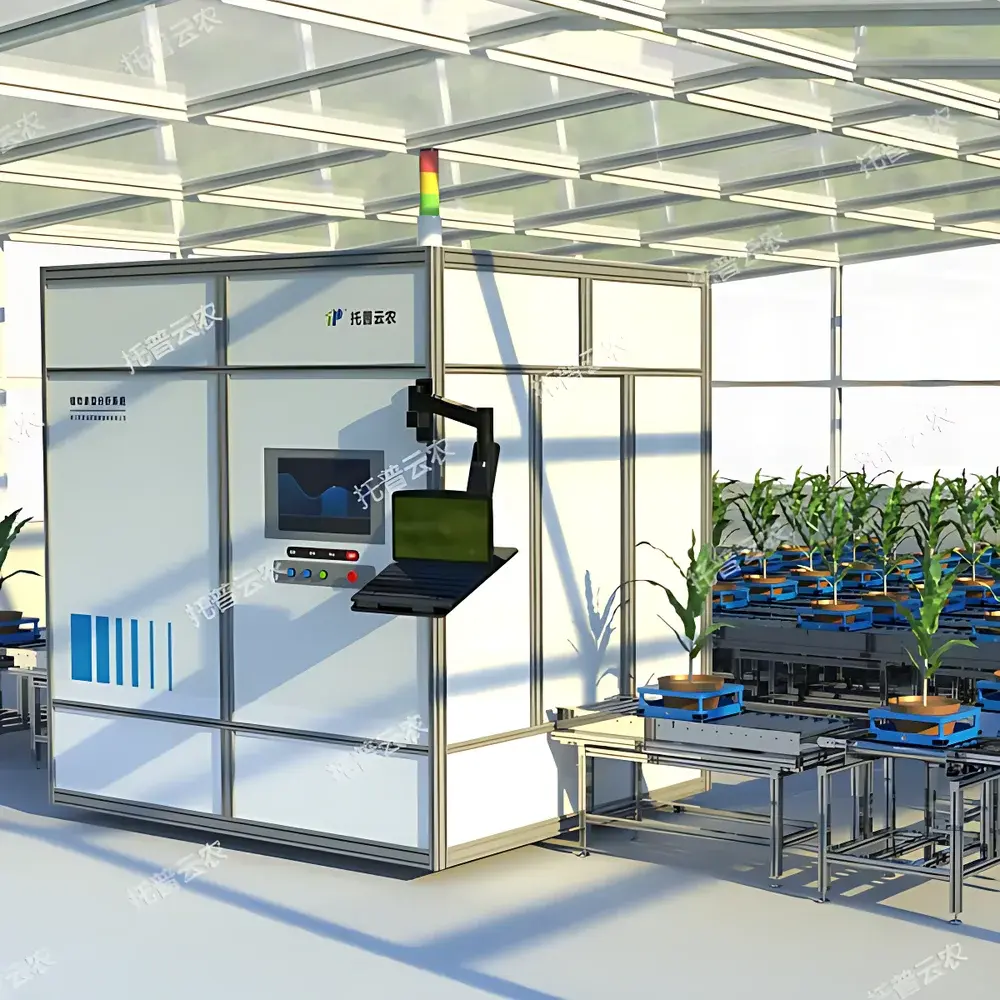
Top Cloud-agri TP-GTL-S1 High-Throughput Laboratory Plant Phenotyping Imaging System
| Brand | Top Cloud-agri |
|---|---|
| Origin | Zhejiang, China |
| Manufacturer Type | OEM Manufacturer |
| Country of Origin | China |
| Model | TP-GTL-S1 |
| Pricing | Upon Request |
Overview
The Top Cloud-agri TP-GTL-S1 High-Throughput Laboratory Plant Phenotyping Imaging System is an integrated, sensor-fused platform engineered for non-destructive, longitudinal phenotypic characterization of plants under controlled laboratory conditions. It operates on the principle of multi-modal optical sensing—combining visible-light 2D/3D imaging, hyperspectral reflectance spectroscopy (400–1000 nm), and synchronized environmental monitoring—to quantitatively capture morphological, structural, textural, spectral, and physiological traits across developmental stages. Designed for reproducible experimental workflows in genetics, breeding, and functional genomics, the system enables high-temporal-resolution acquisition of trait data while maintaining strict environmental control—critical for genotype-by-environment (G×E) studies, abiotic stress phenotyping (e.g., drought, salinity), and biotic stress response profiling.
Key Features
- Intelligent Cultivation Module: Equipped with calibrated soil sensors (moisture, temperature, EC, pH, O₂) and atmospheric probes (air temperature/humidity, CO₂), enabling continuous, time-stamped environmental logging; supports programmable fertigation schedules with precision dosing for targeted stress induction.
- Automated Conveyor & RFID Tracking: A closed-loop conveyor transports pots between cultivation zones and imaging chambers; each pot carries a unique RFID tag, ensuring sample-level metadata linkage across all imaging sessions and environmental logs.
- Modular Multi-Spectral Imaging Suite: Single-chamber integration of three independent imaging modalities: (a) High-resolution 2D RGB imaging (5120 × 5120 pixels, 2.5 µm pixel size) with side-illuminated uniform LED lighting and 360° rotational platform for multi-angle acquisition; (b) Structured-light or stereo-vision-based 3D reconstruction for canopy coverage, volume estimation, and biomass proxy derivation; (c) Hyperspectral imaging (1200 bands, 2.5 nm spectral resolution, 1920 × 1920 spatial resolution) with low-flicker halogen illumination and 25 µm slit width for robust spectral signature acquisition.
- Edge-Based Computational Analytics: On-device processing using proprietary algorithms performs real-time segmentation, feature extraction, 3D model reconstruction, spectral curve generation, and automated calculation of >30 vegetation indices (e.g., NDVI, GVI), chlorophyll-a/b estimates, and canopy nitrogen proxies—all without reliance on cloud infrastructure.
- Scalable Data Architecture: Modular software framework supports experiment-centric project organization, cross-modality data alignment (time-synchronized image + sensor + metadata), role-based access control, and export in FAIR-compliant formats (CSV, HDF5, GeoTIFF).
Sample Compatibility & Compliance
The TP-GTL-S1 accommodates standard growth containers (e.g., 10–20 cm pots, trays up to 60 × 40 cm), supporting monocots (rice, wheat, maize) and dicots (Arabidopsis, soybean, tomato) from seedling to reproductive stage. All imaging protocols adhere to ASTM E2599-22 (Standard Guide for Hyperspectral Imaging Systems) and ISO 11146-3 (Laser beam parameters — Beam widths and divergence angles). Environmental sensor outputs are traceable to NIST-certified reference standards. The system architecture supports audit trails, user authentication, and electronic signatures—enabling compliance with GLP and internal QA/QC requirements for pre-breeding trials and academic phenomics repositories.
Software & Data Management
The proprietary PhenoStudio software provides a unified interface for experiment design, hardware orchestration, batch processing, and statistical visualization. Each imaging session generates a structured dataset containing raw images, calibrated reflectance cubes (for hyperspectral), 3D mesh files (.obj/.ply), trait tables (morphometric, colorimetric, spectral), and synchronized environmental time series. Data export supports interoperability with R (via phenoptr, hyperspec), Python (scikit-image, h5py), and commercial platforms (MATLAB, ENVI). Audit logs record operator actions, parameter changes, and processing versions—meeting documentation rigor expected under institutional review board (IRB) protocols and collaborative phenotyping consortia (e.g., EMPHASIS, PHENOME).
Applications
- Morphological screening of mutant populations for architectural traits (plant height, leaf angle, branching index)
- Quantitative assessment of abiotic stress responses—including osmotic adjustment (via projected area dynamics), stomatal conductance proxies (via thermal-RGB fusion readiness), and senescence progression (via chlorophyll degradation kinetics)
- Nutrient use efficiency (NUE) phenotyping through time-series modeling of canopy nitrogen content and photosynthetic capacity indicators
- Early disease detection and severity grading using hyperspectral anomaly detection and supervised classification (e.g., SVM, Random Forest) trained on spectral libraries of pathogen-infected tissues
- Validation of QTLs and GWAS hits by correlating imaging-derived traits with genomic data in biparental mapping populations or diversity panels
FAQ
What is the minimum plant size compatible with the TP-GTL-S1 system?
Plants as small as 2 cm tall (e.g., 7-day-old Arabidopsis seedlings) can be reliably imaged using the adjustable-height imaging platform and macro-optics configuration.
Can the system operate unattended for multi-week experiments?
Yes—the fully automated conveyor, scheduled imaging routines, and redundant power/data logging enable continuous operation over 28+ days with daily calibration checks and remote health monitoring.
Is hyperspectral data processed in real time or post-acquisition?
Both: basic index computation (NDVI, PRI) occurs during acquisition; full spectral unmixing and quantitative pigment modeling are performed in batch mode post-collection using GPU-accelerated pipelines.
Does the system support integration with external climate chambers?
Yes—via Modbus TCP and OPC UA protocols, enabling synchronized control of chamber setpoints (temperature, humidity, light intensity) and concurrent data ingestion into the central database.
Are software updates and algorithm improvements included in the maintenance agreement?
All firmware upgrades, security patches, and major version releases of PhenoStudio—including new trait models developed for emerging crop species—are provided under the annual support contract.




