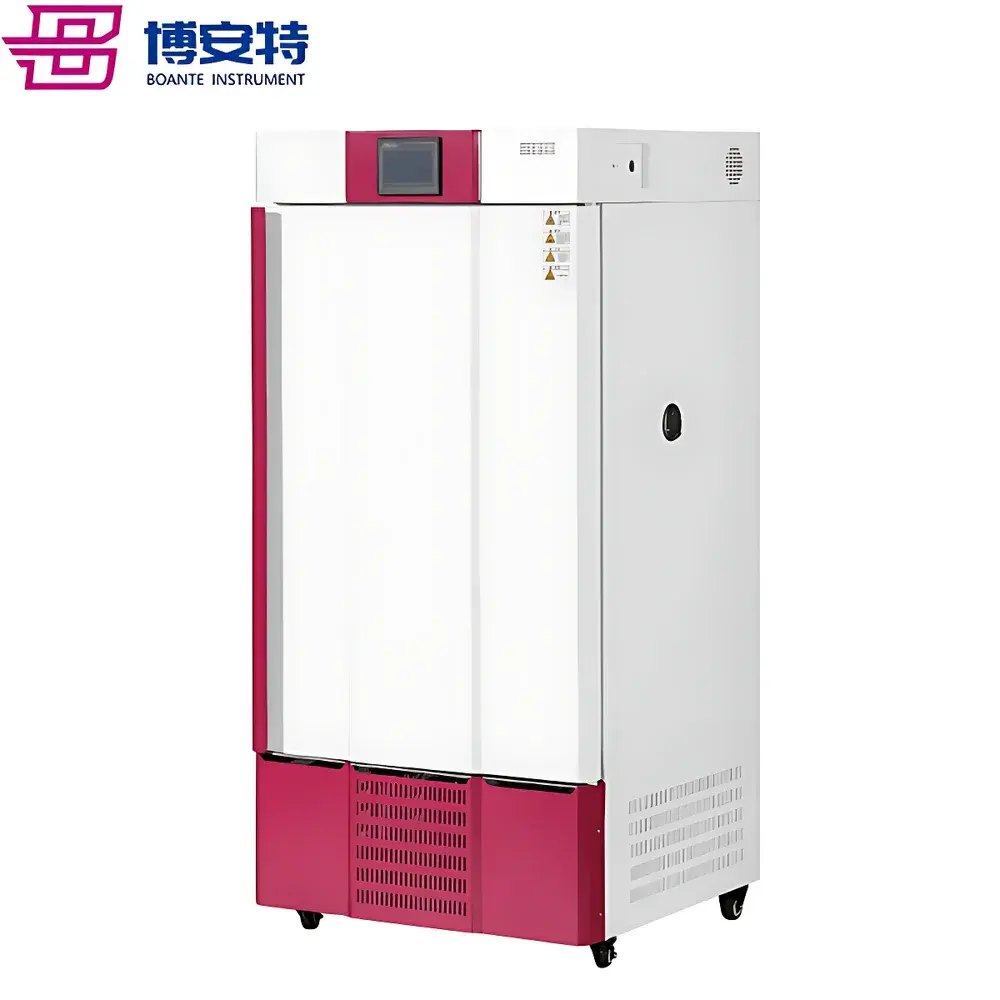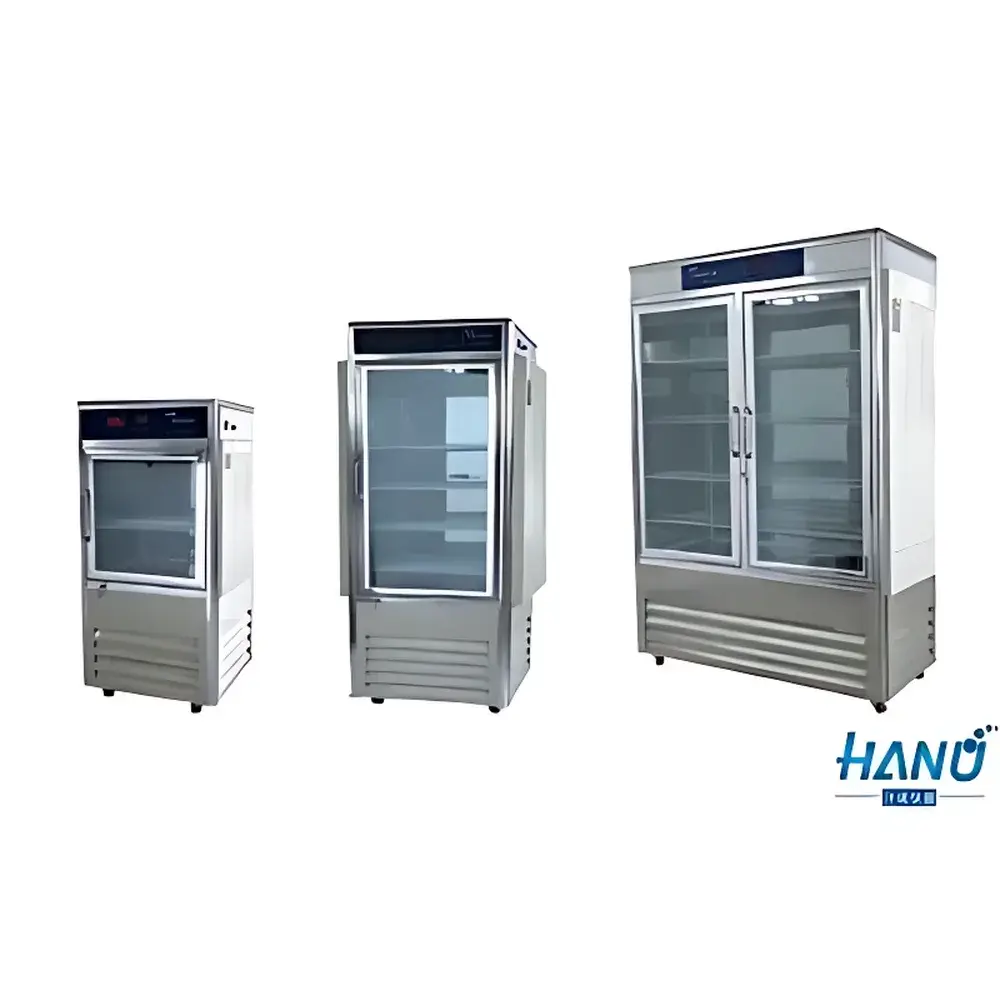
Hanuo PGX-80A Intelligent Plant Growth Chamber
| Brand | Hanuo |
|---|---|
| Origin | Shanghai, China |
| Model | PGX-80A |
| Capacity | 80 L |
| Temperature Range | 0–50 °C |
| Temperature Uniformity | ±0.5 °C |
| Illumination Range | 3,000–22,000 lx |
| Illumination Spectrum | Full-spectrum (optional) |
| Control Mode | Programmable multi-segment (up to 30 segments), independent day/night settings for temperature, illumination, and timing |
| Construction | Stainless steel interior, triple-layer insulated tempered reflective glass door |
| Optional Accessories | Light-tight lamp shroud, internal power outlets, UV sterilization module |
| Compliance | Designed for GLP-compliant plant phenotyping and seed germination studies |
Overview
The Hanuo PGX-80A Intelligent Plant Growth Chamber is a precision-engineered environmental simulation system designed for controlled plant physiology, seed germination, tissue culture, and microbial growth studies. It operates on a dual-mode air circulation principle—combining passive thermal mass stabilization with active forced-air convection via a low-turbulence wind duct system—to ensure spatial temperature uniformity (±0.5 °C) across the 80 L stainless steel chamber volume. Unlike basic incubators, the PGX-80A integrates photobiological control as a core functional axis: its programmable illumination subsystem supports full-spectrum LED arrays (optional), enabling spectral tuning relevant to photomorphogenesis, circadian entrainment, and stress-response assays. The chamber’s microprocessor-based controller maintains traceable environmental logs and supports deterministic scheduling of up to 30 independent time–temperature–light segments per 24-hour cycle—critical for replicating diurnal rhythms or simulating climate gradients in pre-breeding trials.
Key Features
- Robust safety architecture: Dual-redundant overtemperature protection and sensor fault detection prevent thermal runaway and preserve sample integrity.
- High-fidelity environmental programming: Independent day/night profiles for temperature, illumination intensity (3,000–22,000 lx, five-step adjustable), and duration—enabling precise emulation of seasonal photoperiods or altitude-dependent irradiance regimes.
- Energy-efficient thermal management: Triple-pane reflective tempered glass door with low-emissivity coating minimizes radiant heat loss while maintaining optical clarity for non-invasive observation.
- Intelligent power resilience: Built-in battery-backed memory retains all setpoints and runtime history during mains interruption; automatic time compensation ensures uninterrupted experimental timelines.
- Modular expandability: Optional accessories include light-tight lamp shields for dark-phase control, dedicated 24 V DC power outputs for sensor integration, and UV-C sterilization modules compliant with ISO 14644-1 Class 8 cleanroom protocols.
- Human-centered interface: Capacitive touch panel with intuitive icon-driven navigation eliminates mechanical switch wear and supports multilingual UI localization (English, Spanish, German firmware variants available).
Sample Compatibility & Compliance
The PGX-80A accommodates standard plant growth vessels—including Magenta boxes, square petri dishes (100 × 15 mm), hydroponic rafts, and 12-well tissue culture plates—without airflow obstruction. Its stainless steel interior (AISI 304) resists corrosion from nutrient mist, ethanolic disinfectants, and CO₂-enriched atmospheres. The system meets structural requirements for ISO 22716 (Good Manufacturing Practice for cosmetics R&D) and supports audit-ready operation under GLP frameworks when paired with optional data-logging firmware. While not certified for IEC 61000-4 EMC immunity, it demonstrates stable performance in shared laboratory environments with typical EMI shielding (tested per FCC Part 15B Class A). For regulatory submissions involving botanical drug development (e.g., FDA Botanical Guidance), the chamber’s deterministic control logic and timestamped event logging satisfy foundational traceability criteria under 21 CFR Part 11 Annex 11 principles.
Software & Data Management
The embedded controller records timestamped environmental snapshots (temperature, illumination level, elapsed segment time) at user-defined intervals (1–60 min). Data exports via USB 2.0 to CSV or Excel-compatible formats; no proprietary software installation required. Optional Ethernet/Wi-Fi module enables remote monitoring through HTTP-based RESTful endpoints—compatible with LabArchives ELN, Benchling, or custom SCADA integrations. Audit trails include operator ID (PIN-authenticated), parameter change history, and calibration event timestamps. Firmware updates are delivered via signed .bin files to prevent unauthorized modification—a prerequisite for GxP-aligned validation packages.
Applications
- Seed germination kinetics under variable thermoperiods (e.g., stratification protocols per ISTA Rules)
- Arabidopsis thaliana phenotyping across photoperiod treatments (12/12 h vs. 16/8 h)
- In vitro propagation of orchid meristems under spectrally optimized blue:red ratios
- Fungal colony growth assays requiring strict dark-phase synchronization
- Pre-screening of drought-tolerant wheat lines using controlled VPD (vapor pressure deficit) ramps
- Microbial culture stability testing for probiotic consortia under simulated rhizosphere illumination
FAQ
Does the PGX-80A support humidity control?
Humidity regulation is not integrated into the base configuration; however, external humidifiers or desiccant modules can be interfaced via the optional 24 V DC output terminals.
Can illumination spectra be customized beyond the standard white LED array?
Yes—custom narrowband LED configurations (e.g., 450 nm ±10 nm, 660 nm ±15 nm) are available as OEM options with spectral irradiance certification reports (per CIE S 026/E:2019).
Is validation documentation provided for IQ/OQ/PQ protocols?
Factory-generated test certificates (as-built drawings, sensor calibration reports, thermal mapping summary) are included. Full qualification support kits—including blank protocol templates and URS alignment matrices—are available upon request.
What is the maximum ambient operating temperature for reliable performance?
The unit is rated for continuous operation in rooms maintained at ≤30 °C and ≤70% RH non-condensing per IEC 60529 IP20 specifications.
How frequently must temperature sensors be recalibrated?
Annual verification against NIST-traceable reference standards is recommended; the system stores calibration offset values independently per sensor channel.