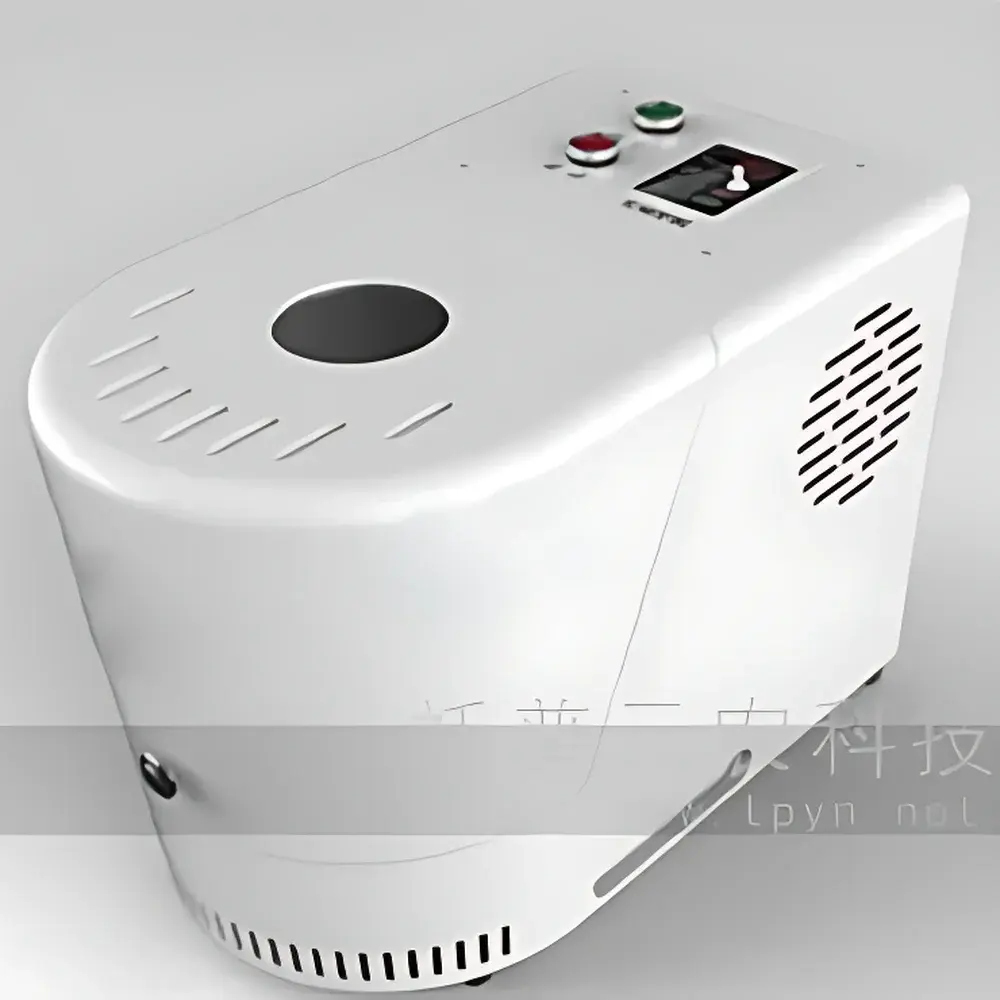
Top Cloud-agri TPYM-50G Planetary Ball Mill for Soil Sample Preparation
| Brand | Top Cloud-agri |
|---|---|
| Origin | Zhejiang, China |
| Manufacturer Type | Direct Manufacturer |
| Product Origin | Domestic (China) |
| Model | TPYM-50G |
| Quotation | Available upon Request |
| Final Particle Size | ≤5 µm |
| Minimum Sample Volume per Jar | 50 mL |
| Maximum Capacity | 4 × 100 mL Jars |
| Main Disc Speed | 50–400 rpm |
| Grinding Jar Speed | 100–800 rpm |
| Transmission Ratio (Main Disc | Jar): 1:−2 |
| Continuous Operation Time Setting | 1–9999 min |
| Pause Interval Setting | 1–999 min |
| Jar Material Options | Stainless Steel, Agate, Zirconia, Alumina, Tungsten Carbide, Polyurethane |
| Jar Volume Range | 50–100 mL |
| Grinding Media Material Options | Stainless Steel, Agate, Zirconia, Alumina, Nylon, PTFE |
| Media Diameter Options | 3, 5, 10, 15, 20 mm |
| Media Mass per Jar | 100–400 g |
| Grinding Modes | Dry and Wet Milling |
| Standard Configuration | 1 Main Unit, 4 × 50 mL Jars, 1 Set of Grinding Balls |
Overview
The Top Cloud-agri TPYM-50G Planetary Ball Mill is an engineered solution for high-efficiency, contamination-controlled size reduction of soil and sediment samples in environmental, agricultural, and geochemical laboratories. Based on the principle of planetary motion—where grinding jars rotate on their own axes while simultaneously revolving around a central sun wheel—the instrument generates high-energy impact and shear forces essential for achieving sub-5 µm particle size distribution. This mechanical energy transfer enables reproducible homogenization and comminution of heterogeneous, clay-rich, or organic-matter-laden soils without thermal degradation or chemical alteration. Designed specifically for routine sample preparation prior to elemental analysis (e.g., ICP-OES, ICP-MS), XRF, XRD, or nutrient extraction protocols, the TPYM-50G complies with methodological requirements outlined in ISO 11464:2021 (soil sampling and pretreatment) and ASTM D422-63 (particle-size analysis of soils), supporting trace-level analytical accuracy through consistent sample representativeness.
Key Features
- Compact benchtop footprint (W × D × H ≈ 320 × 450 × 420 mm) with low mass (<25 kg), facilitating integration into space-constrained QC labs and mobile field laboratories.
- Dual-speed independent control: main disc rotation (50–400 rpm) and jar rotation (100–800 rpm) allow precise tuning of kinetic energy input across diverse soil matrices—including sandy loam, silty clay, and humus-rich topsoil.
- Reversible planetary transmission ratio (1:−2) ensures counter-rotational motion between jar and disc, maximizing collision frequency and energy transfer efficiency.
- Programmable operation logic supports multi-stage milling sequences: continuous run (1–9999 min), intermittent cycles with user-defined pause intervals (1–999 min), and automatic shutdown with audible alert.
- Modular jar and media system accommodates material-specific compatibility requirements—stainless steel for general-purpose grinding, agate/zirconia for trace-metal-free applications, PTFE/nylon for acidic or reactive samples.
- Sealed, leak-proof jar design minimizes cross-contamination and volatile loss during wet milling; optional cooling jacket integration available for temperature-sensitive organic analyses.
Sample Compatibility & Compliance
The TPYM-50G processes a broad spectrum of soil types—mineral soils, peat, compost, contaminated sediments, and air-dried or freeze-dried specimens—without requiring pre-sieving or moisture adjustment. Its dry/wet dual-mode capability supports aqueous slurry milling (e.g., for sequential extraction protocols) and solvent-assisted dispersion (e.g., ethanol for organic carbon preservation). All contact materials conform to ISO 8502-12 (cleanliness of metallic surfaces) and USP particulate matter standards when used with certified agate or zirconia components. The instrument’s mechanical design adheres to IEC 61000-6-2 (immunity) and IEC 61000-6-4 (emissions), ensuring stable performance in shared laboratory environments. Documentation packages include factory calibration records and material traceability certificates for GLP-compliant workflows.
Software & Data Management
While the TPYM-50G operates via intuitive physical keypad interface, its embedded firmware logs all operational parameters—including start/stop timestamps, speed profiles, duration settings, and cycle counts—into non-volatile memory. Audit trails are exportable via USB port in CSV format, supporting 21 CFR Part 11-aligned data integrity practices when paired with validated lab information management systems (LIMS). Optional RS-232 or Ethernet connectivity modules enable remote monitoring and integration with centralized instrument management platforms, facilitating automated report generation for ISO/IEC 17025 accreditation audits.
Applications
- Preparation of homogenized soil reference materials for inter-laboratory proficiency testing (e.g., NIST SRM 2710a, GBW07401).
- Routine comminution prior to total element digestion (EPA Method 3050B, ISO 11466) and pseudo-total extraction (BCR sequential protocol).
- Particle size reduction for X-ray diffraction (XRD) crystallinity analysis and scanning electron microscopy (SEM) sample mounting.
- Homogenization of pesticide-spiked soils for residue method validation under SANTE/2021/1118 guidelines.
- High-throughput processing in environmental monitoring networks where batch consistency and operator-independent repeatability are critical.
FAQ
What jar volumes are supported, and can I use custom-sized jars?
The TPYM-50G is optimized for 50 mL and 100 mL jars; other volumes require mechanical recalibration and are not covered under warranty.
Is the instrument compatible with inert atmosphere milling (e.g., argon purging)?
Yes—jars with gas-tight O-ring seals and optional inlet/outlet ports support controlled-atmosphere grinding for redox-sensitive samples.
Does the system meet FDA or EU regulatory requirements for GMP laboratories?
It satisfies mechanical and electrical safety prerequisites per EN 61010-1; full GMP compliance depends on site-specific validation (IQ/OQ/PQ) and procedural controls.
Can I mill frozen soil samples directly?
No—samples must be air-dried or lyophilized prior to loading; cryogenic conditions may compromise jar seal integrity and motor thermal stability.
How often does the drive belt require replacement under normal usage?
With proper load balancing and adherence to maximum media mass limits, the reinforced poly-V belt typically exceeds 10,000 operating hours before scheduled maintenance.