
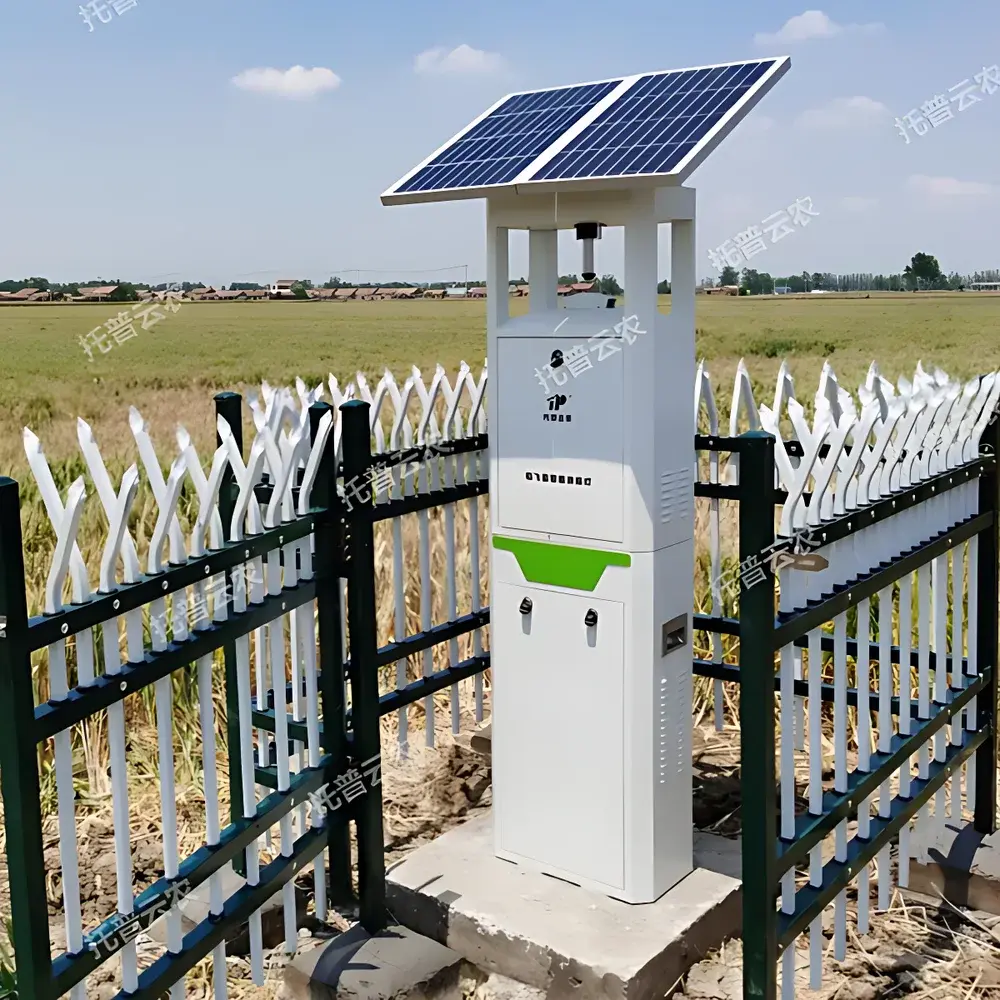
Top Cloud-agri TPCB-XCDY Series Intelligent Pest Monitoring System
| Brand | Top Cloud-agri |
|---|---|
| Origin | Zhejiang, China |
| Manufacturer Type | Direct Manufacturer |
| Product Origin | Domestic (China) |
| Model | TPCB-XCDY Series |
| Instrument Category | Light-Attracted Pest Surveillance System |
| Application Domain | Rice Paddies, Tea Gardens, Orchards (Pear, Grape, Apple, Peach, Pomegranate), and Other Horticultural Cropping Systems |
Overview
The Top Cloud-agri TPCB-XCDY Series Intelligent Pest Monitoring System is an automated, AI-powered surveillance platform engineered for continuous, non-destructive monitoring of minute, light-attracted arthropod pests in open-field agricultural ecosystems. Operating on the principle of phototactic attraction using species-specific narrow-band spectral illumination, the system captures live insects via a low-turbulence aspiration pathway and acquires high-fidelity dorsal-view images under controlled lighting conditions. These images are processed in real time by a field-deployable deep learning inference engine trained on annotated datasets of >20 morphologically similar Hemiptera species—including Nilaparvata lugens (brown planthopper), Sogatella furcifera (white-backed planthopper), Laodelphax striatellus (small brown planthopper), leafhoppers (Cicadellidae), and Apolygus lucorum (green mirid bug). The system delivers quantitative entomological data—species composition, temporal abundance trends, and spatial distribution patterns—enabling early-warning decision support for integrated pest management (IPM) protocols.
Key Features
- Millimeter-Scale Targeted Capture: Engineered inlet geometry with graded mesh filtration selectively admits insects 1–4 mm in body length while excluding larger non-target arthropods and debris, minimizing classification noise and preserving specimen integrity.
- Live-Insect Imaging Protocol: Gentle vacuum aspiration maintains >98% specimen viability and ensures consistent dorsal orientation (>95% of captured individuals), maximizing feature visibility for morphometric analysis and taxonomic discrimination.
- Edge-Deployed AI Recognition: On-device convolutional neural network (CNN) model achieves ≥90% average per-species classification accuracy across field validation trials; inference latency ≤100 ms per image under nominal ambient temperature (−10°C to 50°C).
- Remote Operational Management: Integrated 4G LTE + Wi-Fi dual-mode connectivity enables secure remote access via web dashboard and native iOS/Android applications for firmware updates, capture schedule configuration, and diagnostic status review.
- Geospatial Integration: Embedded GPS/GLONASS module provides sub-5 m positional accuracy; location metadata is synchronized with time-stamped capture events and visualized on GIS-enabled operational maps for multi-site fleet monitoring.
- Autonomous Photoperiod Control: Ambient light sensor triggers fully autonomous nightly operation (activation at dusk, deactivation at dawn); transient exposure to artificial light pulses (e.g., vehicle headlights) does not disrupt scheduled duty cycles.
- All-Weather Structural Design: IP65-rated enclosure with corrosion-resistant aluminum alloy housing and hydrophobic optical lens coating ensures uninterrupted functionality during rain, fog, or high-humidity conditions typical of subtropical paddy and orchard environments.
Sample Compatibility & Compliance
The TPCB-XCDY system is validated for use with adult-stage, winged specimens of phototactic Hemiptera commonly associated with cereal, fruit, and tea crops. It complies with ISO 22000-aligned data integrity requirements for agricultural monitoring systems and supports audit-ready logging (timestamp, GPS coordinates, image hash, classifier confidence score) compatible with GLP-compliant farm recordkeeping. While not certified under FDA 21 CFR Part 11, its encrypted data transmission (TLS 1.2+) and immutable event logs meet baseline traceability expectations for regulatory reporting frameworks in China (NY/T 3307–2018) and ASEAN regional phytosanitary guidelines.
Software & Data Management
Data acquisition, preprocessing, and inference occur locally on the device’s ARM-based edge processor to minimize bandwidth dependency and ensure low-latency response. Captured images and structured metadata are transmitted to a cloud-hosted analytics platform supporting RESTful API integration with third-party farm management information systems (FMIS). Time-series abundance charts, species heatmaps, and phenological trend alerts are generated using statistical smoothing algorithms (Savitzky-Golay filters) and seasonal decomposition (STL). Raw image archives are retained for ≥90 days; users may request retraining of custom classifiers using proprietary image sets under NDA-bound collaboration agreements.
Applications
- Rice agroecosystems: Early detection of planthopper population surges preceding hopperburn outbreaks and virus transmission (e.g., SRBSDV, RGSV).
- Terraced tea plantations: Monitoring Empoasca onukii (tea green leafhopper) emergence timing to optimize biocontrol release windows.
- Deciduous fruit orchards: Tracking seasonal flight activity of Apolygus lucorum to calibrate mating disruption strategies and reduce broad-spectrum insecticide reliance.
- Research stations: Long-term phenological studies requiring standardized, operator-independent capture metrics across climatic gradients.
- Government phytosanitary networks: Scalable deployment for national pest surveillance grids with centralized dashboard visualization and automated anomaly detection.
FAQ
What insect size range is the TPCB-XCDY system optimized for?
The system is calibrated for insects measuring 1–4 mm in body length, with peak sensitivity for planthoppers (1.5–3.0 mm) and leafhoppers (2.0–4.0 mm).
Does the system require manual specimen collection or maintenance?
No physical handling is required; the unit operates autonomously for up to 30 days between cleaning cycles. Internal tray and lens cleaning intervals are configurable via software.
Can the AI model be updated to recognize additional pest species?
Yes—Top Cloud-agri provides algorithm retraining services using customer-submitted image libraries, subject to minimum dataset size (≥500 validated images per target species) and morphological distinctness criteria.
Is solar power integration supported?
The standard configuration includes a 12 V DC input port compatible with external solar charge controllers and deep-cycle batteries; optional solar kits are available upon request.
How is data security ensured during wireless transmission?
All communications use TLS 1.2 encryption; device authentication employs X.509 certificates; no credentials or raw images are stored on the edge device beyond local caching for redundancy.





