
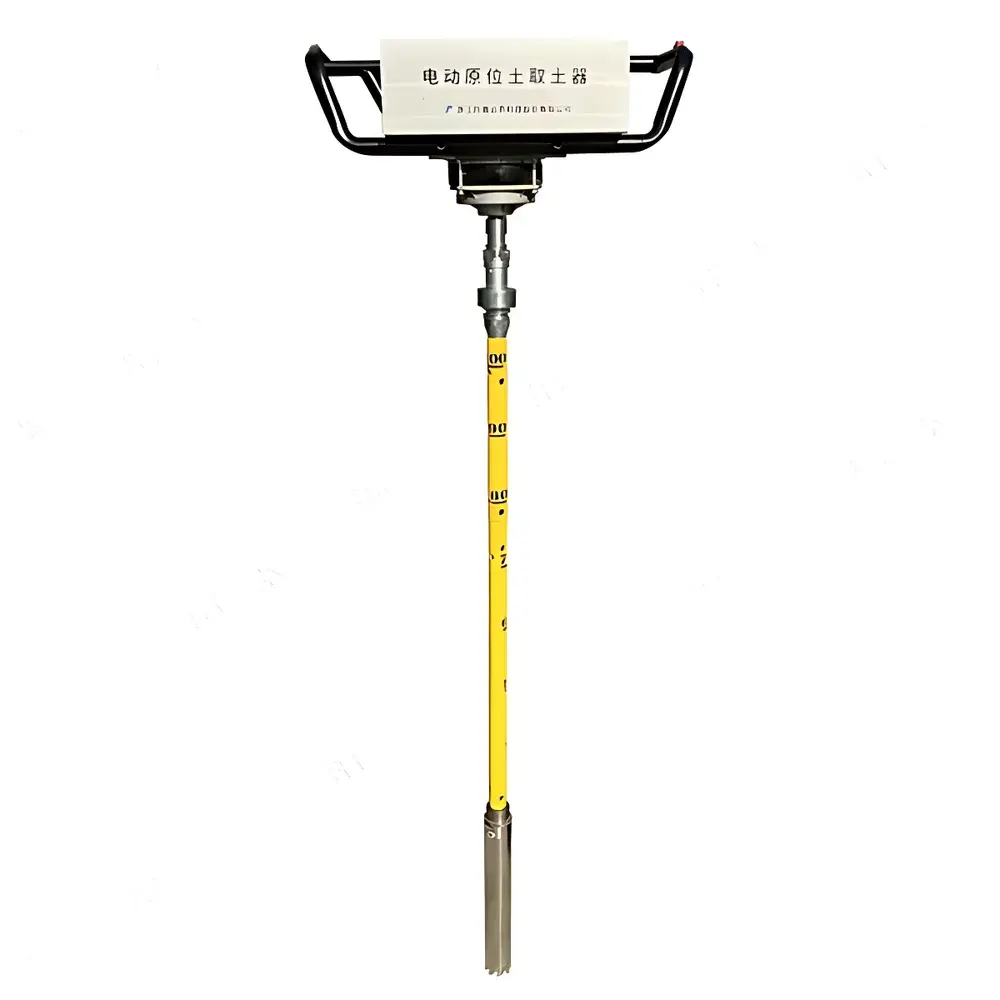
Top Cloud-agri TPLQ-D Electric Soil Core Sampler
| Brand | Top Cloud-agri |
|---|---|
| Origin | Zhejiang, China |
| Manufacturer Type | Direct Manufacturer |
| Country of Origin | China |
| Model | TPLQ-D |
| Instrument Category | Multi-functional Soil Analyzer |
| Power Supply | 48 V Li-ion Battery |
| Overall Dimensions (Main Unit) | 55 cm (L) × 50 cm (W) × 35 cm (H) |
| Extension Rod Lengths | 30 cm or 50 cm (configurable) |
| Auger Dimensions | 28 cm (H) × 4.5 cm (OD) |
| Rotational Speed | 0–300 rpm (infinitely variable) |
| Single-Core Depth | 20 cm (custom depths available) |
| Scale Markings | Integrated depth graduations on auger shaft |
| Modular Design | Fully detachable for transport and storage |
| Interchangeable Auger Bits | Yes |
Overview
The Top Cloud-agri TPLQ-D Electric Soil Core Sampler is a field-deployable, battery-powered rotary coring device engineered for standardized soil sampling across agricultural surveys, environmental site assessments, and national soil census operations. It operates on the principle of controlled rotational torque application to a helical auger bit, enabling consistent, low-disturbance penetration into undisturbed soil profiles. Unlike manual probes or percussion samplers, the TPLQ-D delivers reproducible core geometry and minimal sample compression—critical for subsequent laboratory analysis of bulk density, moisture content, nutrient stratification, and contaminant vertical distribution. Its design adheres to foundational soil sampling protocols referenced in ISO 10381-1 (soil sampling — Part 1: Guidance on the design of sampling programs) and ASTM D1586 (standard test method for penetration resistance and classification of soils using the standard penetration test), supporting traceable, audit-ready data collection workflows.
Key Features
- Helical Cutting Geometry: Precision-machined stainless-steel auger with optimized pitch and edge geometry ensures clean, continuous core extraction—even in clay-rich, gravelly, or compacted soils—without smearing or core collapse.
- 48 V Lithium-Ion Power System: High-capacity, maintenance-free battery enables >150 core extractions per charge (typical field conditions), with integrated state-of-charge indicator and over-current/over-temperature protection circuitry.
- Infinitely Variable Speed Control (0–300 rpm): Digital motor controller allows real-time adjustment to match soil resistance, minimizing vibration-induced operator fatigue and preserving core integrity during variable-depth profiling.
- Depth-Calibrated Auger Shaft: Laser-etched metric graduations (1 cm intervals) along the auger stem permit precise targeting of sampling horizons—essential for horizon-specific analysis per USDA Soil Taxonomy or WRB classification requirements.
- Modular & Field-Serviceable Architecture: Quick-release couplings enable tool-less separation of main drive unit, extension rods, and auger assemblies—reducing transport volume by >60% and facilitating cleaning between sampling sites to prevent cross-contamination.
- Interchangeable Auger Options: Standard 4.5 cm OD auger compatible with optional diameters (3.5 cm, 5.0 cm) and specialized tips (e.g., hardened tungsten carbide for rocky substrates), supporting method-specific sampling per ISO 22030 or EPA Method 5035A.
Sample Compatibility & Compliance
The TPLQ-D accommodates intact core retrieval from mineral soils (sand to heavy clay), organic peat layers (up to 85% OM), and anthropogenically disturbed fill materials. It meets mechanical robustness criteria outlined in IEC 61000-6-2 (electromagnetic immunity) and IP54 ingress protection rating for dust and water splashing resistance. All structural components comply with RoHS Directive 2011/65/EU. For regulatory reporting, the device supports GLP-aligned documentation when paired with Top Cloud-agri’s optional digital field logbook (cloud-synced, timestamped, GPS-tagged entries)—enabling alignment with EPA Region 9 QA/G-5 and ISO/IEC 17025:2017 clause 7.5.2 (sample handling traceability).
Software & Data Management
While the TPLQ-D operates as a standalone hardware platform, it integrates with Top Cloud-agri’s TerraLog™ Mobile App (iOS/Android) via Bluetooth 5.0. The app records core ID, GPS coordinates, depth interval, soil description codes (USDA texture class input), operator ID, and ambient temperature/humidity—exportable as CSV or PDF reports compliant with FAO’s Global Soil Laboratory Information System (GLOSOLAN) metadata schema. Audit trails include tamper-evident digital signatures and automatic backup to encrypted cloud storage—supporting 21 CFR Part 11 electronic record requirements when deployed under contract environmental monitoring programs.
Applications
- National soil resource inventories requiring stratified random sampling at 0–100 cm depth intervals
- Pre- and post-remediation verification sampling at brownfield sites (ASTM E1527-21 Phase I ESA support)
- Vineyard and orchard precision agriculture zoning based on sub-surface nutrient mapping
- Long-term ecological research (LTER) plots requiring annual repeat coring with minimal plot disturbance
- Validation of ground-penetrating radar (GPR) or electromagnetic induction (EMI) geophysical survey interpretations
- Soil carbon stock assessment per IPCC 2019 Refinement guidelines (Tier 2 methodology)
FAQ
What soil types can the TPLQ-D effectively sample?
It performs reliably in A-horizon loams, B-horizon clays, volcanic ash deposits, and moderately stony soils (up to 15% gravel by volume). For highly cemented caliche or bedrock-adjacent layers, optional high-torque gear reduction mode (firmware-upgradable) is recommended.
Is calibration required before each use?
No routine calibration is needed; however, daily pre-use verification of battery voltage, auger sharpness, and coupling torque (using supplied torque wrench) is advised per manufacturer’s maintenance schedule.
Can the device be used in wet or frozen conditions?
Yes—its IP54-rated housing and cold-rated battery (-10°C to +50°C operational range) support winter sampling in seasonally frozen soils down to -5°C surface temperature, though core ejection efficiency decreases below -10°C without pre-warming.
How is cross-contamination prevented between sampling locations?
Through strict adherence to the modular cleaning protocol: disassembly, ethanol-rinse of auger surfaces, air-drying, and visual inspection prior to next deployment—documented within TerraLog™ as part of the chain-of-custody record.
Related Products







