
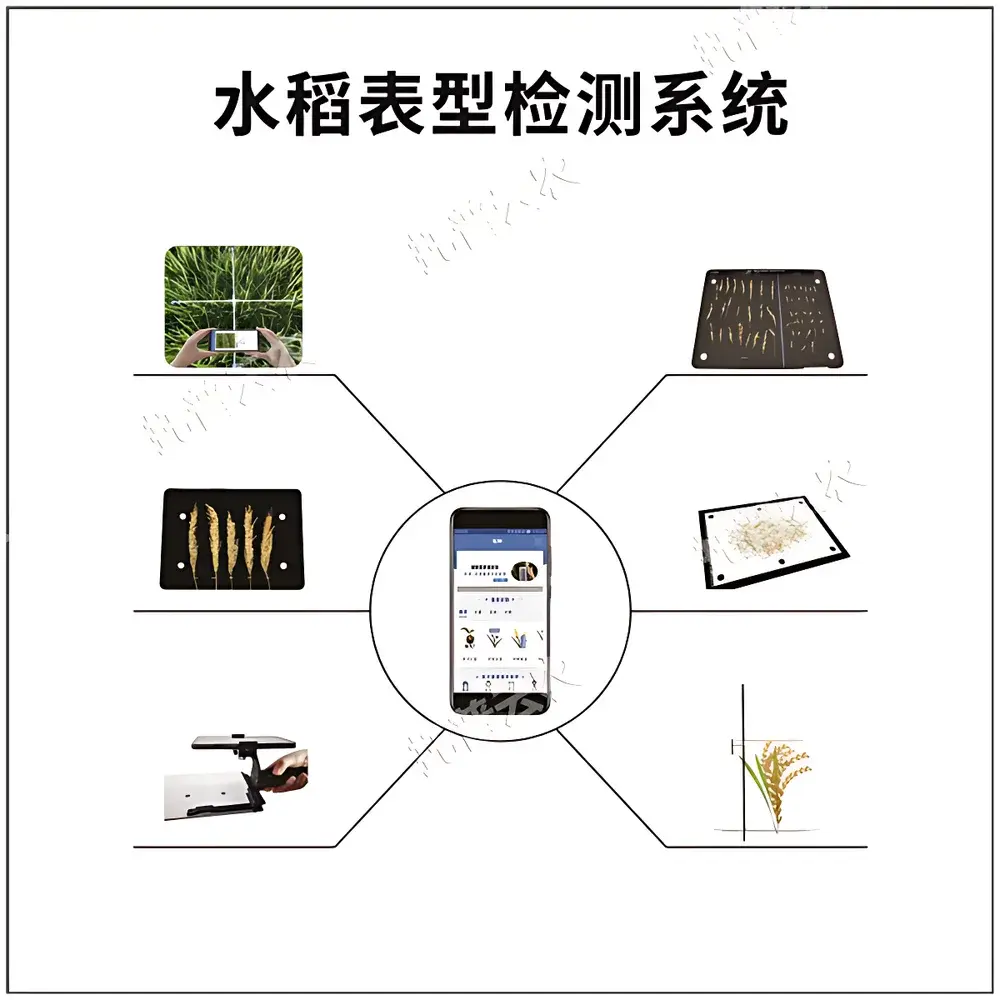
Top Cloud-agri TPS-BX-1 Rice Phenotyping System
| Brand | Top Cloud-agri |
|---|---|
| Origin | Zhejiang, China |
| Manufacturer Type | Direct Manufacturer |
| Region of Origin | Domestic (China) |
| Model | TPS-BX-1 |
| Pricing | Upon Request |
Overview
The Top Cloud-agri TPS-BX-1 Rice Phenotyping System is a field-deployable, image-based quantitative phenotyping platform engineered for high-throughput, non-destructive measurement of morphological and architectural traits in Oryza sativa. It operates on computer vision principles—leveraging calibrated digital imaging, geometric correction algorithms, and pixel-based segmentation—to extract biologically meaningful metrics from standard RGB photographs. Unlike destructive harvest-based assays, the TPS-BX-1 enables longitudinal monitoring across key developmental stages—including booting, heading, flowering, grain filling, milky ripening, and dough ripening—without plant damage. Its design addresses core challenges in rice breeding programs: scalability across field plots, reproducibility under variable lighting and viewing angles, and integration of multi-trait data (e.g., panicle architecture, tiller dynamics, canopy geometry) into unified analytical workflows. The system conforms to FAO-recommended trait definitions for rice phenotyping and supports alignment with international crop ontology standards (e.g., Crop Ontology ID: CO_334).
Key Features
- Multi-mode calibration framework: Dual-area reference standards—cross-shaped (0.25 m²) and square (0.5 m²)—enable cross-validated counting of panicles per unit area, accommodating both low-density and high-density planting configurations.
- Augmented reality (AR)-assisted field imaging: Integrated AR glasses and Bluetooth selfie stick allow real-time camera positioning guidance, mitigating occlusion and perspective distortion during tall-canopy imaging (e.g., late-stage vegetative or reproductive phases).
- Batch-scale panicle density analysis: Processes up to 60 georeferenced field images simultaneously, computing mean panicles per mu (≈667 m²) with statistical summary outputs (mean, SD, CV%).
- Theoretical yield estimation engine: Combines automated panicle count, user-inputted grain number per panicle, thousand-grain weight (g), and spikelet fertility rate (%) to compute projected yield (kg/ha) using ISO 7971-2 compliant calculation logic.
- Adaptive image compensation: Implements dynamic masking for partial occlusion (e.g., leaf overlap), boundary-aware area normalization, and sensitivity-tuned thresholding—maintaining ≤±5% error across flowering, grain-filling, and milky-ripening stages.
- Color-coded annotation layer: Supports dual-color tagging (e.g., red/blue) for ambiguous panicle segmentation; rectangular ROI overlays for spikelet length; and circular markers for individual grain localization.
- Whole-panicle morphometric analysis: Extracts 23 standardized parameters—including primary/secondary branch length, branch-specific grain count, branch-level and panicle-level grain density, rachis length, and pedicel angle—without dehulling or manual dissection.
- High-speed grain counting: Processes ≤1,000 grains in <1 second with ≥98.5% accuracy (tested on indica and japonica cultivars); accommodates 10–8,000 grains per image.
- Automated thousand-grain weight derivation: Calculates g/1000 grains from counted seed number and user-entered mass (g), applying ASTM D7423-22 rounding conventions.
- Auto-scale correction: Compensates for lens distortion and oblique viewing angles via embedded scale-bar recognition and homographic transformation—enabling reliable measurements from consumer-grade smartphones.
Sample Compatibility & Compliance
The TPS-BX-1 is validated for use with cultivated rice (Oryza sativa L.) across major subpopulations (indica, japonica, aromatic). It supports trait capture at all ontogenetic stages—from seedling establishment through physiological maturity—with documented performance limits: panicle density (flowering–milky ripening), panicle morphology (any stage post-heading), plant height (all vegetative and reproductive stages), flag leaf angle (heading–dough ripening), stem diameter (tillering–grain filling), and thousand-grain weight (harvested samples only). Measurement uncertainties comply with ISO 5725-2:2019 repeatability criteria: panicle count (≤±5%), panicle length (≤±2%), total grain count (≤±2%), branch length (≤±3 mm), leaf angle (0–180°, ±5°), stem diameter (0–52 mm, ±0.5 mm), and thousand-grain weight (±2‰, correctable to 100% via manual verification). The system meets GLP-aligned data integrity requirements, including audit-trail logging of all manual corrections and timestamped metadata embedding.
Software & Data Management
The TPS-BX-1 software suite is embedded within the proprietary “Zhi Zhong” (Know-Seed) mobile application (Android OS only). All image acquisition, processing, and annotation occur offline—ensuring data sovereignty and field usability without internet dependency. Processed results are stored locally with SHA-256 hashed identifiers and synchronized to cloud repositories upon connectivity restoration. The application supports FDA 21 CFR Part 11–compliant electronic signatures for result validation, role-based access control (field technician, breeder, data manager), and export to .xlsx with embedded metadata (GPS coordinates, timestamp, cultivar ID, growth stage code per BBCH scale). Interoperability includes CSV export for import into R/Bioconductor (phenotypeR), Python (scikit-image, OpenCV), or breeding management systems (BMS) via RESTful API endpoints.
Applications
- High-resolution QTL mapping of panicle architecture traits (e.g., primary branch number, grain density distribution)
- Early-generation selection for yield component traits in hybrid rice breeding pipelines
- Phenotypic validation of CRISPR/Cas9-edited lines targeting GW2, GS3, or DEP1 orthologs
- Canopy light interception modeling using flag leaf angle and tiller angle datasets
- Longitudinal assessment of drought or nitrogen-stress responses via panicle development kinetics
- Calibration of remote-sensing indices (e.g., NDVI, PRI) against ground-truthed structural metrics
- Training datasets for deep learning models in panicle detection (YOLOv8, Mask R-CNN)
FAQ
Is the TPS-BX-1 compatible with iOS devices?
No—the system is optimized exclusively for Android-based smartphones meeting minimum hardware specifications (Android 10+, 4 GB RAM, dual-camera setup with macro mode).
Can the system be used for other cereal crops such as wheat or barley?
It is specifically calibrated for rice morphology; adaptation to other cereals requires retraining of segmentation models and validation against species-specific trait definitions.
Does the system require internet connectivity during field measurement?
No—all image capture, calibration, and analysis occur offline. Cloud synchronization and report generation occur only upon optional reconnection.
How is measurement traceability ensured for regulatory submissions?
Each analysis generates an immutable log file containing raw image hash, operator ID, timestamp, GPS coordinates, calibration parameters, and full revision history of all manual edits—meeting OECD GLP Annex III documentation requirements.
What is the warranty and service support structure?
Top Cloud-agri provides a 24-month limited hardware warranty and lifetime software updates. On-site technical support is available in mainland China; remote diagnostics and training are offered globally via secure VNC sessions.
Related Products




