
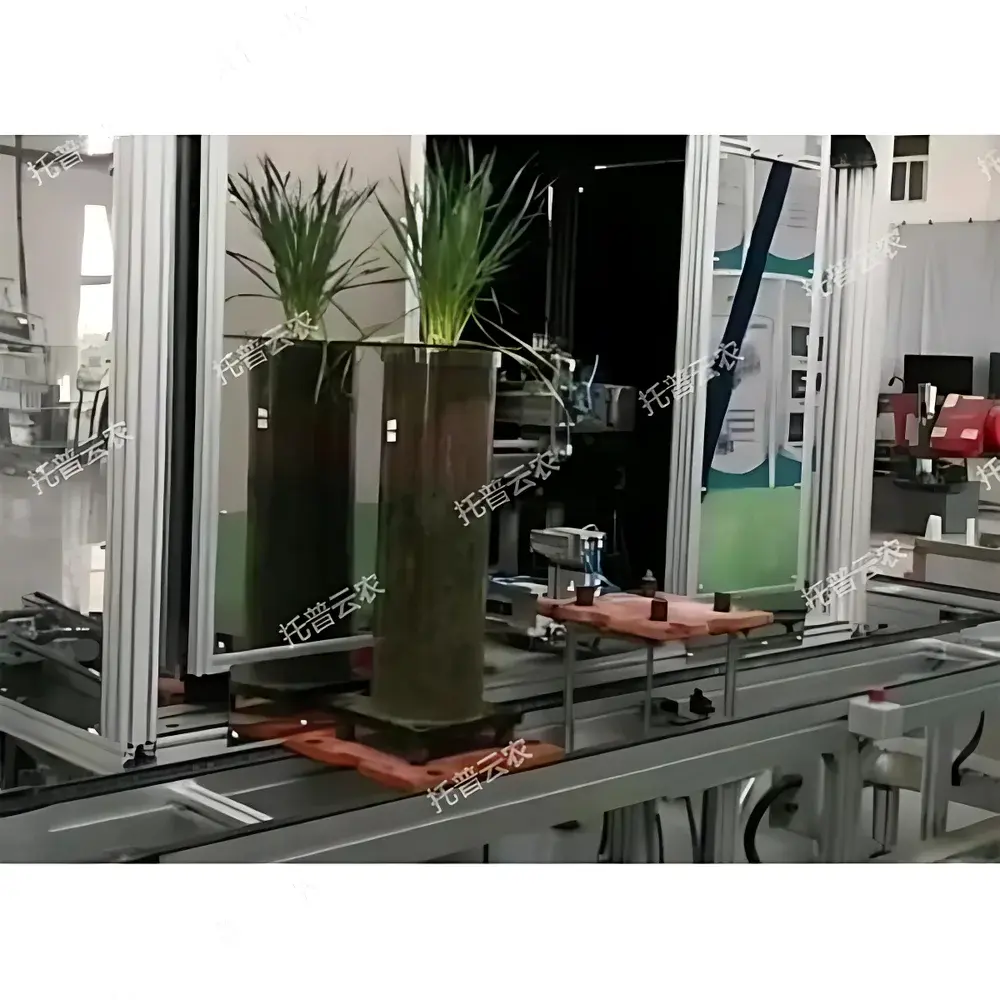
Top Cloud-agri TPN-GXY-GT High-Throughput Rhizotron-Based Plant Root Phenotyping System
| Brand | Top Cloud-agri |
|---|---|
| Origin | Zhejiang, China |
| Manufacturer Type | Direct Manufacturer |
| Region of Origin | Domestic (China) |
| Model | TPN-GXY-GT |
| Pricing | Upon Request |
Overview
The Top Cloud-agri TPN-GXY-GT High-Throughput Rhizotron-Based Plant Root Phenotyping System is an engineered solution for non-destructive, longitudinal imaging and quantitative analysis of root architecture in fibrous-rooted plant species. Designed around a vertically oriented rhizotron cylinder architecture, the system integrates precision mechanical actuation with multi-spectral optical sensing to capture root morphology, spatial distribution, and physiological status in situ. It operates on the principle of controlled-angle rotational imaging combined with spectral reflectance analysis—leveraging visible (400–700 nm) and near-infrared (800–1700 nm) bands to differentiate root tissue integrity, water content gradients, and structural biomass allocation. Unlike excavation-based or hydroponic methods, this rhizotron-based approach preserves natural root-soil interface conditions while enabling repeatable, high-resolution time-series acquisition under standardized environmental control. The system is purpose-built for controlled-environment applications—including growth chambers, climate-controlled greenhouses, and phenotyping core facilities—where reproducibility, scalability, and compliance with GLP-aligned data governance are essential.
Key Features
- Automated 360° rotational positioning stage with ±0.5 mm linear repeatability and ≥1.5 m vertical travel, enabling full circumferential root surface coverage without manual intervention
- High-resolution CMOS imaging subsystem (≥20 MP) calibrated for sub-millimeter spatial resolution (≤0.1 mm), optimized for root boundary detection and topological segmentation
- Dual-band optical module supporting simultaneous visible-light morphological imaging and NIR-based physiological assessment (800–1700 nm), facilitating correlation between structure and function
- Integrated light-shielded imaging chamber with uniform LED illumination array (illuminance variation <5%), eliminating ambient light interference across variable facility lighting conditions
- AI-accelerated image analysis pipeline delivering automated extraction of 12+ root architectural traits per scan—including total root length, branching density, diameter frequency distribution, surface area, volume, and root tip count—with processing time <5 minutes per plant
- Modular rhizotron cylinder design: standard diameter range 10–50 cm; constructed from corrosion-resistant, optically transparent polymer with low autofluorescence and minimal spectral distortion
- Environmental resilience: operational temperature range 10–40 °C; IP65-rated enclosure for dust and moisture resistance in greenhouse deployments
Sample Compatibility & Compliance
The TPN-GXY-GT system is validated for use with monocot and dicot species exhibiting fibrous root systems. Confirmed compatibility includes staple cereals (e.g., Triticum aestivum, Oryza sativa, Zea mays), solanaceous vegetables (e.g., Solanum lycopersicum, Capsicum annuum, Cucumis sativus), and specialty crops such as Nicotiana tabacum and medicinal herbs with shallow-to-moderate rooting depth (<1.2 m). All hardware and software components conform to IEC 61000-6-3 (EMC emissions) and IEC 61000-6-2 (immunity) standards. Data acquisition workflows support audit-trail generation aligned with GLP principles; metadata tagging includes timestamp, environmental sensor logs (optional soil moisture integration), operator ID, and instrument calibration status. While not FDA 21 CFR Part 11-certified out-of-the-box, the system’s LIMS-compatible API enables integration with validated electronic lab notebook (ELN) and data management platforms meeting regulatory documentation requirements.
Software & Data Management
- Proprietary root phenotyping software suite featuring batch processing, cross-experiment comparative analytics, and export-ready outputs in CSV, TIFF, and HDF5 formats
- Native support for FAIR data principles: each dataset includes embedded MIAPPE-compliant metadata (Minimum Information About a Plant Phenotyping Experiment)
- RESTful API for bidirectional communication with Laboratory Information Management Systems (LIMS) and digital crop modeling platforms
- Optional integration modules: RGB/multispectral camera synchronization for shoot-root trait correlation; IoT-enabled soil moisture sensor fusion for root-zone environment mapping
- On-device storage (≥2 TB SSD) with RAID-1 redundancy; remote access via secure SSH or HTTPS with role-based user permissions
Applications
This system supports hypothesis-driven research across multiple domains: (1) Root developmental biology—quantifying dynamic changes in lateral root emergence, gravitropic response, and aging-related senescence patterns; (2) Abiotic stress physiology—assessing root plasticity under controlled drought, salinity, or nutrient limitation regimes; (3) Quantitative genetics—high-throughput phenotyping for QTL mapping and genomic selection of root ideotypes; (4) Soil–plant interaction studies—generating 3D root distribution maps correlated with rhizosphere microbiome sampling coordinates; (5) Precision breeding pipelines—enabling early-stage root trait screening in segregating populations prior to field evaluation.
FAQ
What root depth ranges can the system accommodate?
The standard vertical travel (≥1.5 m) and customizable cylinder height support root profiling up to 1.2 meters, suitable for most annual crops grown in rhizotrons.
Is the system compatible with soil-based substrates?
Yes—it is designed for use with structured media including peat-perlite mixes, sandy loam analogs, and hydrogel-based root-support matrices that maintain optical clarity during imaging.
Can raw image data be exported for third-party analysis?
Absolutely. Full-resolution TIFF stacks, point-cloud OBJ files, and segmented binary masks are exportable without proprietary codec restrictions.
Does the system require external climate control?
No. While it operates within 10–40 °C, optimal root phenotyping requires integration with externally regulated growth environments; the system itself does not provide active heating/cooling.
How is calibration maintained over long-term deployment?
A quarterly optical calibration protocol is provided, using NIST-traceable grayscale and spatial reference targets; all calibration events are logged in the system audit trail.





