
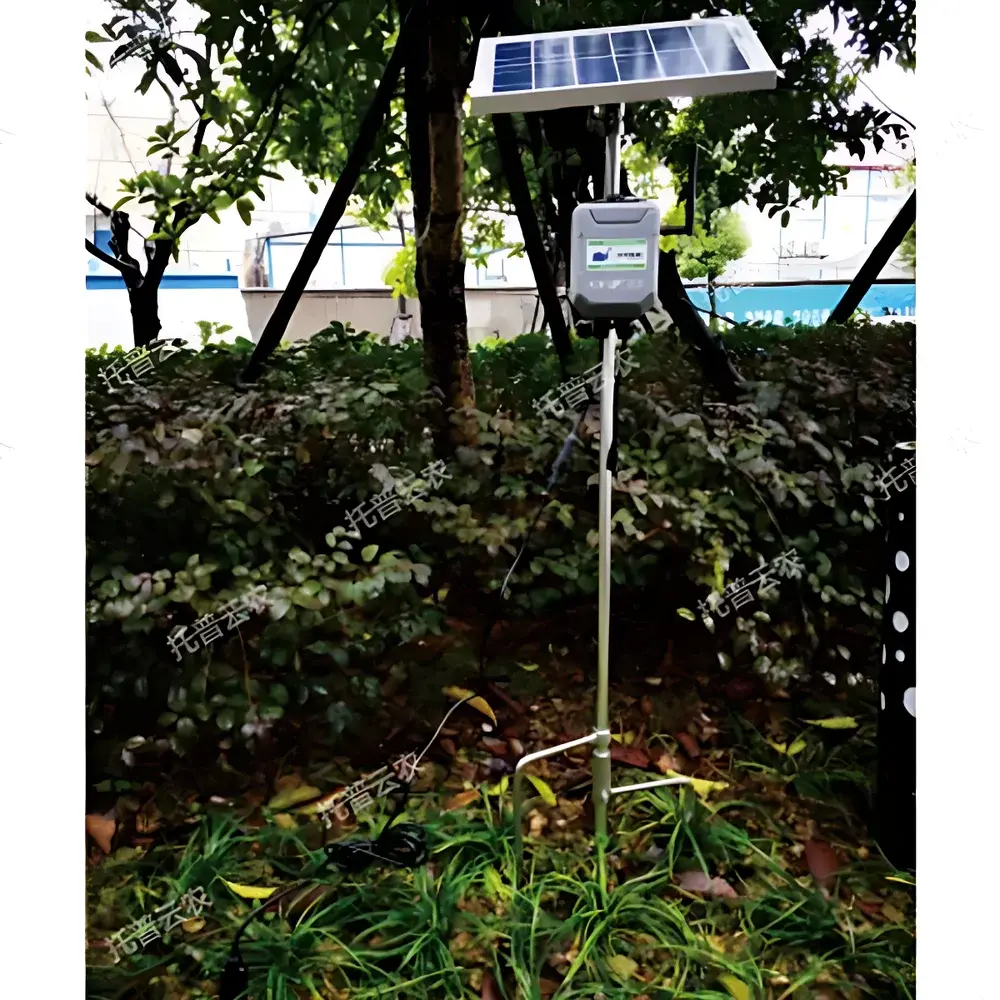
Top Cloud-agri TPFS-WS Series Multi-Depth Soil Moisture Monitoring Station
| Brand | Top Cloud-agri |
|---|---|
| Origin | Zhejiang, China |
| Manufacturer Type | OEM/ODM Producer |
| Country of Origin | China |
| Model | TPFS-WS Series |
| Power Supply | Solar + 220 V AC + Internal 20 Ah / 3.7 V Li-Polymer Battery |
| Operating Temperature | −20 °C to +70 °C |
| Enclosure Rating | IP67 |
| Data Storage Capacity | ~500,000 records |
| Wireless Communication | Built-in LTE-M/NB-IoT with Remote Configuration Support |
| GPS Module | Integrated for Real-Time Geotagging |
| Sensor Expansion | Up to 32 Analog/Digital Sensors |
| Soil Moisture Range | 0–100 % vol |
| Soil Moisture Accuracy | ±3 % vol |
| Soil Moisture Resolution | 0.1 % vol |
| Soil Temperature Range | −40 °C to +100 °C |
| Soil Temperature Accuracy | ±0.5 °C |
| Soil Temperature Resolution | 0.1 °C |
| Standby Duration (Solar-Charged) | ≥200 Days |
| Alarm Modes | Web Dashboard, Mobile Push, LED Indicator, Voice Alert |
| Data Evaluation | Configurable Thresholds, Crop-Specific Alert Templates, Automated Anomaly Detection |
| Cloud Platform | InstrumentCloud™ Web & Mobile Application with Audit-Trail Logging, Exportable CSV/Excel Reports, and GLP-Compliant Metadata Tagging |
Overview
The Top Cloud-agri TPFS-WS Series Multi-Depth Soil Moisture Monitoring Station is an integrated environmental telemetry system engineered for long-term, unattended field deployment in agricultural research, precision irrigation management, drought early-warning networks, and agrometeorological observation programs. Based on time-domain reflectometry (TDR) or capacitance-based dielectric measurement principles—depending on sensor configuration—the system delivers high-reproducibility volumetric water content (θv) and soil temperature data across multiple depth profiles (1–4 layers). Its modular architecture supports co-location of heterogeneous sensors—including EC, pH, salinity, air temperature, relative humidity, rainfall, and wind speed—enabling synchronized multi-parameter analysis essential for evapotranspiration modeling, root-zone water balance assessment, and climate-resilient cropping system design.
Key Features
- Solar-Ready Hybrid Power Architecture: Equipped with a 20 Ah / 3.7 V lithium-polymer battery and integrated photovoltaic panel, the station maintains continuous operation under low-light conditions; power autonomy exceeds 200 days without solar input, validated per IEC 62244-2 ambient cycling tests.
- Scalable Sensor Integration: Supports up to 32 analog (0–5 V, 4–20 mA) and digital (RS-485 Modbus RTU, SDI-12) sensors via configurable input channels, enabling flexible deployment across heterogeneous soil types and crop systems.
- Robust Edge Intelligence: Onboard microcontroller performs real-time data validation, outlier rejection, and unit conversion prior to transmission—reducing cloud-side processing latency and bandwidth consumption.
- Multi-Modal Alerting Framework: Configurable threshold-based notifications delivered via SMS, email, InstrumentCloud™ dashboard, local LED status indicators, and optional voice synthesis module—fully compliant with ISO 22320 emergency communication protocols.
- Geospatial Data Integrity: Integrated GPS receiver logs WGS84 coordinates at each transmission cycle, ensuring traceable georeferencing for spatial interpolation, GIS layer integration, and FAO WaPOR-compliant water productivity mapping.
- Regulatory-Ready Data Governance: InstrumentCloud™ platform implements role-based access control (RBAC), immutable audit trails, electronic signatures, and 21 CFR Part 11–compliant metadata logging—supporting GLP, GMP, and ISO/IEC 17025 laboratory accreditation requirements.
Sample Compatibility & Compliance
The TPFS-WS series is validated for use in mineral soils (sand, loam, clay), organic substrates (peat, compost), and saline-affected fields (EC ≤ 8 dS/m). All sensors conform to ASTM D5084–22 (in-situ saturated hydraulic conductivity estimation) and ISO 11274:2020 (soil water retention curve determination). The enclosure meets IP67 ingress protection standards per IEC 60529, and wireless modules comply with ETSI EN 300 328 (Europe), FCC Part 15 Subpart B (USA), and SRRC certification (China). System firmware adheres to IEC 62443-3-3 security levels for industrial IoT devices.
Software & Data Management
InstrumentCloud™ is a browser-based SaaS platform accessible via HTTPS with TLS 1.3 encryption. It provides real-time dashboards with customizable widgets, automated statistical summaries (daily min/max/mean, 7-day rolling averages), and export functions supporting CSV, Excel (.xlsx), NetCDF4, and GeoJSON formats. Data integrity is enforced through SHA-256 hashing of all transmitted payloads and server-side validation against sensor-specific calibration certificates. Historical datasets are retained indefinitely with optional cold-archive migration to AWS S3 Glacier for long-term compliance archiving. API endpoints support integration with third-party platforms including FarmOS, AgriWebb, and national meteorological databases (e.g., NOAA NCDC, CMA CNEMC).
Applications
- Agricultural drought monitoring and index derivation (e.g., Standardized Soil Moisture Index – SSMI)
- Irrigation scheduling optimization using real-time root-zone θv feedback loops
- Validation of satellite-derived soil moisture products (e.g., SMAP, Sentinel-1)
- Long-term edaphic trend analysis in climate change impact studies
- Calibration and ground-truthing of hydrological models (e.g., SWAT, HYDRUS-1D)
- Supporting FAO’s Water Productivity Assessment Framework in smallholder farming systems
FAQ
What depth configurations are available for the TPFS-WS series?
The system offers four standardized variants: TPFS-WS-1 (single depth), TPFS-WS-2 (dual depth), TPFS-WS-3 (triple depth), and TPFS-WS-4 (quadruple depth)—each configured with factory-calibrated TDR or FDR probes pre-installed at user-specified intervals (e.g., 10/20/40/60 cm).
Is the system compatible with third-party weather stations or SCADA infrastructure?
Yes—via Modbus TCP/RTU and MQTT v3.1.1 protocols, the station integrates seamlessly with legacy farm management systems, municipal irrigation controllers, and national agro-meteorological networks.
How is data security ensured during wireless transmission?
All LTE-M/NB-IoT transmissions use AES-128 encryption; device authentication employs X.509 certificate-based mutual TLS handshake, preventing man-in-the-middle attacks and unauthorized firmware updates.
Can calibration certificates be downloaded for audit purposes?
Each sensor ships with NIST-traceable calibration documentation accessible through InstrumentCloud™’s “Device History” tab—including date-stamped verification reports, drift analysis, and uncertainty budgets per ISO/IEC 17025 Annex A.3.







