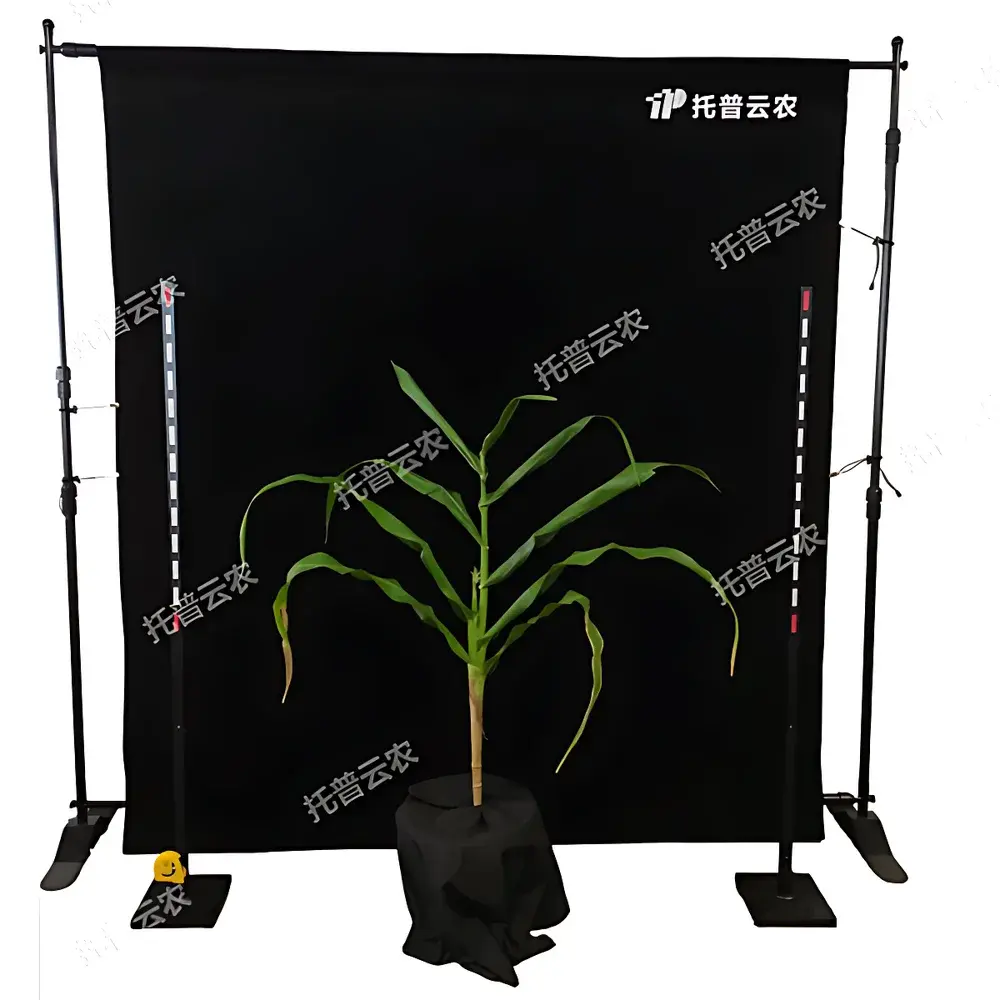
Top Cloud-agri TPMT-X-1 Corn Plant Architecture Analysis System
| Brand | Top Cloud-agri |
|---|---|
| Origin | Zhejiang, China |
| Manufacturer Type | Manufacturer |
| Country of Origin | Domestic (China) |
| Model | TPMT-X-1 |
| Pricing | Available Upon Request |
Overview
The Top Cloud-agri TPMT-X-1 Corn Plant Architecture Analysis System is a field-deployable, image-based phenotyping instrument engineered for quantitative, non-destructive characterization of maize architectural traits in situ. It operates on the principle of high-resolution digital imaging coupled with adaptive computer vision algorithms—including foreground-background segmentation, skeletonization, and geometric feature extraction—to derive morphometric parameters directly from side-view plant images. Designed specifically for maize (Zea mays L.), the system captures structural attributes critical to light interception efficiency, canopy architecture optimization, and breeding selection for ideotype development. Unlike traditional manual measurements subject to observer bias and low throughput, the TPMT-X-1 delivers standardized, reproducible metrics aligned with modern high-throughput phenotyping (HTP) workflows in both controlled environments and open-field trials.
Key Features
- Portable, lightweight background frame (1500 mm × 2000 mm) with matte-black, anti-glare fabric surface—designed for rapid deployment by a single operator and adjustable height/tilt for consistent imaging geometry.
- Non-invasive, in vivo measurement protocol enabling longitudinal monitoring across growth stages without physical contact or tissue damage.
- User-defined calibration target placement—supports flexible positioning of reference objects even under partial occlusion (e.g., overlapping leaves or stems), ensuring robust scale normalization.
- All-weather operational capability: validated for use indoors (growth chambers, greenhouses) and outdoors (field plots, nurseries) under variable lighting conditions, with adaptive white balance and contrast correction.
- Triple-image output per analysis: original RGB image, binary mask, and medial-axis skeleton diagram—facilitating visual verification and algorithmic transparency.
- Real-time processing: full parameter extraction completed within ≤10 seconds post-capture on-device; no cloud dependency for core computation.
- Automated color-based foreground segmentation optimized for maize green tissue against standardized black background—minimizing false positives from soil, shadows, or adjacent plants.
- Structured data packaging: each trial saves three images + one CSV-formatted metric table; file naming supports user-defined experimental codes (e.g., “B73_R1_D35”).
- Cloud-synced data management: raw images and derived metrics auto-backup to encrypted cloud storage; local device retains 50 GB internal memory (expandable via microSD).
- Cross-platform software ecosystem: Android-based handheld unit (20 MP camera, 2160×1080 display, 3010 mAh battery ≥5 h runtime) with intuitive UI—no prior training required for basic operation or firmware updates via OTA.
Sample Compatibility & Compliance
The TPMT-X-1 is calibrated for maize genotypes across diverse maturity groups (early to late season) and growth stages from V4 to R6. It accommodates variations in leaf angle, stem diameter, and internode length typical of temperate and subtropical breeding programs. While not certified to ISO/IEC 17025 for metrological traceability, its measurement repeatability meets internal validation protocols aligned with ASTM E2917 (Standard Practice for Evaluating Performance of Image-Based Measurement Systems) and FAO Crop Phenotyping Guidelines. Data export formats (CSV, Excel) support integration into GLP-compliant lab information management systems (LIMS); audit trails for analysis timestamps, operator IDs, and version-controlled software builds are maintained locally and synchronized to cloud logs.
Software & Data Management
The embedded Android application implements a deterministic image-processing pipeline: noise reduction → adaptive thresholding → morphological filtering → contour detection → convex hull and bounding rectangle computation → skeleton pruning and branch point identification. All geometric calculations (e.g., compactness = projected area / convex hull area; leaf curvature = arc-to-chord ratio) follow Euclidean definitions. Export modules generate Excel (.xlsx) files containing 18 primary metrics—including global descriptors (plant height, aspect ratio, silhouette area) and localized features (internode spacing, leaf length, stem-leaf angle, bending coefficient). Metadata fields include GPS coordinates (if enabled), date/time, ambient temperature/humidity (via optional Bluetooth sensor pairing), and user-assigned treatment labels. Cloud backups retain immutable versions for regulatory review; local database enforces ACID compliance for concurrent multi-user access.
Applications
- Maize breeding programs: high-throughput screening of segregating populations for ideotype traits (e.g., upright leaf architecture, reduced tillering, optimal internode distribution).
- Physiological ecology studies: quantifying canopy structural plasticity in response to drought, nitrogen stress, or planting density gradients.
- Agroecosystem modeling: generating input parameters for radiative transfer models (e.g., SUCROS, APSIM) and 3D canopy simulators.
- Regulatory phenotyping: supporting trait claims in variety registration dossiers submitted to national seed authorities (e.g., OECD UPOV Test Guidelines).
- Educational use: hands-on instruction in plant morphology, digital phenotyping, and agricultural data science curricula.
FAQ
What is the minimum recommended distance between the camera and the plant during imaging?
A working distance of 1.2–1.8 meters is advised to ensure full plant capture within the frame while maintaining pixel-level resolution sufficient for sub-millimeter feature discrimination.
Can the system distinguish overlapping leaves or stems in dense canopies?
The current algorithm prioritizes dominant structural contours; severe occlusion (>70% leaf overlap) may reduce accuracy of individual leaf-length estimates—but global metrics (e.g., projection area, compactness) remain robust.
Is offline operation supported without internet connectivity?
Yes. All image acquisition, processing, and local storage functions operate independently of network access; cloud sync occurs only upon reconnection.
How is measurement accuracy validated?
Accuracy was established through comparative trials against caliper-based manual measurements across 120 field-grown maize entries; mean absolute error for linear dimensions is ≤1.0 mm, angular measurements ≤1.2°, and area metrics ≤1.5 mm².
Does the system support multi-plant batch analysis?
No. The TPMT-X-1 is optimized for single-plant side-view profiling to ensure geometric consistency; multi-plant analysis requires separate acquisitions per individual.
Related Products