
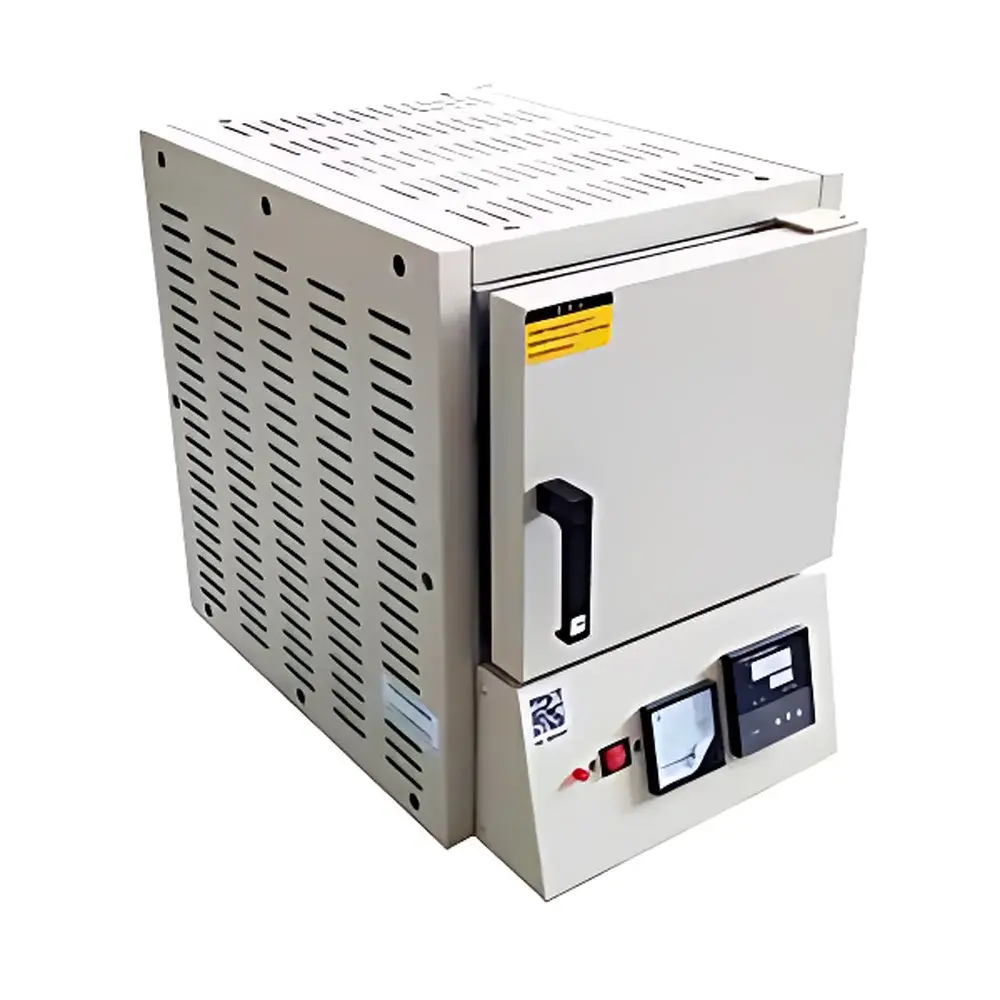
Zhuochi SX3-3-13 Ceramic Fiber Muffle Furnace
| Brand | Zhuochi |
|---|---|
| Origin | Zhejiang, China |
| Instrument Type | Box-Type Muffle Furnace |
| Maximum Temperature | 1300 °C |
| Temperature Uniformity | ±1 °C |
| Rated Power | 3 kW |
| Heating Rate (to max temp) | ≤50 °C/min |
| Internal Chamber Dimensions | 300 × 200 × 150 mm |
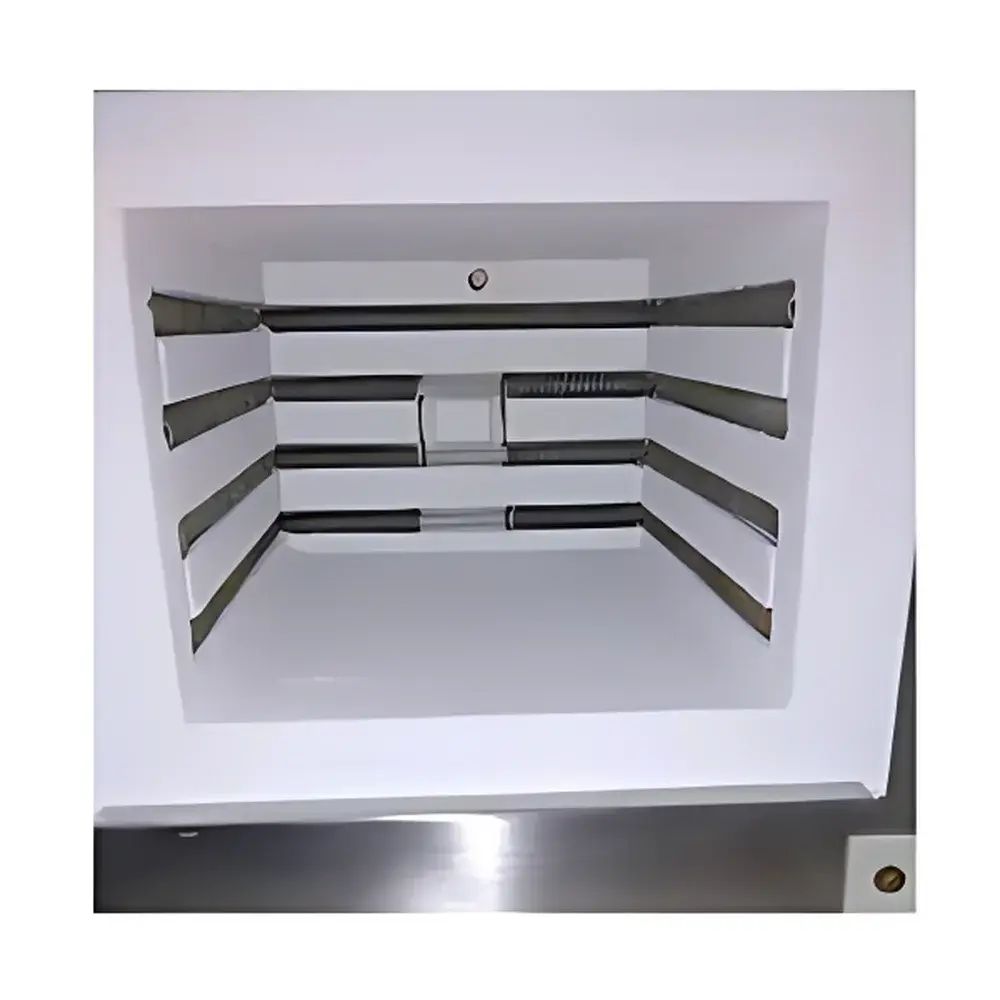
| Heating Element | U-shaped Silicon Carbide Rods |
| Control System | LTDE Programmable PID Controller (30-Stage Ramp/Soak) |
| Thermal Insulation | High-Efficiency Ceramic Fiber Board (6-Sided Modular Construction) |
| Weight | ~43 kg |
| Power Supply | 220 V, 50 Hz |
Overview
The Zhuochi SX3-3-13 Ceramic Fiber Muffle Furnace is a high-performance, laboratory-grade box-type furnace engineered for precise, repeatable thermal processing in academic, industrial, and R&D environments. It operates on the principle of resistive heating via U-shaped silicon carbide (SiC) rods, delivering rapid, uniform heat distribution across its insulated chamber. Unlike traditional brick-lined furnaces, this model employs a modular six-sided ceramic fiber insulation system—comprising ultra-lightweight, low-heat-capacity refractory boards—which enables faster thermal response, reduced standby energy loss, and improved temperature stability. The furnace achieves a maximum operating temperature of 1300 °C with a certified temperature uniformity of ±1 °C at 1000 °C, meeting stringent requirements for ashing, calcination, sintering, heat treatment, and gravimetric analysis. Its compact external footprint (605 × 420 × 510 mm) houses an unusually spacious working chamber (300 × 200 × 150 mm), offering 50% greater usable volume than conventional furnaces of comparable outer dimensions—making it especially suitable for batch processing of heterogeneous or multi-sample configurations.
Key Features
- Ultra-lightweight construction: Total mass ~43 kg—70% lighter than equivalent brick-insulated muffle furnaces—facilitating safe repositioning and minimizing structural load requirements.
- High-efficiency thermal architecture: Ceramic fiber insulation reduces thermal inertia, enabling programmable heating rates from ambient to 1300 °C in ≤50 °C/min (fully adjustable down to <1 °C/min).
- Advanced LTDE programmable controller: 30-segment ramp/soak capability with real-time curve visualization, automatic hold-to-completion logic, and user-defined shutdown protocols.
- Dual-stage overtemperature protection: Independent hardware-based safety cutoffs (primary SSR-driven limit control + secondary mechanical thermostat) compliant with IEC 61000-4-5 surge immunity and EN 60519-1 electrical safety standards for industrial heating equipment.
- Integrated electrical assembly: All heater-to-controller wiring pre-installed; only mains power connection required for immediate operation—no field commissioning or calibration needed.
- Robust mechanical design: Dual-shell enclosure with phosphate-treated cold-rolled steel exterior (computer gray epoxy finish), reinforced corner joints, and rear-mounted thermocouple port (Type S PtRh10–Pt) for traceable temperature monitoring.
Sample Compatibility & Compliance
The SX3-3-13 accommodates standard crucibles (alumina, quartz, platinum, stainless steel), ceramic boats, and refractory trays up to 120 mm in height. Its open-chamber geometry supports free convection airflow, ensuring consistent oxidation kinetics during ashing per ASTM D3174 and ISO 1171. The furnace meets GLP-aligned operational prerequisites—including audit-ready event logging (via optional RS485 interface), time-stamped temperature profiles, and configurable hold durations—supporting regulatory workflows in pharmaceutical QC (USP , ), environmental testing (EPA Method 2540C), and materials certification (ISO 5660-1 cone calorimetry prep). While not FDA 21 CFR Part 11–validated out-of-the-box, its deterministic control architecture permits integration into validated systems when paired with qualified data acquisition software and electronic signature modules.
Software & Data Management
The embedded LTDE controller provides local HMI operation with LED display (1 °C resolution), tactile keypad navigation, and non-volatile memory retention for up to 10 independent programs. Optional communication interfaces—including RS485 Modbus RTU—enable remote parameter setting, real-time temperature streaming, and synchronized data logging via third-party SCADA or LIMS platforms (e.g., LabWare, Thermo Fisher SampleManager). All ramp/soak sequences are stored with timestamped start/stop events and deviation alerts, supporting ISO/IEC 17025 clause 7.7.1 requirements for measurement traceability. Firmware updates are performed via USB port using vendor-supplied configuration utilities; no proprietary runtime licenses are required.
Applications
- Quantitative ash residue determination in coal, biomass, foodstuffs, and polymers (ASTM D3174, ISO 1171)
- Pre-treatment of catalyst supports and ceramic precursors prior to XRD or BET analysis
- Thermal decomposition studies under controlled oxidative atmospheres
- Calibration of thermocouples and reference materials (per ISO/IEC 17025 Annex A.3)
- Heat treatment of metallurgical samples for microstructure stabilization
- Residue ignition in pharmacopeial heavy metal testing (USP )
FAQ
What type of thermocouple is used for temperature sensing?
A Type S (Platinum–10% Rhodium / Platinum) thermocouple is factory-installed and calibrated to NIST-traceable standards.
Is the furnace suitable for inert or reducing atmospheres?
No—it is designed exclusively for air-atmosphere operation. For controlled atmospheres, a tube furnace with gas inlet/outlet ports and purge capability is recommended.
Can the heating rate be precisely controlled below 10 °C/min?
Yes. The LTDE controller allows continuous adjustment of ramp rates from 0.1 to 50 °C/min in 0.1 °C/min increments.
What maintenance is required for the silicon carbide heating elements?
SiC rods require no periodic replacement under normal use but should be visually inspected for cracking or surface erosion before each high-temperature cycle; output voltage drift >5% warrants recalibration.
Does the unit include documentation for IQ/OQ validation support?
Yes—factory test reports, calibration certificates, wiring diagrams, and component traceability records are supplied with each unit to facilitate installation and operational qualification.



