
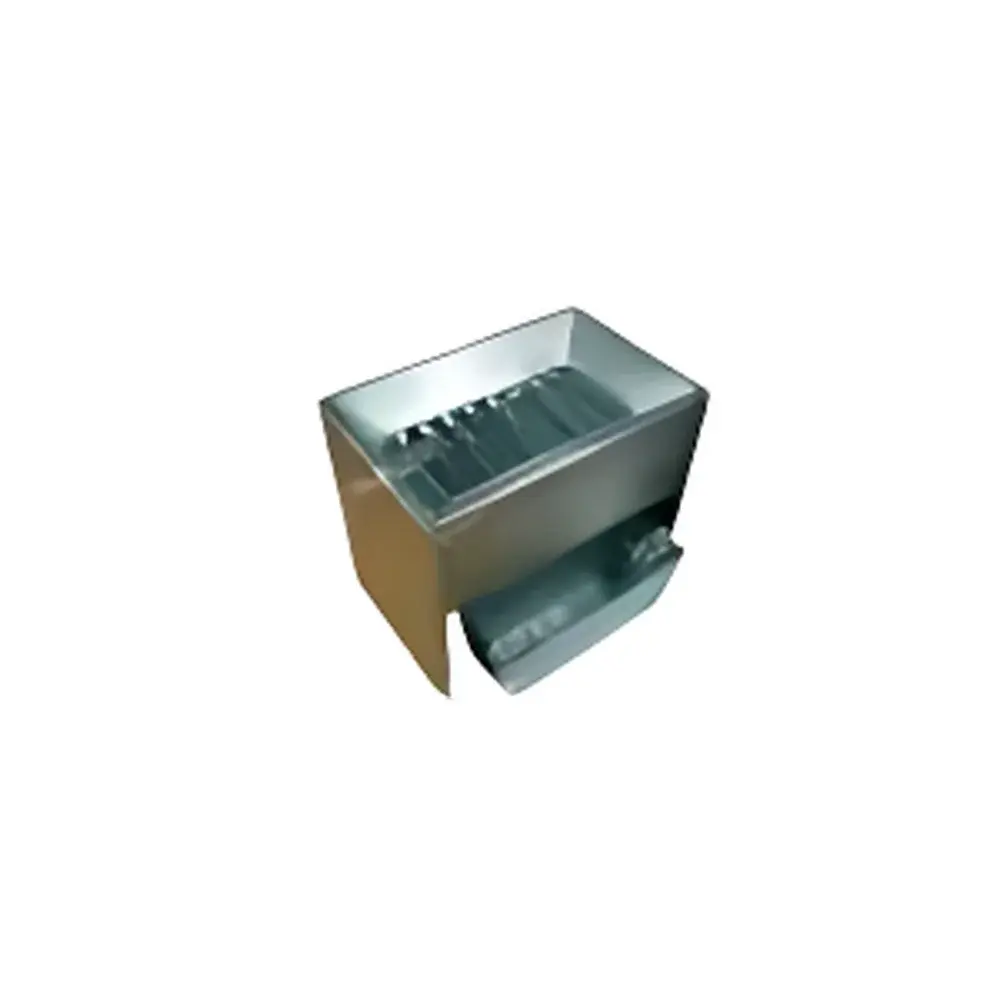
Top Cloud-agri HGG-II Stainless Steel Cross-Sectional Sample Divider
| Brand | Top Cloud-agri |
|---|---|
| Origin | Zhejiang, China |
| Manufacturer Type | Direct Manufacturer |
| Country of Origin | China |
| Model | HGG-II |
| Material | 304 Stainless Steel |
| Number of Grooves | 12 |
| Groove Width | 25.4 mm |
| Maximum Sample Capacity | 300–2000 g |
| Overall Dimensions (L×W×H) | 420 × 240 × 280 mm |
| Intended Sample Type | Large-grain seeds (e.g., soybean, maize) |
| Compliance | Designed per GB/T 3543.2–1995 (National Standard of the People’s Republic of China for Seed Testing — Part 2: Sampling) |
Overview
The Top Cloud-agri HGG-II Stainless Steel Cross-Sectional Sample Divider is a precision mechanical sampling device engineered for reproducible, bias-free subdivision of bulk seed lots in agricultural quality control, seed certification, and research laboratories. It operates on the principle of gravitational flow combined with symmetrical groove distribution—utilizing a fixed array of 12 parallel stainless steel channels arranged in a single linear row. As bulk seed material is poured uniformly onto the top inlet, it flows downward through a series of alternating, counter-directional chutes that bifurcate the stream at each stage, ultimately delivering two equal-mass subsamples with high inter-trial consistency. This physical partitioning method eliminates operator-dependent variability inherent in manual scooping or coning-and-quartering techniques, ensuring compliance with internationally recognized sampling protocols for heterogeneous granular materials.
Key Features
- Construction from food-grade 304 stainless steel—resistant to corrosion, abrasion, and residue accumulation; fully cleanable and suitable for repeated use in regulated environments.
- 12 precisely machined grooves, each 25.4 mm wide, optimized for uniform flow dynamics of large-grain seeds such as soybean (Glycine max) and maize (Zea mays), minimizing bridging or channeling effects.
- Rigid, low-center-of-gravity chassis (420 × 240 × 280 mm) ensures stability during operation and compatibility with standard laboratory workbenches or mobile sampling carts.
- No moving parts or external power requirement—fully passive, maintenance-free design supporting GLP-aligned operational simplicity and long-term reliability.
- Calibrated for consistent mass split ratios across the specified capacity range (300–2000 g), validated using reference seed lots under ambient humidity and temperature conditions (20–25°C, 40–60% RH).
Sample Compatibility & Compliance
The HGG-II is specifically validated for free-flowing, non-cohesive, large-particle agricultural seeds with nominal diameters between 4.5 mm and 12 mm. Its groove geometry and chute angle meet dimensional recommendations outlined in ISO 6638:2020 (Seed sampling—General principles and methods) and align with national standard GB/T 3543.2–1995 for seed testing procedures in China. While not certified to ISO/IEC 17025, the device supports traceable sampling workflows when integrated into documented laboratory SOPs—including chain-of-custody logging, pre-use visual inspection checklists, and periodic performance verification using certified reference seeds. It is not intended for fine powders, fibrous materials, or hygroscopic or electrostatically charged samples.
Software & Data Management
As a purely mechanical instrument, the HGG-II does not incorporate embedded electronics, firmware, or digital interfaces. Consequently, it generates no electronic data streams and requires no software installation, network configuration, or cybersecurity validation. All sampling records—including lot ID, date/time, operator initials, initial mass, and subsample masses—are manually entered into laboratory notebooks or LIMS-compatible spreadsheets. This analog architecture inherently satisfies regulatory requirements for auditability in settings where electronic systems are restricted (e.g., certain USDA-APHIS-certified labs or facilities operating under legacy GLP frameworks). For full 21 CFR Part 11 compliance, users may pair the HGG-II with validated digital weighing systems and timestamped documentation platforms.
Applications
- Primary sample reduction in official seed certification programs prior to purity analysis, germination testing, and genetic identity verification.
- Subsampling of harvested grain lots for mycotoxin screening, moisture content determination, and varietal purity assessment.
- Preparation of representative test portions for near-infrared (NIR) spectroscopy calibration and chemometric model development.
- Quality assurance workflows in seed processing plants, including batch release testing and in-process monitoring of cleaning/sorting efficiency.
- Educational use in agronomy and plant science curricula to demonstrate statistical sampling theory and measurement uncertainty propagation in heterogeneous populations.
FAQ
What seed types are compatible with the HGG-II divider?
Soybean, maize, sorghum, and other large-grain seeds with minimal surface moisture and no clumping behavior. It is not recommended for rice, wheat, or small-seeded legumes—use the HGT-II model instead.
Does the HGG-II require calibration or periodic verification?
No formal calibration is required; however, users should perform quarterly verification by splitting three replicate 1000 g seed lots and confirming subsample mass deviation remains within ±1.5% of theoretical 50:50 division.
Can the HGG-II be used for non-agricultural particulates?
Only if particle size, shape, and flow properties closely match those of large cereal grains. Validation data for sand, plastic pellets, or pharmaceutical granules are not available from the manufacturer.
Is cleaning documentation required between samples?
Yes—per ISO 22000 and internal QA protocols, visual inspection and dry brushing between lots is mandatory; stainless steel construction permits optional ethanol wipe-down for bio-contamination control.



