
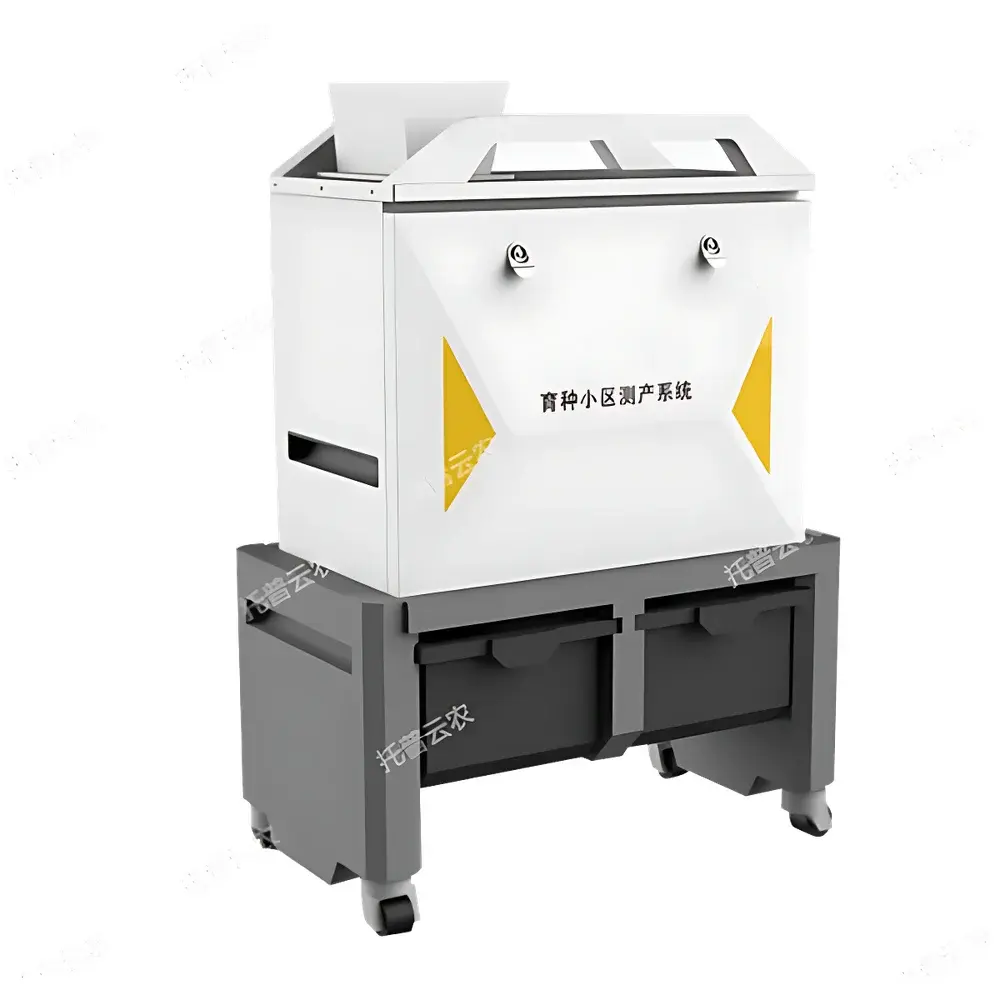
Top Cloud-agri TPXQ-C-1 Breeding Plot Yield Measurement System
| Brand | Top Cloud-agri |
|---|---|
| Origin | Zhejiang, China |
| Manufacturer Type | Direct Manufacturer |
| Country of Origin | China |
| Model | TPXQ-C-1 |
| Instrument Category | Specialized Agricultural Yield Measurement System |
| Moisture Measurement Range | ±1% (absolute error) |
| Weighing Capacity | 2.5 kg per measurement |
| Weighing Resolution | ±10 g per measurement |
| Bulk Density Accuracy | ±10 g/L per measurement |
Overview
The Top Cloud-agri TPXQ-C-1 Breeding Plot Yield Measurement System is an integrated, field-deployable instrumentation platform engineered for high-reproducibility yield quantification in small-plot agricultural trials. Designed specifically for national crop variety testing programs and plant breeding research stations, the system applies gravimetric weighing combined with calibrated capacitance-based moisture sensing and volumetric displacement principles to simultaneously determine three critical agronomic parameters: net grain mass, moisture content (% w.b.), and bulk density (g/L). Its architecture supports both standalone operation—paired with a plot threshing unit—and direct integration into plot harvester platforms, enabling real-time, on-the-go yield data acquisition during harvest without interrupting workflow. The system conforms to standardized small-plot trial protocols defined by the National Crop Variety Evaluation Program (China) and aligns with FAO-recommended practices for plot-level yield validation in varietal release pipelines.
Key Features
- Modular hardware design: detachable Android tablet, thermal label printer, and grain measurement chamber enable flexible deployment across tractors, trailers, or stationary threshing stations.
- Dynamic weighing compensation: integrated inclinometer and vibration-damping algorithms mitigate mechanical instability from field terrain, ensuring ±10 g repeatability even on uneven ground or moving platforms.
- Multi-point moisture calibration: user-configurable calibration curves accommodate species-specific dielectric response variations across maize, wheat, and rice—supporting traceable adjustment per ISO 712:2016 methodology.
- Stratified sampling protocol: automated sequential subsampling reduces compaction-induced bias in moisture uniformity and bulk density estimation, improving inter-lot comparability in replicated trials.
- Deterministic measurement cycle: stabilized output delivered within 6 seconds post-feed cessation, validated under GLP-aligned operational conditions (ambient 15–35°C, RH ≤85%).
Sample Compatibility & Compliance
The TPXQ-C-1 is validated for shelled maize (Zea mays), common wheat (Triticum aestivum), and paddy rice (Oryza sativa) harvested at standard combine-compatible moisture levels (12–25% w.b.). It complies with national technical specifications for seed and variety testing equipment (NY/T 787–2020, China), and its moisture sensor meets reference accuracy requirements outlined in ISO 4889-1:2022 for cereal grain moisture analyzers. Data integrity safeguards include timestamped audit trails, operator ID logging, and non-volatile memory retention—supporting compliance with internal QA procedures for GxP-aligned breeding trials.
Software & Data Management
- TPXQ-FieldSuite v3.2 software provides dual-mode operation: preloaded 16-plot layout templates or freehand route mapping via touchscreen interface.
- Real-time RS232 serial communication between tablet and instrument enables bidirectional control—including remote start/stop, calibration trigger, and firmware update initiation.
- Georeferenced yield visualization: spatial heatmaps overlay plot coordinates with normalized yield metrics (kg/plot, % moisture deviation, g/L bulk density), exportable as GeoJSON or PNG.
- Data persistence: local storage retains ≥50,000 complete plot records; export options include Excel (.xlsx), CSV, and encrypted USB backup with SHA-256 hash verification.
- On-device thermal printing: generates compliant field labels containing plot ID, timestamp, operator code, raw weight/moisture/bulk density, and QR-coded metadata for LIMS integration.
Applications
This system serves core functions across public-sector agricultural research infrastructure: (1) multi-location variety trials coordinated by provincial academies of agricultural sciences; (2) F1–F6 generation yield screening in hybrid development pipelines; (3) abiotic stress response evaluation (e.g., drought-tolerant lines under rainfed conditions); (4) precision phenotyping workflows integrating with drone-based canopy cover metrics; and (5) regulatory submission packages requiring auditable, instrument-generated yield evidence per Ministry of Agriculture and Rural Affairs (MARA) guidelines. Its portability and low-power DC operation (12–24 V) make it suitable for off-grid field stations with solar-charged battery banks.
FAQ
Can the TPXQ-C-1 be used with unshelled maize or paddy rice?
No—the system requires fully threshed, cleaned grain to ensure consistent dielectric response and volumetric fill characteristics. Unshelled kernels introduce measurement artifacts in both moisture and bulk density modules.
Is calibration traceable to national standards?
Yes—moisture calibration uses certified reference materials traceable to CNAS-accredited laboratories (e.g., GBW(E)130337 maize moisture standard); weight calibration employs NIST-traceable Class M2 weights per JJG 1036–2008.
Does the software support network synchronization across multiple devices?
Not natively—data exchange occurs via USB transfer or manual Wi-Fi file sharing. Centralized cloud sync requires third-party middleware integration through documented REST API endpoints.
What maintenance intervals are recommended for field deployment?
Moisture sensor cleaning every 200 measurements; load cell zero-check before each day’s operation; annual factory recalibration recommended for metrological continuity.
Is FDA 21 CFR Part 11 compliance supported?
The system does not implement electronic signature or audit trail encryption required for Part 11; however, its raw data logs meet ALCOA+ principles (Attributable, Legible, Contemporaneous, Original, Accurate) for internal research use.





