
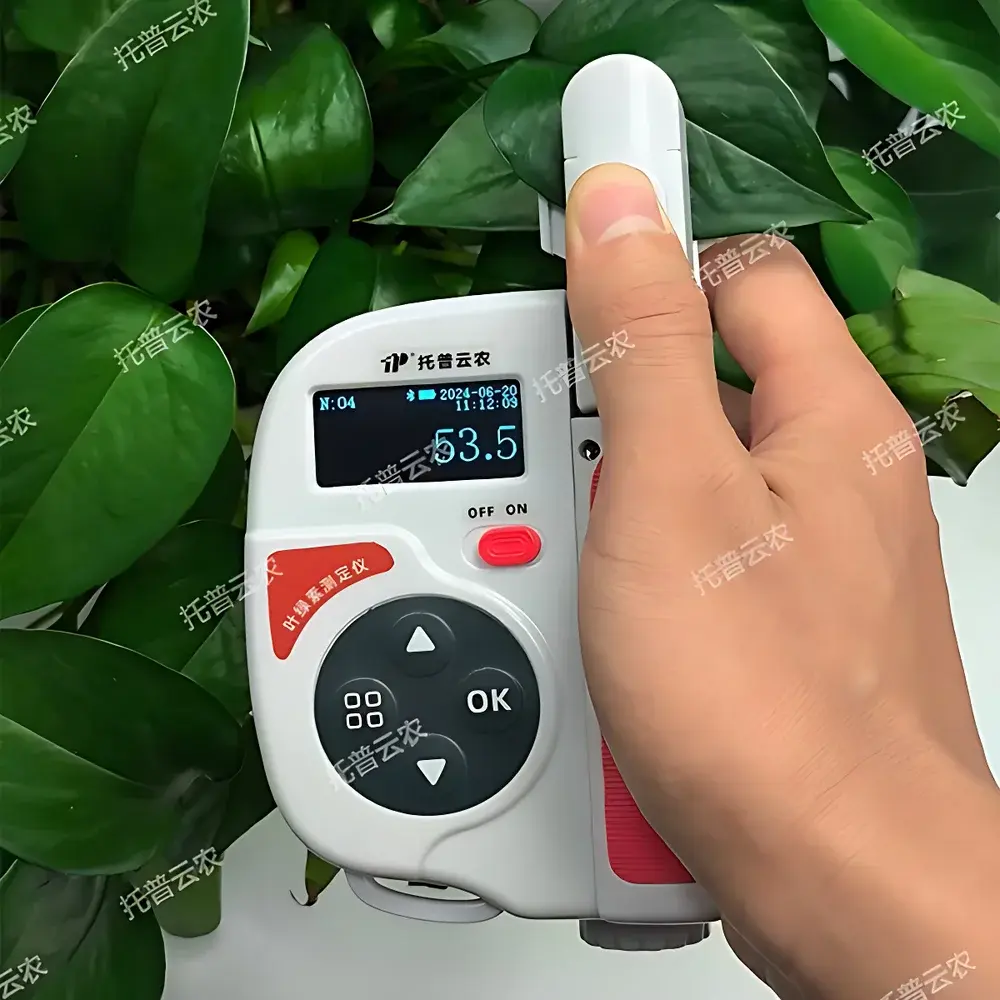
Top Cloud-agri TYS-B Portable Chlorophyll Meter with Leaf Temperature Sensor
| Brand | Top Cloud-agri |
|---|---|
| Origin | Zhejiang, China |
| Manufacturer Type | Direct Manufacturer |
| Model | TYS-B |
| Chlorophyll Range | 0.0–99.9 SPAD |
| Leaf Surface Temperature Range | 0–50 °C (customizable) |
| Measurement Interval | <2 s |
| Measurement Area | 2 mm × 2 mm |
| Chlorophyll Accuracy | ±1.0 SPAD (at room temperature, SPAD 0–50) |
| Temperature Accuracy | ±0.5 °C |
| Repeatability | ±0.3 SPAD / ±0.2 °C |
| Display | 1.3″ OLED |
| Data Transfer | Bluetooth 5.0 |
| Power | Two 1.5 V AA batteries (≈5,000 measurements per set) |
| Onboard Storage | 2,000 records |
| App & Cloud Integration | Yes |
Overview
The Top Cloud-agri TYS-B Portable Chlorophyll Meter is a field-deployable, non-destructive optical instrument engineered for rapid, in-situ quantification of relative chlorophyll content (expressed as SPAD units) and leaf surface temperature in intact plant foliage. It operates on the principle of dual-wavelength optical absorption—measuring transmittance at 650 nm (peak chlorophyll-a absorption band) and 940 nm (chlorophyll-insensitive reference band)—to compute the SPAD index, a well-validated proxy for chlorophyll concentration per unit leaf area. Simultaneous infrared thermometry enables concurrent assessment of leaf thermal status, supporting integrated physiological interpretation. Designed for longitudinal monitoring in agronomic trials, ecological surveys, and controlled-environment physiology studies, the TYS-B delivers traceable, repeatable data without tissue excision or solvent extraction—preserving experimental integrity and enabling high-throughput phenotyping.
Key Features
- Non-invasive optical measurement: No leaf clipping, grinding, or chemical reagents required; maintains plant viability and permits repeated sampling of the same leaf over time.
- High-resolution localized sensing: 2 mm × 2 mm measurement spot size enables targeted assessment of heterogenous leaf regions (e.g., interveinal zones, stress-affected margins).
- Optimized optical architecture: Multi-layer light-shielding chamber minimizes ambient light leakage and thermal cross-talk, ensuring measurement stability under variable solar irradiance and ambient temperature conditions.
- Real-time statistical display: OLED screen shows instantaneous SPAD and temperature values alongside rolling statistics—mean, min, and max of the last 10 measurements—for immediate trend recognition.
- Field-robust power system: Dual AA battery configuration supports ≥5,000 consecutive readings; low-battery alert (at 20% remaining capacity) prevents mid-measurement shutdown.
- Bluetooth 5.0 wireless interface: Secure pairing with iOS/Android devices enables real-time data streaming, geotagging, and timestamp synchronization without physical cables or proprietary dongles.
Sample Compatibility & Compliance
The TYS-B is validated for use across broadleaf angiosperm species—including cereals (wheat, rice, maize), legumes (soybean, pea), horticultural crops (tomato, lettuce), and woody perennials (apple, grapevine)—with leaf thickness ≤0.5 mm and surface reflectance within typical green-vegetation spectral ranges (350–1100 nm). It complies with ISO 10212:2021 guidelines for non-destructive chlorophyll estimation and aligns with ASTM E2780-22 protocols for handheld leaf optical sensor calibration verification. While not certified for GLP/GMP-regulated clinical trials, its onboard audit trail (timestamped measurements, firmware version logging) and cloud-based metadata tagging support FAIR (Findable, Accessible, Interoperable, Reusable) data practices recommended by the International Society of Plant Phenomics.
Software & Data Management
The companion mobile application—TopCloud Chlorophyll Manager—supports structured experimental metadata capture: sample ID, plot number, GPS coordinates, observer name, and optional photo documentation synchronized to each SPAD reading. All data are encrypted during BLE transmission and stored locally on-device before optional upload to the TopCloud Agri Platform—a secure, ISO/IEC 27001-aligned SaaS environment. The platform implements role-based access control, automated backup, and full audit logs compliant with FDA 21 CFR Part 11 requirements for electronic records and signatures. Users may generate dynamic visualizations—including time-series line plots, treatment-group boxplots, and spatial heatmaps—and export standardized CSV or Excel files compatible with R, Python (pandas), and JMP for downstream statistical modeling.
Applications
- Optimizing nitrogen fertilizer scheduling via SPAD-guided top-dressing decisions in cereal production systems.
- Screening germplasm for chlorophyll retention under drought, heat, or heavy-metal stress in breeding programs.
- Validating photosynthetic efficiency models by correlating SPAD dynamics with gas exchange (A/Ci curves) and chlorophyll fluorescence (Fv/Fm) datasets.
- Monitoring canopy-level chlorophyll gradients in vertical farming installations to calibrate LED spectral output.
- Supporting citizen-science biodiversity projects through standardized, low-cost leaf health metrics for urban tree inventories.
FAQ
What is the SPAD unit, and how does it relate to absolute chlorophyll concentration?
SPAD (Soil-Plant Analysis Development) is a dimensionless index derived from the ratio of absorbance at 650 nm and 940 nm. It correlates linearly with chlorophyll a + b content (µg/cm²) in many species but requires species-specific calibration for quantitative conversion.
Can the TYS-B measure chlorophyll in conifer needles or senescing leaves?
Yes, though accuracy decreases when leaf anthocyanin or carotenoid concentrations exceed 3× chlorophyll levels; users should establish empirical correction factors for such samples.
Is the leaf temperature measurement calibrated against a reference standard?
Yes—the built-in IR sensor is factory-calibrated against NIST-traceable blackbody sources across the 0–50 °C range; drift is <±0.1 °C/year.
Does the device require annual recalibration?
No routine recalibration is needed; however, users performing regulatory submissions should verify optical performance annually using the included ceramic reference tile (certified SPAD 38.2 ± 0.5).
How is data security handled in the cloud platform?
All data transmissions use TLS 1.3 encryption; stored data are AES-256 encrypted at rest; platform undergoes quarterly penetration testing and SOC 2 Type II attestation.
Related Products




