
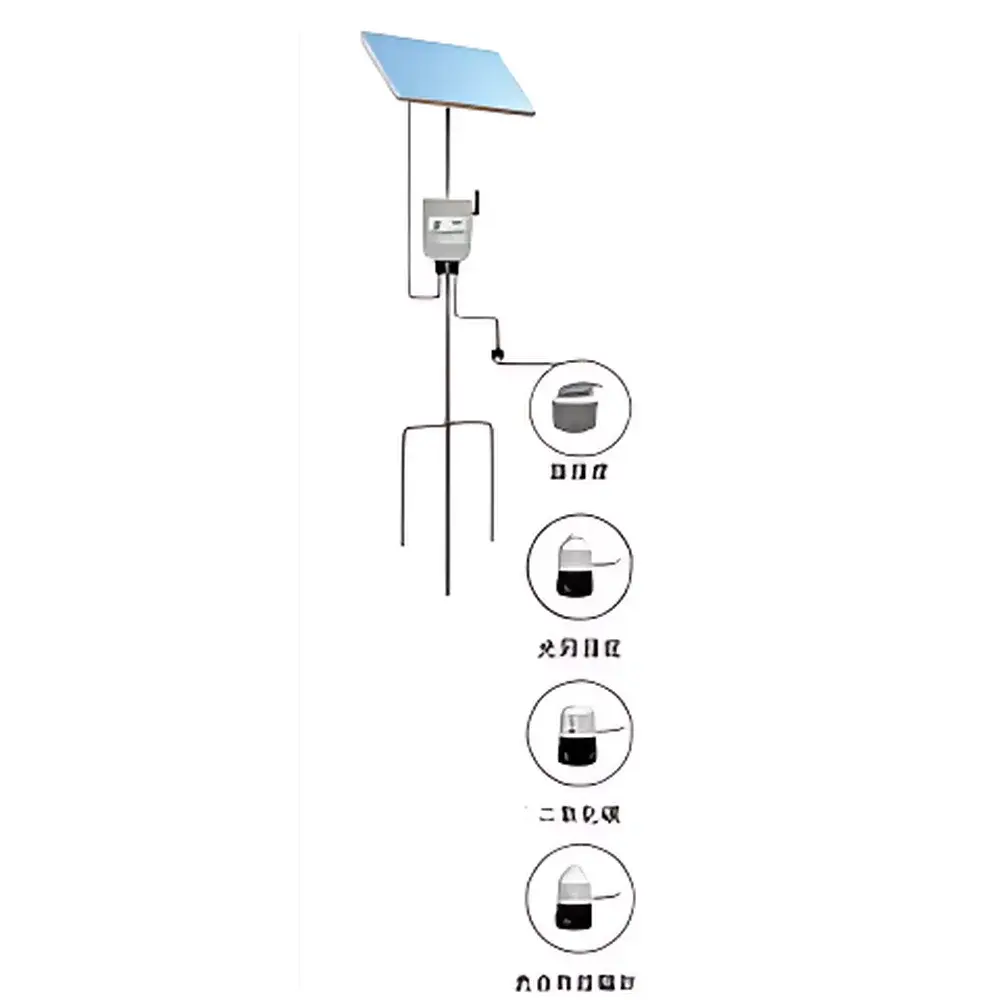
Top Cloud-agri TPFS-WG-1 Online Temperature and Illuminance Monitor
| Brand | Top Cloud-agri |
|---|---|
| Origin | Zhejiang, China |
| Manufacturer Type | Manufacturer |
| Country of Origin | China |
| Model | TPFS-WG-1 |
| Price | Upon Request |
| Operating Temperature Range | −20 °C to 70 °C |
| Enclosure Rating | IP67 |
| Battery Capacity | 20 Ah / 3.7 V Li-polymer |
| Temperature Sensor Range | −40 °C to 120 °C |
| Temperature Accuracy | ±0.4 °C |
| Temperature Resolution | 0.1 °C |
| Illuminance Range | 0–100 % (relative scale) |
| Illuminance Accuracy | ±3 % |
| Illuminance Resolution | ±0.1 % |
| Data Storage Capacity | ~500,000 records |
| GPS Integration | Yes |
| Wireless Communication | Cellular (LTE-M/NB-IoT), Optional Wi-Fi/LoRa |
| Power Supply | Dual-mode — Solar panel + rechargeable battery (200+ days autonomy) |
| Sensor Expansion | Up to 32 analog/digital sensor inputs |
| Default Accessories | Weatherproof mounting bracket, monocrystalline solar panel, embedded SIM (data plan included), waterproof enclosure |
Overview
The Top Cloud-agri TPFS-WG-1 Online Temperature and Illuminance Monitor is an industrial-grade environmental telemetry system engineered for continuous, unattended monitoring of ambient temperature and relative light intensity in open-field and semi-controlled agricultural environments. Unlike conventional handheld or benchtop photometric or thermometric instruments, the TPFS-WG-1 operates as a networked edge node—integrating sensing, power management, geolocation, wireless transmission, and cloud synchronization into a single ruggedized unit. Its measurement architecture relies on calibrated semiconductor-based temperature transducers (PT1000-class equivalent) and silicon photodiode-based illuminance sensors, configured to output stable analog voltage or digital I²C signals with temperature-compensated linearization. Designed for deployment in variable outdoor conditions—including high-humidity greenhouses, orchards, tea plantations, and broad-acre cropland—the device complies with IEC 60529 (IP67) ingress protection standards and operates reliably across a −20 °C to 70 °C ambient envelope. The integrated GPS module provides timestamped georeferencing at ≤5 m CEP accuracy, enabling spatial correlation of microclimate data across distributed farm networks.
Key Features
- Solar-powered autonomy: Equipped with a monocrystalline solar panel and 20 Ah / 3.7 V lithium-polymer battery, delivering ≥200 days of continuous operation without grid connection under typical insolation conditions (≥3 kWh/m²/day).
- Scalable sensor architecture: Supports up to 32 external analog (0–5 V, 4–20 mA) or digital (RS485, Modbus RTU, I²C) sensors—enabling modular expansion to include CO₂, PAR, soil moisture, or dew point modules without hardware replacement.
- Robust data resilience: Local storage buffers ~500,000 timestamped records with automatic overwrite policy; dual-write redundancy ensures no loss during intermittent cellular connectivity.
- Multi-channel alerting: Configurable threshold-based alarms triggered via SMS, email, web dashboard notifications, LED status indicators, and optional voice alerts through connected gateways.
- Intelligent traffic allocation: Embedded eSIM with shared data pool management allows dynamic redistribution of unused monthly bandwidth across multiple TPFS-series nodes—reducing operational overhead in large-scale deployments.
- Zero-touch provisioning: Device registration and initial configuration accomplished via QR code scan; no CLI or firmware flashing required.
Sample Compatibility & Compliance
The TPFS-WG-1 is validated for long-term exposure in non-corrosive agricultural atmospheres, including high-UV, high-condensation, and dust-laden environments. Its IP67-rated polycarbonate enclosure resists UV degradation (IEC 60068-2-5), salt mist (ISO 9227), and mechanical impact (IK08). While not certified for explosive atmospheres (ATEX/IECEx) or medical-grade use, the instrument meets electromagnetic compatibility requirements per EN 61000-6-2 (immunity) and EN 61000-6-4 (emissions). Sensor calibration traceability follows ISO/IEC 17025 principles through third-party accredited laboratories; factory calibration certificates are provided with each unit. Data integrity conforms to GLP-aligned logging practices—each record includes UTC timestamp, GPS coordinates, sensor ID, raw ADC value, compensated engineering units, and CRC-16 checksum.
Software & Data Management
The TPFS-WG-1 interfaces natively with the Top Cloud-agri Instrument Cloud Platform—a secure, role-based SaaS environment accessible via browser or native iOS/Android applications. The platform implements audit-trail functionality compliant with FDA 21 CFR Part 11 Annex 11 requirements—including electronic signatures, user access logs, and immutable record history. Real-time dashboards display live metrics overlaid on interactive GIS maps; historical trends support statistical analysis (min/max/avg/std dev), custom aggregation intervals (1-min to 24-h), and export to CSV/Excel/JSON. Preconfigured crop-specific alert templates—e.g., “Tomato flowering stage: temp 32°C for >2h”—accelerate deployment readiness. All data resides in ISO 27001-certified AWS-hosted infrastructure with TLS 1.3 encryption in transit and AES-256 at rest.
Applications
- Greenhouse climate optimization—correlating diurnal illuminance profiles with heating/ventilation actuation logic.
- Phenological monitoring in perennial crops—tracking cumulative thermal time (growing degree days) and photoperiod thresholds for budbreak or harvest timing.
- Irrigation scheduling support—using temperature-driven vapor pressure deficit (VPD) estimation when paired with optional humidity sensors (TPFS-WSG-1 variant).
- Regulatory compliance reporting—generating auditable environmental logs for GlobalG.A.P., GRASP, or Organic Certification audits.
- Research-grade microclimate mapping—deploying dense sensor grids to characterize spatial heterogeneity in orchard canopy light interception or inter-row soil warming patterns.
FAQ
What communication protocols does the TPFS-WG-1 support?
It uses NB-IoT or LTE-M cellular networks by default; optional RS485 Modbus RTU and LoRaWAN gateway integration are available upon request.
Can the device operate without cellular coverage?
Yes—local data logging continues uninterrupted; uploads resume automatically when signal is restored, with no data loss.
Is sensor calibration performed in-house or by an external lab?
All temperature and illuminance sensors undergo two-point calibration at certified facilities; calibration certificates with uncertainty budgets are shipped with each unit.
How is firmware updated in the field?
Over-the-air (OTA) updates are delivered securely via the Instrument Cloud Platform; rollback capability and versioned release notes ensure operational continuity.
Does the system support integration with third-party SCADA or farm management software?
Yes—RESTful API and MQTT endpoints are documented and supported; JSON payloads conform to AgGateway ADAPT schema conventions for interoperability.
Related Products







