
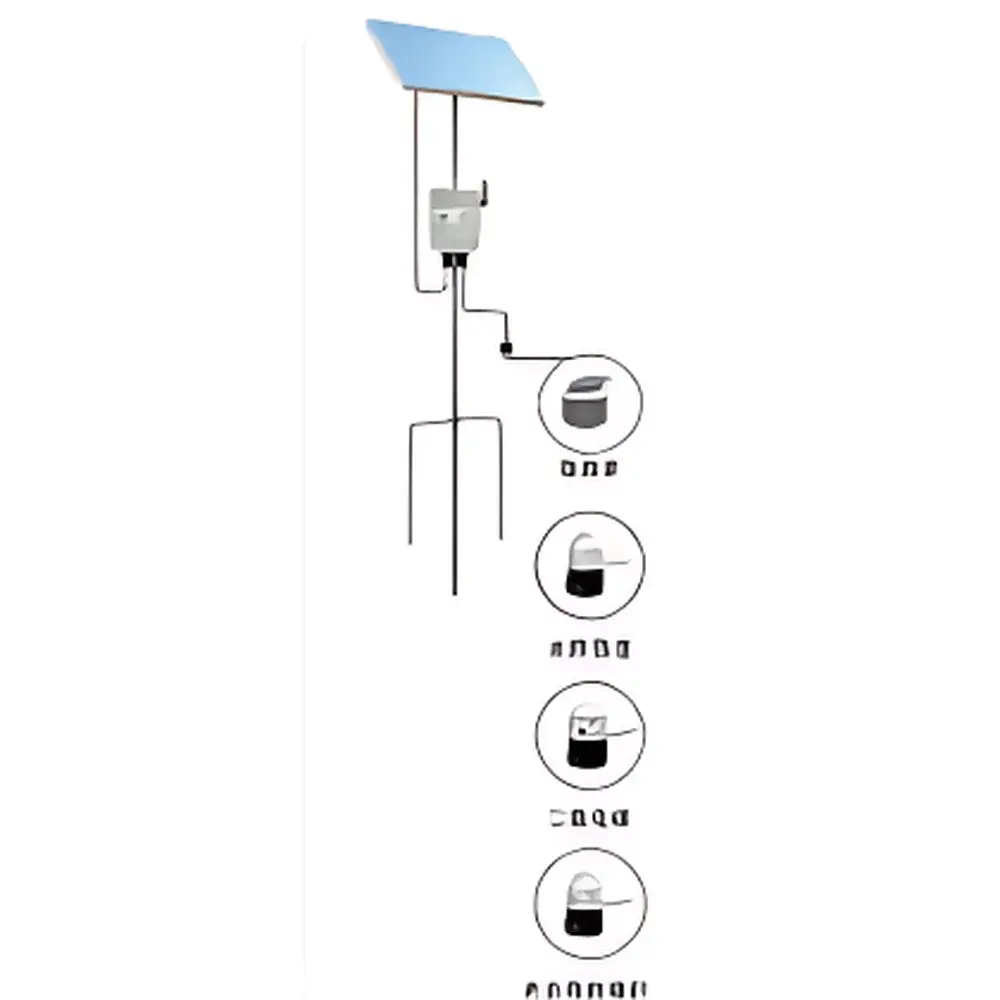
Top Cloud-agri TPFS-CO2-1 Online Carbon Dioxide Monitor
| Brand | Top Cloud-agri |
|---|---|
| Origin | Zhejiang, China |
| Manufacturer Type | OEM/ODM Producer |
| Country of Origin | China |
| Model | TPFS-CO2-1 |
| Pricing | Available Upon Request |
| Operating Temperature | −20 °C to +70 °C |
| Enclosure Rating | IP67 |
| Battery | 20 Ah / 3.7 V Lithium Polymer Rechargeable |
| CO₂ Measurement Range | 0–2000 ppm (customizable up to 5000 ppm or higher upon order) |
| Accuracy | ±(50 ppm + 3% of reading) |
| Resolution | 1 ppm |
| Data Storage Capacity | ~500,000 records |
| Power Options | Integrated solar panel + AC 220 V + internal battery (≥200 days runtime on full charge) |
| Communication | Embedded cellular (LTE-M/NB-IoT), GPS module, QR-code-based device registration |
| Sensor Interface | Supports up to 32 external analog/digital sensors |
| Default Accessories | Weatherproof mounting bracket, monocrystalline solar panel, pre-activated IoT data SIM card, waterproof enclosure |
Overview
The Top Cloud-agri TPFS-CO₂-1 Online Carbon Dioxide Monitor is a rugged, field-deployable environmental sensing system engineered for continuous, real-time monitoring of atmospheric CO₂ concentration in agricultural and horticultural settings. It employs a non-dispersive infrared (NDIR) sensing principle—widely recognized for its long-term stability, low drift, and immunity to cross-sensitivity from common ambient gases such as water vapor and methane. Unlike portable or spot-check instruments, the TPFS-CO₂-1 is designed for unattended operation across diverse outdoor environments, including greenhouses, open-field crop zones, controlled-environment agriculture (CEA) facilities, and soil respiration study plots. Its embedded solar-charging architecture and industrial-grade IP67 enclosure ensure reliable performance under fluctuating temperature extremes (−20 °C to +70 °C) and high-humidity conditions typical of agro-ecological deployments.
Key Features
- Solar-Integrated Power Architecture: Combines a monocrystalline solar panel, 20 Ah / 3.7 V lithium polymer battery, and dual-input charging circuitry (solar + AC 220 V), enabling >200 days of autonomous operation without grid dependency.
- Scalable Multi-Sensor Platform: Native support for up to 32 analog (0–5 V, 4–20 mA) and digital (RS485 Modbus RTU, SDI-12) sensors—enabling synchronized CO₂ measurement with complementary parameters such as temperature, humidity, PAR, soil moisture, or leaf wetness.
- Robust Edge Data Handling: Onboard storage capacity of approximately 500,000 timestamped records ensures continuity during extended network outages; data retention persists across power cycles and firmware updates.
- Embedded Cellular & GPS Connectivity: LTE-M/NB-IoT modem with pre-provisioned IoT SIM card enables secure, low-bandwidth telemetry; integrated GPS provides georeferenced metadata for spatial mapping and asset tracking within the cloud platform.
- Configurable Alerting Framework: Programmable threshold-based alarms (min/max limits) trigger notifications via SMS, email, web dashboard, LED indicators, or synthesized voice alerts—supporting rapid response to critical CO₂ excursions affecting plant physiology or worker safety.
- Zero-Touch Deployment: Device provisioning via QR code scanning eliminates manual configuration; firmware, sensor calibration profiles, and alert rules are remotely pushed via the Instrument Cloud Management Platform.
Sample Compatibility & Compliance
The TPFS-CO₂-1 is optimized for ambient air sampling in open and semi-enclosed agricultural environments. Its NDIR sensor head features a diffusion-based inlet with hydrophobic particulate filter, minimizing contamination from dust, pollen, and condensate. The instrument complies with IEC 60529 (IP67 ingress protection), RoHS Directive 2011/65/EU, and CE marking requirements for electromagnetic compatibility (EN 61000-6-3, EN 61000-6-4). While not certified for Class I Div 1 hazardous locations, it meets functional safety expectations for non-explosive agricultural atmospheres per ISO 22000-aligned monitoring protocols. Data integrity safeguards—including immutable timestamps, CRC-verified transmission, and audit-ready event logs—support adherence to GLP principles for long-term environmental data collection.
Software & Data Management
The Instrument Cloud Management Platform serves as the central interface for remote device supervision, data visualization, and analytical reporting. Users access real-time and historical CO₂ time-series through responsive web dashboards or native iOS/Android applications. The platform supports automated calculation of derived metrics (e.g., diurnal CO₂ flux trends, cumulative exposure indices), configurable data export (CSV, Excel, PDF), and role-based user permissions. All data transmissions adhere to TLS 1.2+ encryption; platform-level audit trails record every configuration change, user login, and alarm activation—facilitating compliance with FDA 21 CFR Part 11 requirements where electronic records serve as regulatory evidence. Optional API integration (RESTful JSON endpoints) enables interoperability with third-party farm management systems (FMS), SCADA platforms, or climate control logic controllers.
Applications
- Greenhouse climate optimization—correlating CO₂ levels with photosynthetic efficiency and yield metrics in tomato, cucumber, and leafy greens production.
- Soil respiration monitoring—tracking temporal variations in rhizosphere CO₂ efflux as an indicator of microbial activity and organic matter decomposition.
- Controlled-environment agriculture (CEA) validation—verifying CO₂ enrichment system performance and uniformity across vertical farming racks.
- Agricultural research trials—long-term CO₂ exposure studies assessing cultivar-specific responses under elevated carbon conditions.
- Post-harvest storage monitoring—detecting abnormal CO₂ accumulation in cold rooms or modified-atmosphere packaging (MAP) chambers.
- Environmental education and citizen science projects—deploying low-maintenance, solar-powered nodes for regional air quality awareness initiatives.
FAQ
What is the recommended calibration interval for the CO₂ sensor?
Field recalibration is advised every 12 months using certified zero gas (N₂) and span gas (e.g., 1000 ppm CO₂ in air); factory calibration certificates are provided with each unit.
Can the TPFS-CO₂-1 operate reliably in high-humidity greenhouses?
Yes—the sensor housing incorporates a heated optical path and hydrophobic membrane to mitigate condensation-induced signal attenuation; IP67-rated electronics prevent moisture ingress during routine irrigation or fogging cycles.
Is raw sensor output accessible for custom algorithm development?
Yes—Modbus RTU over RS485 provides direct access to unprocessed ADC values and diagnostic registers; full register map and communication protocol documentation are available under NDA.
Does the system support integration with third-party SCADA or BMS platforms?
Yes—via Modbus TCP gateway mode or REST API; pre-built connectors exist for Ignition SCADA, Siemens Desigo CC, and Climate Corp FieldView.
How is data security managed during cellular transmission?
All payloads are encrypted end-to-end using AES-256; device authentication uses X.509 certificates; SIM cards operate on private APN networks to isolate traffic from public internet routing.







