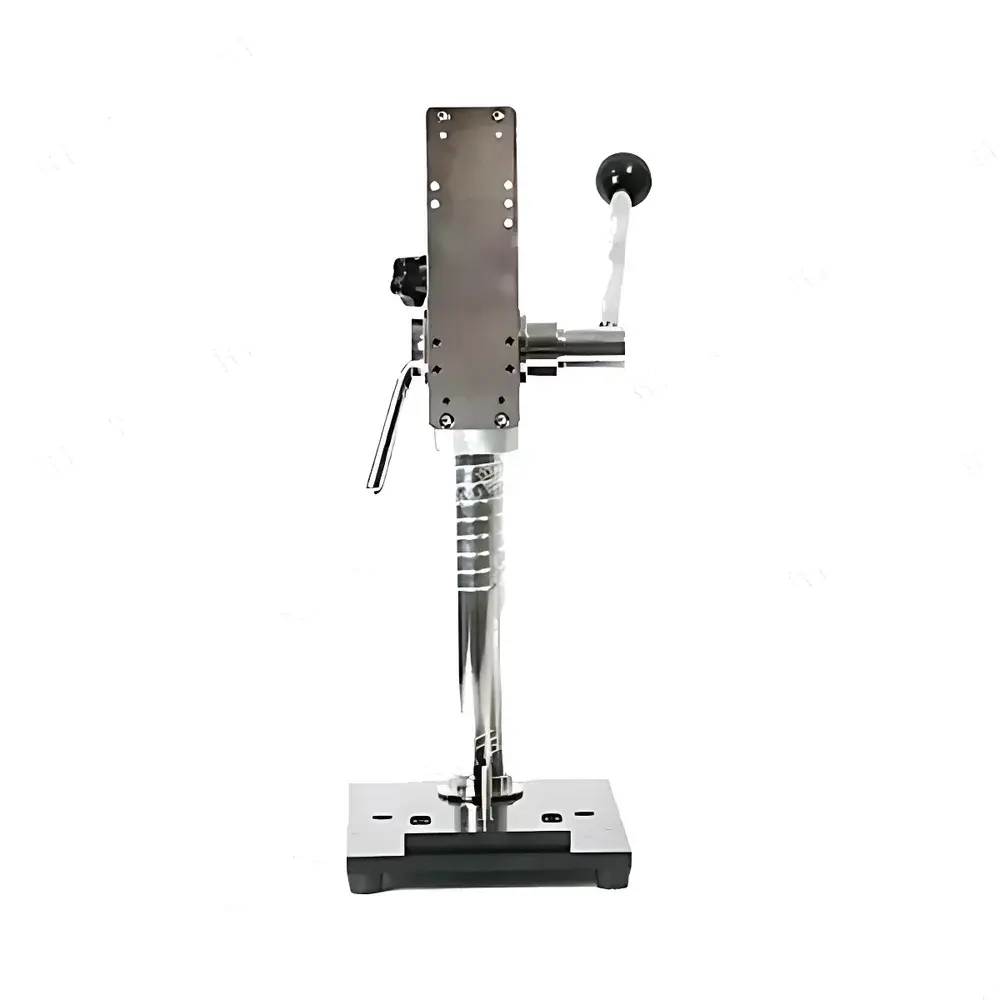
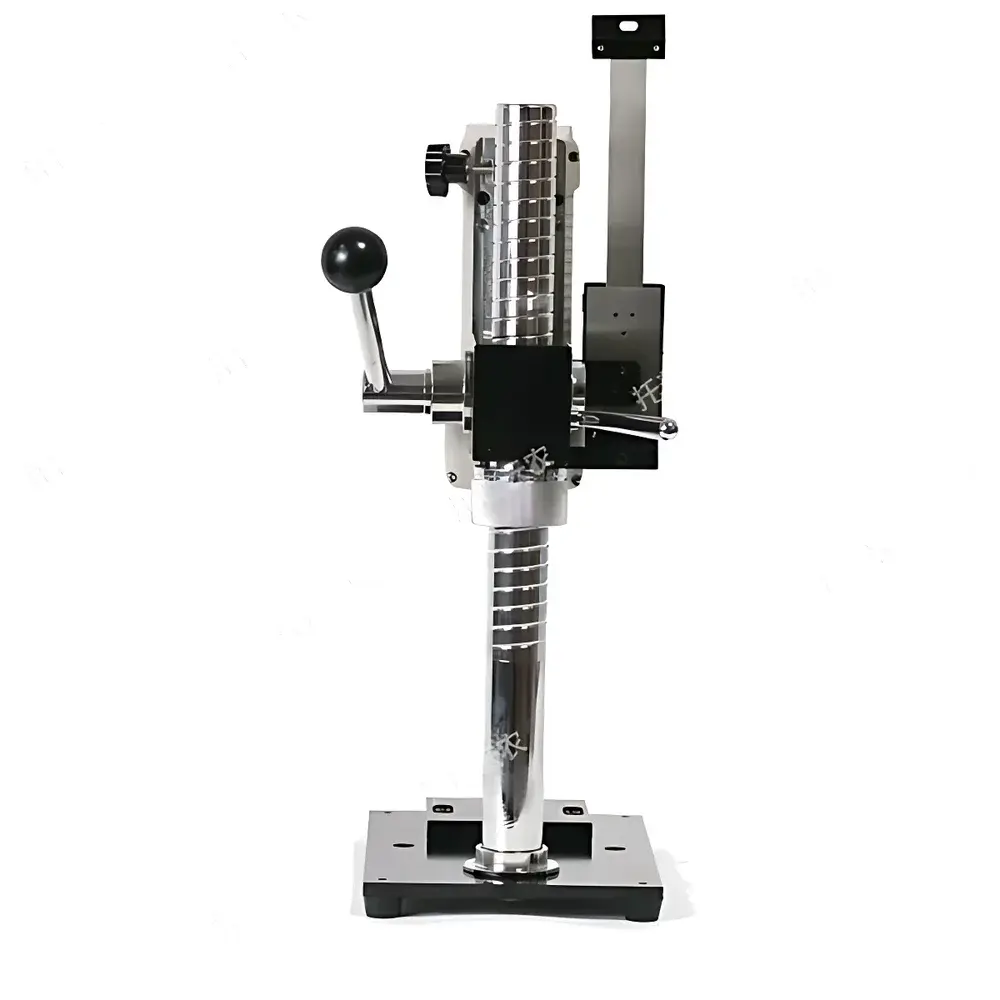
Top Cloud-agri TP-GY-4-J Portable Fruit Hardness Testing Stand
| Brand | Top Cloud-agri |
|---|---|
| Origin | Zhejiang, China |
| Manufacturer Type | Direct Manufacturer |
| Country of Origin | China |
| Model | TP-GY-4-J |
| Travel | 70 mm |
| Max Load Capacity | 1000 N |
| Dimensions (L×W×H) | 235 × 155 × 430 mm |
| Net Weight | 9 kg |
Overview
The Top Cloud-agri TP-GY-4-J Portable Fruit Hardness Testing Stand is a precision mechanical support platform engineered specifically for use with the TP-GY-4 digital fruit hardness tester. Designed to eliminate operator-induced variability during puncture testing, this stand provides controlled, vertical force application through a manually actuated gear-and-rack transmission system. It operates on the fundamental principle of standardized axial compression—applying calibrated downward force at a defined rate and depth to measure the resistance of fruit tissue (e.g., apple, pear, peach, kiwifruit) to deformation. This method aligns with widely accepted horticultural postharvest evaluation protocols, including those referenced in ISO 8760:1987 (Fruit and vegetable — Determination of firmness by penetrometer) and ASTM F3103-17 (Standard Test Method for Measuring Firmness of Fresh Fruits Using a Penetrometer). The stand does not perform measurement autonomously; rather, it serves as a stable, repeatable interface between the operator and the TP-GY-4 sensor, ensuring consistent probe alignment, perpendicular loading, and minimized lateral deviation—critical factors influencing inter-laboratory reproducibility.
Key Features
- Manual lever-actuated mechanism with adjustable height stop—enables precise control over penetration depth and accommodates varying fruit sizes without tooling changes.
- Robust gear-and-rack linear transmission system—ensures smooth, backlash-free vertical motion with high mechanical efficiency and long-term dimensional stability.
- Dedicated mounting interface for TP-GY-4 fruit hardness tester—includes standardized adapter plate and locking screws for rapid, repeatable instrument installation and removal.
- Universal auxiliary capability—compatible with standard push-pull force gauges (e.g., IMADA, MARK-10 series) and custom fixtures via M6 threaded mounting points on the crosshead and base plate.
- Heavy-duty cast aluminum base (235 × 155 mm footprint) with non-slip rubber feet—provides inertial stability during peak-load events up to 1000 N and supports secure benchtop anchoring using optional T-slot clamps or bolt-through mounting.
- Compact vertical profile (430 mm height) and lightweight portability (9 kg net weight)—facilitates transport between orchard field stations, packinghouse QC labs, and university teaching laboratories without requiring recalibration.
Sample Compatibility & Compliance
The TP-GY-4-J stand supports routine hardness assessment of whole or halved fruits ranging from 30 mm to 120 mm in diameter. Its open-frame architecture allows unobstructed access to the sample zone, enabling real-time visual monitoring of skin puncture, flesh deformation, and probe slippage. While primarily intended for intact fruit, it may also be adapted—via fixture customization—for standardized compression testing of soft agricultural commodities such as tomatoes, berries (in clamshell fixtures), or postharvest root vegetables. The mechanical design conforms to general safety requirements outlined in ISO 12100:2010 (Safety of machinery) and incorporates no electrical or pneumatic components, eliminating risks associated with hazardous energy sources. As a passive mechanical aid, it requires no regulatory certification but is routinely deployed in GLP-compliant horticultural research environments where traceable instrumentation setup and documented test configuration are mandatory.
Software & Data Management
The TP-GY-4-J itself contains no embedded electronics, firmware, or data storage. All measurement acquisition and analysis occur externally via the connected TP-GY-4 hardness tester, which outputs analog or digital signals (RS-232/USB) compatible with third-party data logging software (e.g., LabVIEW, MATLAB, or proprietary horticultural QA platforms). When used in regulated settings—such as USDA-accredited quality assurance labs or contract research organizations—the stand’s fixed geometry and repeatable positioning contribute directly to audit-ready test method validation. Its physical consistency supports full traceability under FDA 21 CFR Part 11 when paired with compliant software systems that enforce electronic signatures, audit trails, and user access controls for hardness test records.
Applications
- Postharvest maturity grading of apples, pears, and stone fruits across commercial packing lines.
- Longitudinal firmness tracking during cold storage trials to optimize shelf-life prediction models.
- Genotype × environment interaction studies in breeding programs evaluating texture inheritance.
- Validation of non-destructive NIR or ultrasound firmness prediction algorithms against reference mechanical measurements.
- Undergraduate and graduate laboratory instruction in plant physiology, food engineering, and postharvest technology curricula.
- Cross-functional mechanical testing—including plug拔 force of citrus segments, stem detachment force in berries, and peel adhesion strength in mandarins—using interchangeable fixtures.
FAQ
Is the TP-GY-4-J compatible with hardness testers other than the TP-GY-4?
Yes—its modular mounting plate accepts any hardness tester or digital force gauge with a 30 mm × 30 mm mounting pattern and M4 or M6 threaded holes.
Does the stand require calibration?
No—calibration is performed solely on the connected force sensor (e.g., TP-GY-4). However, annual mechanical verification of travel linearity and load-axis perpendicularity is recommended per ISO/IEC 17025 guidelines.
Can it be used for destructive testing beyond fruit?
Yes—within its 1000 N load limit and 70 mm stroke, it supports standardized compression, tension, and shear tests on soft biomaterials, gels, foams, and packaged food products when equipped with appropriate fixtures.
What surface preparation is required for stable operation?
A level, rigid, vibration-dampened work surface (e.g., granite slab or heavy steel bench) is required. The base must remain fully seated—no lifting or rocking—during maximum-load application.
Is technical documentation available in English for regulatory submissions?
Yes—full dimensional drawings, materials declarations, mechanical performance specifications, and compliance statements are provided upon request for inclusion in SOPs, validation protocols, or audit packages.