
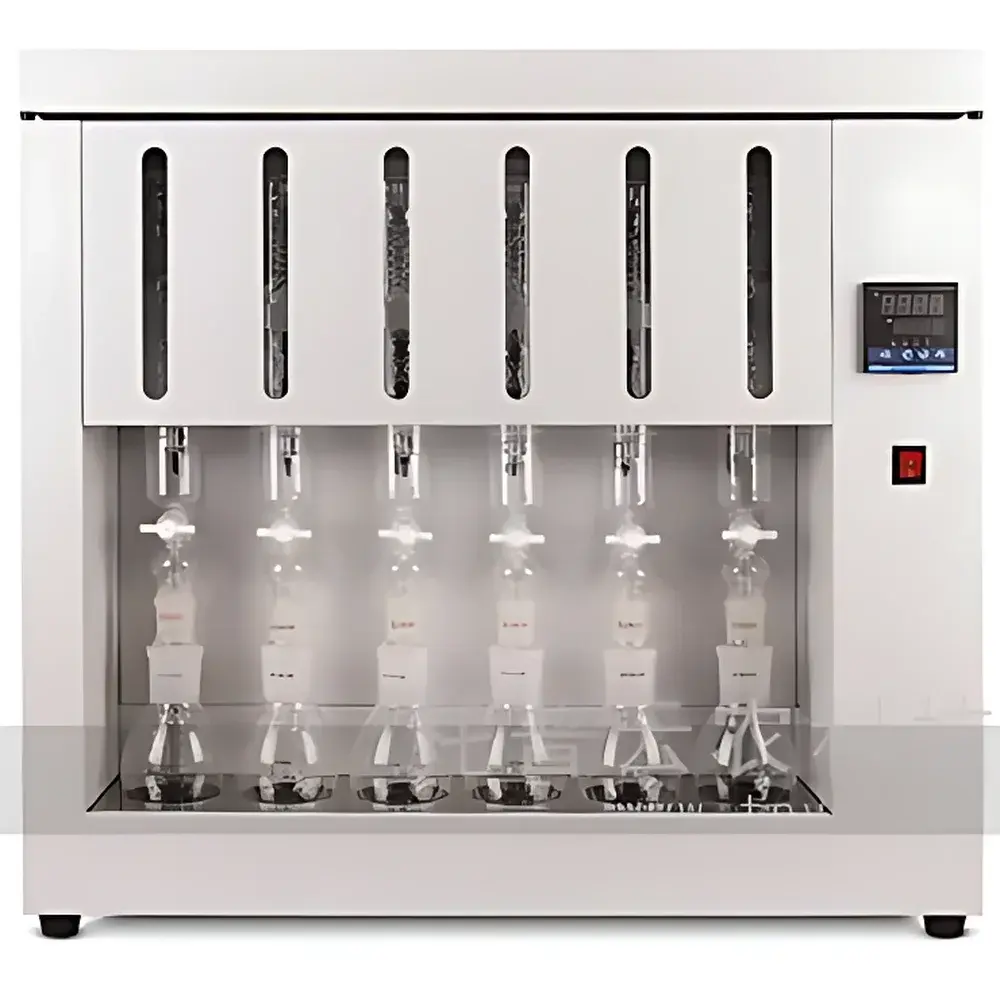
Top Cloud-agri SZF-06C Automatic Fat Analyzer
| Brand | Top Cloud-agri |
|---|---|
| Origin | Zhejiang, China |
| Manufacturer Type | Direct Manufacturer |
| Country of Origin | China |
| Model | SZF-06C |
| Power Supply | 220 V, 50 Hz |
| Heating Method | Water Bath |
| Heating Power | 800 W |
| Temperature Control Range | Room Temperature +5 °C to 90 °C |
| Solvent Recovery Rate | ≥80% |
| Sample Capacity | 6 positions simultaneously |
| Sample Matrix Compatibility | Grains, feeds, oilseeds, and fat-containing food products with fat content between 0.5% and 60% |
| Dimensions (W×D×H) | 570 × 330 × 655 mm |
| Weight | 23 kg |
| Sealing Interface | Ground-glass joints |
| Solvent Options | Anhydrous diethyl ether or petroleum ether |
| Extraction Principle | Soxhlet extraction |
Overview
The Top Cloud-agri SZF-06C Automatic Fat Analyzer is an engineered solution for quantitative determination of crude fat content in solid and semi-solid biological and agricultural samples. It implements the classical Soxhlet extraction principle—a standardized gravimetric method recognized by AOAC International, ISO 6496, and GB/T 6433—where analytes are repeatedly washed with refluxing organic solvent (e.g., anhydrous diethyl ether or petroleum ether) to solubilize lipids. The extracted solution is then evaporated under controlled thermal conditions, and the residual mass—comprising crude fat along with co-extracted non-saponifiable substances (e.g., waxes, resins, pigments)—is quantified gravimetrically. Unlike acid hydrolysis methods that liberate bound lipid fractions, the SZF-06C delivers reproducible results aligned with regulatory definitions of “crude fat” for nutritional labeling, feed formulation, and quality assurance workflows.
Key Features
- Simultaneous six-position extraction capacity for high-throughput routine analysis in QC laboratories.
- Water bath heating system with digital PID temperature controller (range: RT +5 °C to 90 °C), ensuring uniform thermal distribution and minimizing localized overheating risks associated with direct electric plate heating.
- Ground-glass joint interfaces across condenser, extractor, and receiving flask assemblies—eliminating elastomeric seals susceptible to swelling or degradation upon repeated exposure to ether-based solvents.
- Integrated automatic solvent recovery module with ≥80% recovery efficiency, reducing reagent consumption, lowering operational costs, and supporting laboratory sustainability goals per ISO 14001-aligned practices.
- Digital timer and temperature display panel enabling precise protocol replication, essential for GLP-compliant documentation and audit readiness.
- Compact footprint (570 × 330 × 655 mm) optimized for benchtop deployment in space-constrained analytical labs without compromising accessibility or maintenance ergonomics.
Sample Compatibility & Compliance
The SZF-06C supports a defined working range of 0.5–60% fat content across heterogeneous matrices including cereal grains, compound animal feeds, oilseed cakes, and processed food products. Its design adheres to fundamental safety and performance expectations outlined in IEC 61010-1 for electrical equipment used in laboratory environments. While not certified to UL or CE standards out-of-the-box, its construction—including solvent-resistant borosilicate glass components and sealed water bath enclosure—meets baseline requirements for safe operation under national standards GB/T 6433 (China) and AOAC Official Method 920.39. Users deploying this instrument in regulated environments (e.g., FDA-regulated food facilities or ISO/IEC 17025-accredited testing labs) must validate method performance per their internal SOPs and document calibration, maintenance, and operator training records accordingly.
Software & Data Management
The SZF-06C operates as a standalone hardware platform with no embedded microprocessor or data logging capability. All process parameters—including setpoint temperature, extraction duration, and cycle count—are manually configured via front-panel controls. As such, raw data (e.g., pre- and post-extraction weights) must be recorded externally using calibrated analytical balances and documented in laboratory notebooks or LIMS-integrated spreadsheets. For laboratories requiring electronic record integrity under 21 CFR Part 11, supplementary validation of manual entry procedures—including user access controls, audit trails, and electronic signature protocols—is required during IQ/OQ/PQ implementation.
Applications
- Nutritional labeling compliance testing for packaged foods and dietary supplements.
- Feed formulation verification and raw material acceptance testing in livestock and aquaculture supply chains.
- Quality control of edible oils, roasted nuts, and bakery products where fat stability directly impacts shelf life.
- Academic research in food science, agricultural engineering, and biochemistry involving lipid partitioning studies.
- Regulatory submissions requiring AOAC-validated methodologies for crude fat quantification.
FAQ
What solvent types are compatible with the SZF-06C?
Anhydrous diethyl ether and petroleum ether (boiling point range 30–60 °C) are validated solvents. Chlorinated or highly polar solvents (e.g., chloroform, methanol) are not recommended due to compatibility constraints with glass components and safety limitations of the water bath system.
Is the instrument suitable for acid hydrolysis-based fat determination?
No. The SZF-06C implements only Soxhlet extraction. Acid hydrolysis requires separate digestion apparatus and is not supported by this platform.
Can the unit be integrated into a LIMS or automated lab workflow?
It lacks digital communication ports (e.g., RS-232, USB, Ethernet) and cannot interface directly with external software. Integration requires manual data transcription or third-party weighing station synchronization.
What maintenance intervals are recommended?
Daily visual inspection of ground-glass joints for residue buildup; monthly cleaning of water bath chamber and descaling if hard water is used; annual verification of temperature sensor accuracy against NIST-traceable reference thermometers.



