
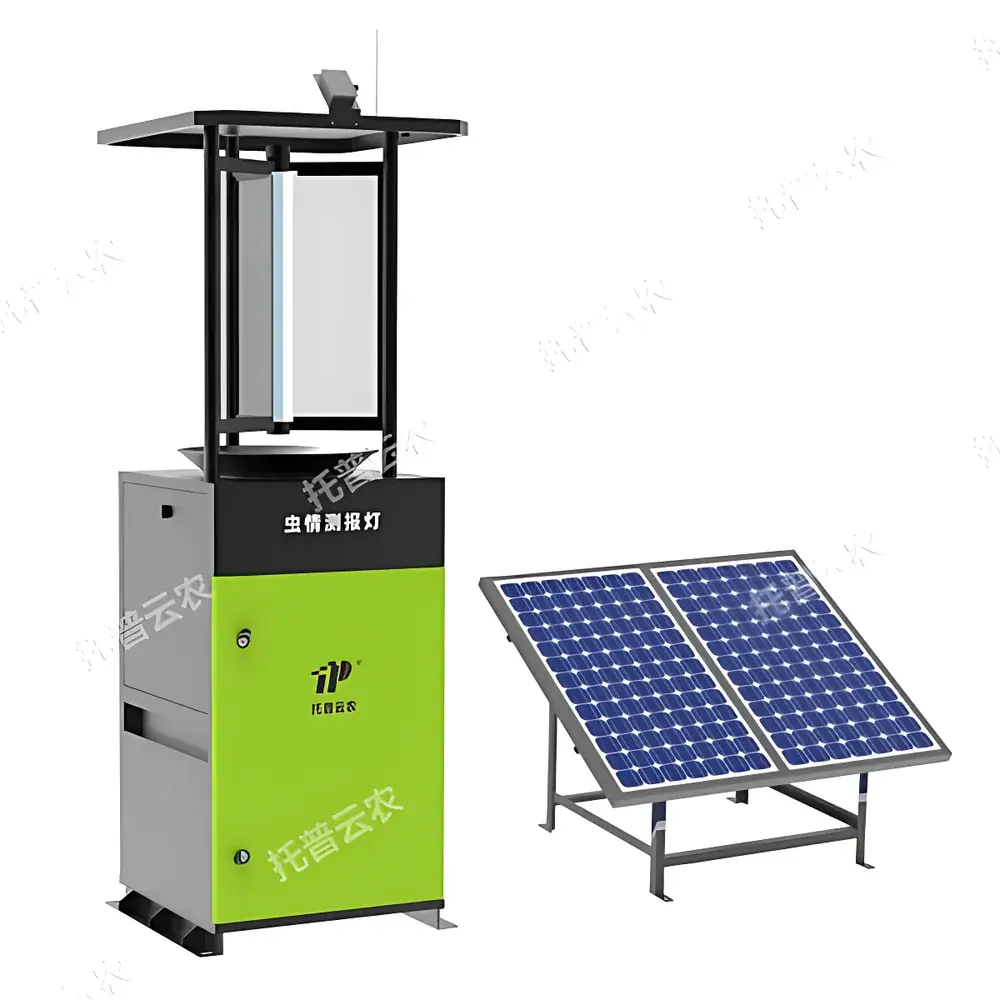
Top Cloud-agri TPCB-III-C4.0 Solar-Powered Intelligent Insect Monitoring and Reporting Lamp
| Brand | Top Cloud-agri |
|---|---|
| Origin | Zhejiang, China |
| Manufacturer Type | Direct Manufacturer |
| Country of Origin | China |
| Model | TPCB-III-C4.0 |
| Instrument Category | Pest Surveillance System |
| Power Supply | DC 12V (Solar Panel + Rechargeable Battery) |
| UV Light Source | 20W Tube, Peak Wavelength 365 nm |
| Touch Interface | 7-inch Capacitive Color Touchscreen (Android 4.0 OS) |
| Insect Killing & Drying | Dual-layer Far-Infrared Chamber (85 ± 5°C after 15 min |
| Treatment Duration Adjustable | 1–60 min) |
| Insect Mortality Rate | ≥98% |
| Insect Integrity Rate | ≥95% |
| Time Segmentation | Up to 24 Programmable Time Slots per Day |
| Automatic Tray Rotation | 8-Position Sequential Collection Carousel |
| Rain Control | Active Drainage + Adaptive Rain-Sensing Activation |
| Voltage Stabilization | 160–280 V AC Input → Stable 220 V Output |
| Environmental Sensor Expansion Support | Ambient Temp/RH, Soil Temp/Moisture, Wind Speed/Direction, Illuminance |
| Operating Temperature | 0–70°C |
| Operating Humidity | ≤95% RH |
| Max Power Consumption | ≤210 W |
| Insulation Resistance | >2.5 MΩ |
| Compliance | GB/T 4237 (Stainless Steel Construction) |
Overview
The Top Cloud-agri TPCB-III-C4.0 is a solar-powered, autonomous insect surveillance and reporting lamp engineered for long-term, unattended deployment in open-field agricultural, forestry, horticultural, and specialty crop environments. It operates on the principle of phototactic attraction using ultraviolet (UV-A) radiation at 365 nm—optimized to elicit strong behavioral response from nocturnal Lepidoptera, Coleoptera, and Hemiptera species—followed by non-chemical, far-infrared (FIR) thermal processing to ensure high-fidelity specimen preservation. Unlike conventional trapping methods requiring daily manual collection, the TPCB-III-C4.0 integrates real-time environmental adaptation (rain sensing, light-level triggering), time-resolved sample segregation (8-slot carousel), and robust power management (solar + battery + wide-input voltage stabilization), enabling continuous, standardized data acquisition across seasonal pest dynamics. Its stainless-steel enclosure conforms to GB/T 4237, ensuring corrosion resistance under prolonged outdoor exposure.
Key Features
- Solar-dependent DC 12V operation with integrated charge controller and deep-cycle battery support—designed for off-grid deployment in remote orchards, tea plantations, tobacco fields, and ecological reserves.
- Dual-stage far-infrared chamber system: upper zone for rapid insect mortality induction (≥98% kill rate within defined thermal profile), lower zone for controlled desiccation (≥95% specimen integrity maintained), minimizing decomposition prior to visual or digital identification.
- Programmable temporal resolution: up to 24 independent time slots per 24-hour cycle, allowing alignment with known circadian flight patterns of target pests (e.g., Spodoptera frugiperda, Lymantria dispar, Anthonomus grandis).
- Intelligent rain control: hydrophobic housing design combined with active drainage channels and capacitive rain-sensing logic prevents water ingress and ensures uninterrupted operation during intermittent precipitation events.
- Capacitive 7-inch touchscreen interface running Android 4.0 OS—enabling local configuration of light activation thresholds, heating duration, tray rotation sequence, and diagnostic status review without external connectivity.
- Modular sensor expansion capability: supports optional integration of ambient temperature/humidity, soil moisture/temperature, wind speed/direction, and photosynthetic photon flux density (PPFD) sensors—facilitating multivariate correlation analysis between abiotic conditions and trap catch volume.
- Power resilience architecture: built-in wide-range AC/DC converter (160–280 V input) maintains stable internal voltage supply, mitigating grid instability common in rural electrification infrastructure.
Sample Compatibility & Compliance
The TPCB-III-C4.0 is validated for consistent capture and preservation of adult flying insect specimens across major agricultural pest taxa, including moths, beetles, leafhoppers, and planthoppers. Its mechanical design minimizes physical damage during impact and transfer, supporting morphological verification and subsequent taxonomic classification. The unit complies with national material standards (GB/T 4237 for austenitic stainless steel construction), meets basic electrical safety requirements (insulation resistance >2.5 MΩ), and incorporates surge protection and grounding provisions aligned with IEC 62305-4 for lightning-prone regions. While not certified to ISO/IEC 17025 or GLP for laboratory-grade metrology, its operational repeatability and time-stamped collection protocol support FAO-recommended pest monitoring frameworks and national phytosanitary surveillance programs.
Software & Data Management
Local firmware enables full device configuration, event logging (trap activation timestamps, rain detection triggers, heating cycle completion), and error diagnostics via the embedded touchscreen. Though the base TPCB-III-C4.0 model operates offline, its hardware architecture supports future firmware upgrades compatible with LoRaWAN or NB-IoT modules—allowing integration into centralized pest intelligence platforms. All collected temporal and environmental metadata adhere to structured CSV export conventions, facilitating ingestion into GIS-based decision support systems (e.g., QGIS, ArcGIS) or statistical analysis tools (R, Python pandas). Audit trails include timestamped system boot events, parameter modification logs, and power interruption records—supporting traceability in regulatory reporting contexts where field data integrity is required.
Applications
This instrument serves as a foundational node in integrated pest management (IPM) networks across diverse agroecosystems: monitoring Helicoverpa armigera migration corridors in cotton-growing zones; tracking Bactrocera dorsalis emergence peaks in mango and guava orchards; quantifying Scirpophaga incertulas pressure in rice paddies; and evaluating efficacy of pheromone-based mating disruption strategies in apple and pear production systems. Its adaptability to solar power makes it particularly suitable for protected cultivation areas (greenhouses, net houses) and conservation agriculture sites where grid access is limited or prohibited. Field validation studies conducted across Zhejiang, Yunnan, and Sichuan provinces demonstrate statistically significant correlation (p<0.01) between weekly trap counts and subsequent larval infestation levels measured via standardized sweep-net or visual scouting protocols.
FAQ
Does the TPCB-III-C4.0 require internet connectivity to function?
No—the core trapping, killing, drying, and time-segmented storage functions operate fully autonomously without network dependency. Connectivity is optional and reserved for future telemetry upgrades.
Can the far-infrared treatment parameters be customized per insect group?
Yes—users may adjust heating duration (1–60 minutes) and monitor chamber temperature via onboard diagnostics; however, default 85 ± 5°C profile is empirically optimized for broad-spectrum efficacy while preserving key morphological features.
What maintenance intervals are recommended for sustained accuracy?
Bi-weekly visual inspection of UV tube output intensity, cleaning of collection trays and infrared reflectors, and quarterly calibration of rain sensor sensitivity are advised under standard field conditions.
Is the unit compatible with third-party weather station networks?
Yes—its RS485 and analog signal interfaces support interoperability with industry-standard environmental monitoring hardware (e.g., Campbell Scientific, Onset HOBO), enabling synchronized multi-parameter dataset generation.
How is specimen cross-contamination prevented during extended deployments?
The 8-position rotating carousel physically isolates catches by time segment; each compartment is sealed during non-collection periods, and firmware enforces strict sequential actuation logic to eliminate overlap or misalignment.





