
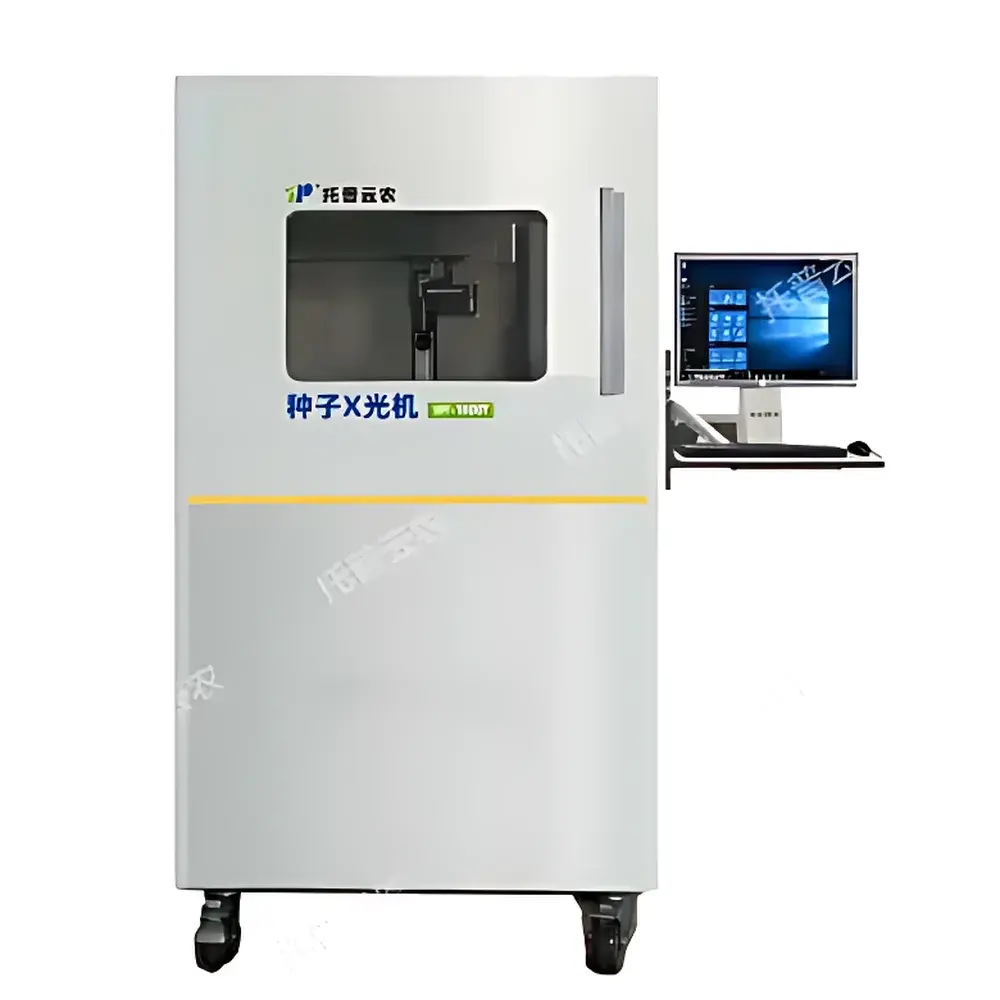
Top Cloud-agri HY-1800T Digital Radiographic Seed Imaging System
| Brand | Top Cloud-agri |
|---|---|
| Origin | Zhejiang, China |
| Manufacturer Type | OEM/ODM Manufacturer |
| Country of Origin | China |
| Model | HY-1800T |
| Pricing | Upon Request |
| Pixel Pitch | 140 µm |
| A/D Conversion | 16-bit |
| Spatial Resolution | 4.0 line pairs/mm |
| X-ray Tube Voltage | 40–60 kV |
| X-ray Tube Current | 1–10 mA |
| Maximum Object Thickness Capacity | 600 mm |
| Digital Imaging Field of View | 350 × 430 mm (customizable) |
| External Dimensions | 1350 × 800 × 710 mm |
| Weight | 350 kg |
Overview
The Top Cloud-agri HY-1800T Digital Radiographic Seed Imaging System is a purpose-built non-destructive evaluation (NDE) instrument engineered for high-throughput, high-fidelity internal structural assessment of agricultural and forestry seeds. Based on digital radiography principles—utilizing a microfocus X-ray source and a high-sensitivity flat-panel detector—the system generates real-time, high-contrast grayscale images that reveal internal morphological features without physical sectioning or chemical staining. Unlike conventional film-based radiography, this system eliminates darkroom processing, developer disposal, and exposure variability, delivering consistent image quality across repeated acquisitions. It is designed specifically for seed science laboratories, breeding programs, phytosanitary inspection units, and post-harvest research facilities where rapid, objective, and repeatable internal quality assessment is required under GLP-aligned workflows.
Key Features
- Real-time digital radiography: No darkroom or film processing; images acquired and displayed live on integrated 14-inch laptop with low-latency frame capture.
- Comprehensive image enhancement suite: Built-in software supports contrast adjustment, edge enhancement, inversion, pseudo-color mapping, localized histogram equalization, geometric measurement (length, width, perimeter, area, angular orientation), cropping, zoom, and pixel-level calibration.
- Dual-tier sample stage: Upper platform offers fine positional adjustability for small or delicate seeds (e.g., rice, rapeseed); lower platform provides extended field-of-view (350 × 430 mm) optimized for larger fruits and nuts (e.g., chestnuts, apples, jujubes).
- High-speed acquisition cycle: Full radiographic imaging—including positioning, exposure, readout, and display—completed in ≤4 seconds per sample, enabling throughput of >900 samples per 8-hour shift.
- Integrated safety architecture: Fully shielded lead-lined cabinet (≥2 mm Pb equivalent) certified to meet GBZ 130–2020 (Chinese national standard for X-ray equipment radiation protection), ensuring operator dose <1 µSv/h at 5 cm from any external surface during operation.
- Remote operation capability: Foot-switch interface allows hands-free initiation of X-ray exposure from outside the primary beam zone, minimizing operator proximity to the irradiation chamber.
- On-device output and archival: Direct USB/LAN connectivity to standard printers enables immediate hardcopy generation; all images are saved in DICOM-compliant and TIFF formats with embedded metadata (exposure parameters, timestamp, operator ID, sample ID).
Sample Compatibility & Compliance
The HY-1800T accommodates a broad spectrum of botanical specimens—from monocot and dicot seeds (rice, maize, rapeseed, pine nuts) to fleshy fruits (apples, jujubes) and hard-shelled nuts (chestnuts). Its 600 mm maximum penetration depth supports dense, high-Z materials such as dried fruit cores or mineralized insect remains within seeds. The system complies with ISO 17025:2017 requirements for testing laboratory competence when operated within documented SOPs. While not FDA-cleared as a medical device, its radiographic performance aligns with ASTM E2737–21 (Standard Practice for Digital Radiographic Testing of Seeds and Plant Materials) and supports traceable data collection compatible with ISO/IEC 17025 audit trails. Radiation shielding meets national regulatory limits defined in GBZ 130–2020 and is suitable for installation in standard university or agricultural research facility labs without additional structural modifications.
Software & Data Management
The proprietary acquisition and analysis software runs natively on Windows 10/11 and includes role-based user accounts, audit-log functionality (capturing user login, image acquisition events, parameter changes, and export actions), and encrypted local storage. Image datasets support batch export in CSV (for morphometric metrics) and DICOM (for interoperability with PACS or third-party analysis platforms). Software versioning and update history are logged automatically. Optional integration with LIMS via HL7 or REST API is available upon request for centralized sample tracking and QA/QC reporting. All raw image files retain EXIF-style metadata including kV, mA, exposure time, detector gain, and spatial calibration coefficients—enabling retrospective reprocessing and metrological traceability.
Applications
- Seed viability and vigor assessment via embryo integrity, endosperm density, and presence of internal cavities or necrotic zones.
- Detection and localization of internal insect infestation (e.g., granary weevil larvae, moth pupae) and fungal colonization in stored grains and nuts.
- Morphometric phenotyping for breeding programs: automated measurement of seed size distribution, shape descriptors (circularity, aspect ratio), and developmental staging (e.g., cotyledon expansion, radicle emergence).
- Post-harvest quality control: identification of mechanical damage, shriveling, shrunk embryos, or abnormal tissue differentiation in commercial seed lots.
- Phytosanitary certification: non-invasive verification of pest absence in export-bound seed consignments per ISPM No. 23 and IPPC guidelines.
- Research in seed dormancy mechanisms, desiccation tolerance, and storage physiology through longitudinal radiographic monitoring.
FAQ
Is the HY-1800T compliant with international radiation safety standards?
Yes—the lead cabinet design conforms to GBZ 130–2020, with verified leakage radiation <1 µSv/h at all accessible surfaces. Equivalent performance satisfies IEC 61331-1:2014 requirements for diagnostic X-ray equipment shielding.
Can the system be integrated into an existing laboratory information management system (LIMS)?
Yes—optional HL7 or REST API modules enable bidirectional data exchange for sample registration, result ingestion, and audit trail synchronization.
What is the minimum detectable feature size under standard operating conditions?
At 50 kV and optimal geometry, the system resolves features ≥120 µm in diameter with ≥10% contrast difference, validated per ASTM E2737 Annex A1.
Does the software support multi-user environments with permission tiers?
Yes—administrator, technician, and viewer roles are configurable, with password-protected access and session timeout enforcement.
Is routine calibration required, and what documentation is provided?
An annual performance verification protocol is recommended; a factory-issued calibration certificate (including spatial resolution, contrast sensitivity, and dose rate measurements) is supplied with each unit.




