
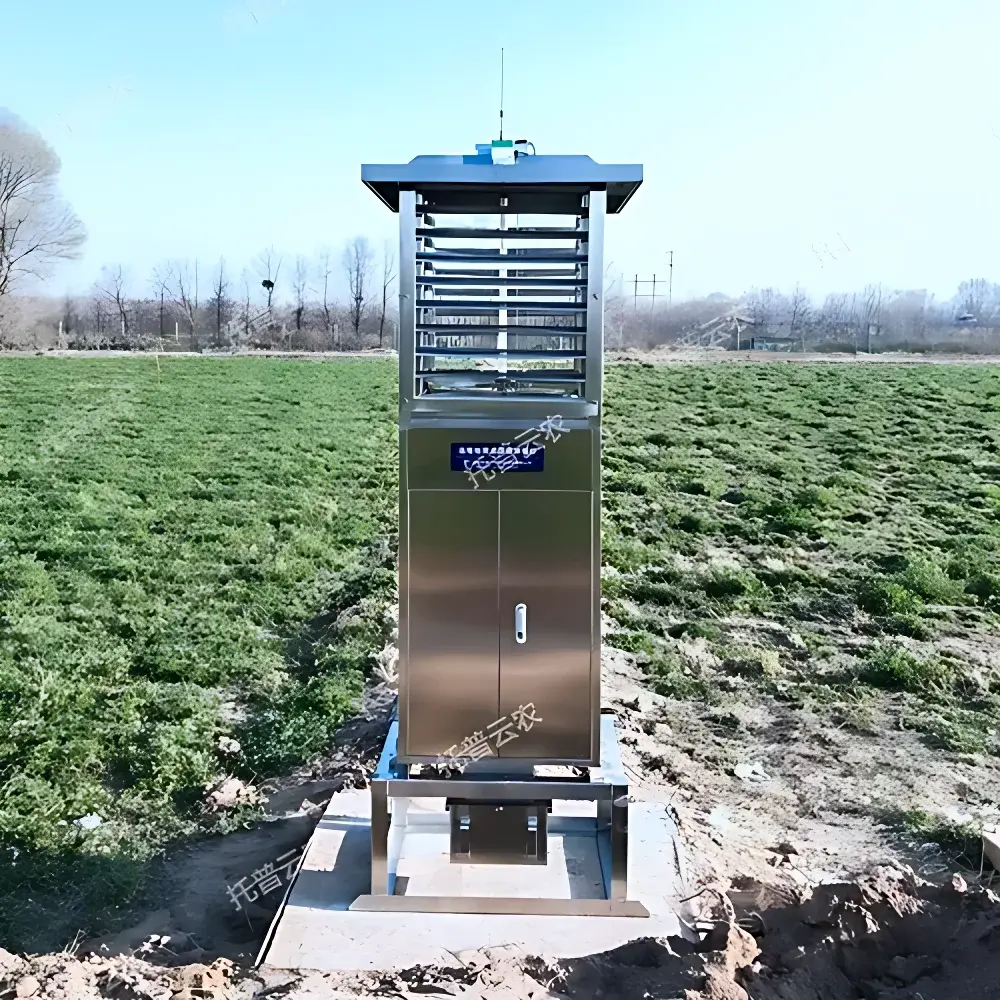
Top Cloud-agri TPCB-III-C 6.0plus IoT-Enabled Automated Insect Monitoring & Reporting Lamp
| Brand | Top Cloud-agri |
|---|---|
| Origin | Zhejiang, China |
| Manufacturer Type | Direct Manufacturer |
| Country of Origin | China |
| Model | TPCB-III-C 6.0plus |
| Power Supply | AC 220 V / DC 12 V (with 100 Ah battery & 320 W solar panel) |
| Imaging System | 12 MP industrial-grade camera |
| Image Capture Interval | Adjustable from 10 min to 3 h per frame |
| Data Upload Speed | ≥1 Mbps |
| GPS Positioning | Integrated |
| Infrared Killing Temperature | 85 ±5 °C (dual-zone far-infrared chamber) |
| Mortality Rate | ≥98% |
| Specimen Integrity Rate | ≥95% |
| Rain Separation | Active rain-drain baffle + rain-sensing control |
| Lightning Protection | Built-in Class II surge protection |
| Remote Control | Full bidirectional command via cloud platform and mobile app (Android/iOS) |
| Display | 7-inch industrial capacitive touchscreen (Android OS) |
| Compliance | Designed for ISO 17025-aligned field monitoring workflows |
Overview
The Top Cloud-agri TPCB-III-C 6.0plus IoT-Enabled Automated Insect Monitoring & Reporting Lamp is an autonomous, solar-compatible entomological surveillance system engineered for continuous, unattended detection and documentation of nocturnal, phototactic insect pests in agricultural ecosystems. Operating on the principle of ultraviolet light attraction combined with controlled thermal mortality and high-resolution digital imaging, the device captures, kills, dries, disperses, and images captured specimens without human intervention. Its architecture integrates photonic sensing, precision thermal control, real-time image acquisition, and secure edge-to-cloud data transmission—enabling scalable deployment across large-scale orchards, paddy fields, vineyards, and protected cultivation facilities. Unlike legacy trap-based systems, this instrument delivers time-stamped, georeferenced visual evidence suitable for longitudinal pest population trend analysis, threshold-based intervention triggering, and regulatory documentation under national phytosanitary frameworks.
Key Features
- Robust 304 stainless steel enclosure with IP65-rated weatherproofing, including anti-rain louvers and an active rain-drain chamber that separates precipitation from insect capture pathways—ensuring uninterrupted operation during rainfall events.
- Dual-zone far-infrared killing and drying chamber operating at 85 ±5 °C, delivering ≥98% mortality while preserving ≥95% morphological integrity of specimens for accurate taxonomic verification.
- 12-megapixel industrial-grade CMOS camera with adjustable capture intervals (10 minutes to 3 hours), mounted above a vibration-assisted specimen dispersion conveyor belt to ensure uniform, non-overlapping presentation of insects within the imaging field of view.
- Integrated GPS module enabling precise geolocation tagging of each image and real-time asset tracking—critical for distributed network deployments and theft recovery protocols.
- Full remote operational control via encrypted cloud platform and cross-platform mobile application (Android/iOS), supporting bidirectional commands including lamp activation, heater toggling, conveyor start/stop, vibration motor control, and chamber evacuation.
- 7-inch capacitive industrial touchscreen running Android OS, featuring localized Chinese UI, programmable time-scheduled operation modes, manual/automatic photo capture, and local preview functionality—even during network outages.
- Adaptive environmental sensing suite incorporating light-level detection (for dusk/dawn auto-start), rain detection (for dynamic mode adjustment), and surge-protected power input compatible with both AC 220 V grid and DC 12 V solar-battery hybrid configurations (320 W PV panel + 100 Ah deep-cycle battery).
Sample Compatibility & Compliance
The TPCB-III-C 6.0plus is optimized for monitoring phototactic arthropod species prevalent in temperate and subtropical agroecosystems—including Lepidoptera (e.g., Helicoverpa armigera, Spodoptera frugiperda), Coleoptera (e.g., Anomala corpulenta), and Hemiptera (e.g., Nephotettix cincticeps). Its mechanical design accommodates specimens ranging from 2 mm to 25 mm in length, with surface-area-dependent dispersion ensuring minimal occlusion during imaging. While not a diagnostic laboratory instrument, the system meets functional requirements for field-level pest surveillance as referenced in FAO Pest Monitoring Guidelines and China’s GB/T 31752–2015 standard for automated insect monitoring equipment. Data output formats (JPEG, CSV metadata, KML geotags) are interoperable with national pest forecasting platforms and support traceability under Good Agricultural Practice (GAP) and Integrated Pest Management (IPM) reporting frameworks.
Software & Data Management
Data acquisition, storage, and dissemination follow a tiered architecture: on-device edge processing handles image compression, timestamping, and GPS embedding; encrypted transmission occurs over 4G LTE or fiber-optic uplinks at ≥1 Mbps sustained throughput. The centralized cloud platform provides role-based access control, time-series visualization dashboards, batch-download capabilities, and API endpoints compliant with RESTful conventions. All user actions—including parameter modifications, remote commands, and image reviews—are logged with immutable timestamps and operator identifiers, satisfying basic audit-trail requirements aligned with GLP principles. Raw image archives are retained for ≥180 days; metadata exports support integration with GIS mapping tools and statistical modeling environments such as R or Python-based entomological analytics pipelines.
Applications
- Large-scale regional pest surveillance networks operated by provincial agricultural extension centers.
- Real-time early-warning systems for migratory pests (e.g., oriental armyworm, rice leaf roller) in cereal-growing belts.
- Validation of biocontrol agent efficacy through longitudinal comparison of pre- and post-release trap catch densities.
- Supporting pesticide resistance monitoring programs by enabling morphometric analysis of field-collected specimens prior to lab-based susceptibility assays.
- Integration into smart farm management platforms where insect count trends trigger irrigation, pruning, or scouting task assignments via IFTTT-style automation rules.
FAQ
Does the device require constant internet connectivity to function?
No—the unit operates autonomously in offline mode: capturing, killing, drying, and imaging insects locally. Connectivity is required only for data upload, remote configuration, and live status monitoring.
Can the system distinguish between pest and non-pest insect species?
The TPCB-III-C 6.0plus does not perform onboard AI-based classification; it delivers high-fidelity imagery for expert or algorithmic post-processing. Species identification requires integration with external image recognition models or manual verification by entomologists.
What maintenance intervals are recommended for long-term reliability?
Bi-weekly cleaning of UV lamps and optical lenses is advised; quarterly inspection of conveyor belt tension, heating element resistance, and battery state-of-charge ensures >5 years of field service life under typical deployment conditions.
Is the device certified for electromagnetic compatibility (EMC) and electrical safety?
Yes—it conforms to GB 4706.1 (IEC 60335-1) for household and similar electrical appliances, and GB/T 17626 series for ESD, surge, and radiated immunity testing, as verified by third-party certification bodies in China.
How is data security ensured during transmission and storage?
All communications use TLS 1.2+ encryption; stored images and metadata reside in ISO 27001-certified cloud infrastructure with optional client-side AES-256 encryption keys managed independently by the end user.






