
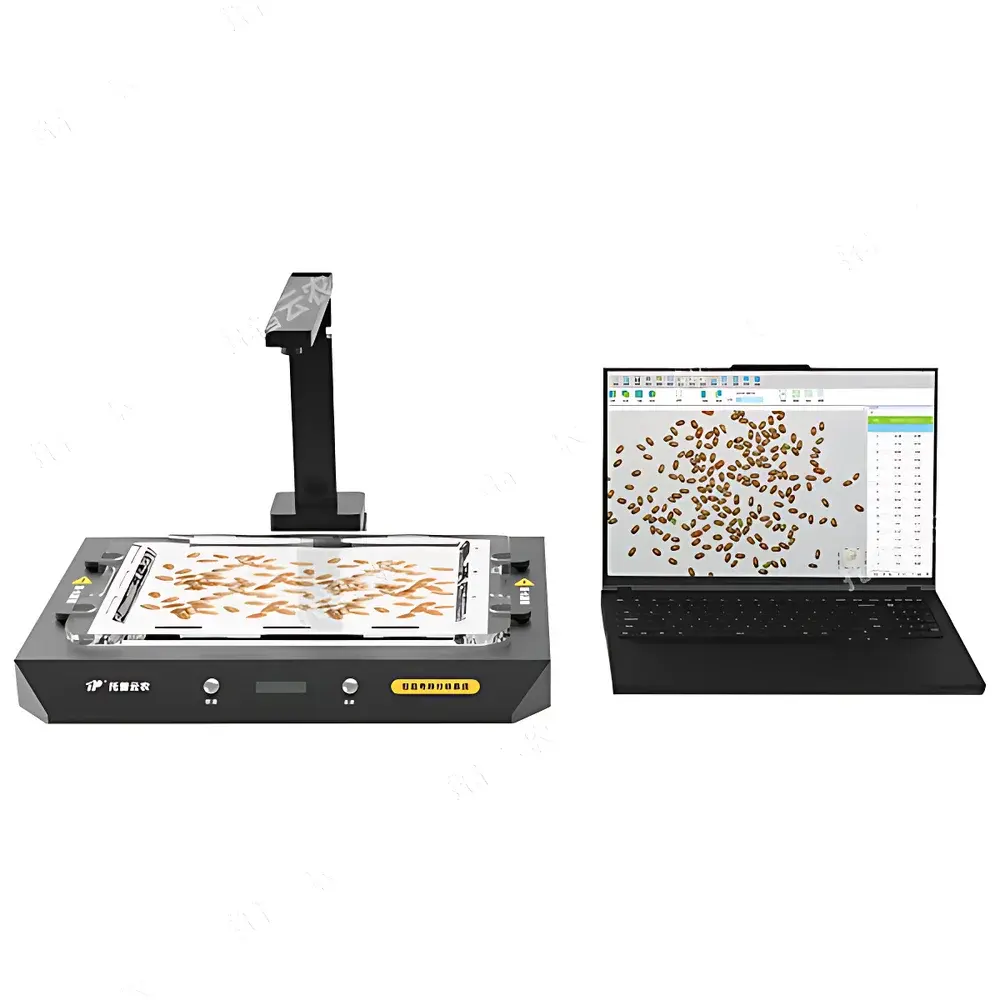
Top Cloud-agri TPKZ-3 Automated Seed Phenotyping & Thousand-Kernel Weight Analyzer
| Brand | Top Cloud-agri |
|---|---|
| Origin | Zhejiang, China |
| Manufacturer Type | Direct Manufacturer |
| Product Category | Domestic |
| Model | TPKZ-3 |
| Instrument Type | Benchtop |
| Sample Types | Rice, Wheat, Rapeseed, Soybean seeds |
| Counting Speed | 1,200–20,000 seeds/min |
| Counting Accuracy | ≤ ±0.5% |
| Thousand-Kernel Weight Accuracy | ≤ ±0.5% |
| Weighing Range | 0–5 kg |
| Imaging Resolution | 4896 × 3672 (22 MP) |
| Backlight Source | Uniform LED panel with auto-calibration tray |
| Display | 2.1-inch OLED weight display |
| Data Export | Excel, thermal print, cloud upload |
| Software Security | Dynamic QR-code + hardware dongle encryption |
Overview
The Top Cloud-agri TPKZ-3 Automated Seed Phenotyping & Thousand-Kernel Weight Analyzer is a benchtop digital imaging and gravimetric system engineered for high-throughput, non-destructive quantitative analysis of seed morphological and mass-related traits. It integrates machine vision—based on high-resolution top-down imaging under controlled backlight illumination—with precision weighing to simultaneously acquire both geometric and mass parameters from bulk seed samples. The system operates on the principle of binary segmentation and contour-based feature extraction, supported by adaptive thresholding and sub-pixel edge detection algorithms. Designed specifically for agricultural research laboratories, breeding programs, and seed quality control facilities, the TPKZ-3 delivers standardized, repeatable measurements compliant with ISO 5725 (accuracy and precision of measurement methods) and aligned with FAO/WHO guidelines for seed quality assessment. Its dual-mode operation—combining automated image acquisition with real-time mass feedback—enables direct calculation of thousand-kernel weight (TKW), hundred-kernel weight (HKW), and per-seed dimensional metrics without manual intervention or post-processing calibration.
Key Features
- 22-megapixel A3-format imaging module (4896 × 3672 resolution) with uniform ultra-thin LED backlight panel and auto-calibrating transparent seed tray—eliminating shadow artifacts and ensuring consistent contrast for accurate segmentation.
- Integrated weighing module (0–5 kg range) co-located beneath the imaging stage; weight data transmitted in real time via RS232/USB interface and automatically synchronized with image-derived count and morphology data.
- 2.1-inch OLED display embedded in the weighing platform provides immediate visual feedback during sample loading—supporting dynamic adjustment of seed quantity to meet target count or mass thresholds.
- Interactive image viewer with zoom, pan, region-of-interest (ROI) selection, and bounding rectangle overlay—enabling verification of segmentation accuracy at the single-seed level.
- Deep learning–enabled classification engine trained on multi-species seed libraries (Oryza sativa, Triticum aestivum, Brassica napus, Glycine max); supports supervised retraining using user-provided labeled datasets for novel or varietal variants.
- Manual correction toolkit: mouse-driven split/merge functions for misclassified or fused seeds—ensuring traceable, auditable refinement to achieve 100% counting fidelity.
- Flexible counting modes: full-field enumeration, user-defined rectangular ROI counting, and batch-wise analysis across multiple trays or replicates.
- Dynamic software licensing secured via dual-layer protection: hardware dongle authentication combined with time-limited, device-bound QR code activation—preventing unauthorized redistribution or concurrent use.
Sample Compatibility & Compliance
The TPKZ-3 is validated for routine analysis of major cereal and oilseed crops including paddy rice, winter wheat, rapeseed (canola), and soybean. Its optical and mechanical design accommodates seeds ranging from 1.5 mm (e.g., mustard) to 12 mm (e.g., maize kernels), with optimized focus depth and illumination geometry to minimize parallax error. All measurement outputs—including TKW, HKW, mean length/width/area/perimeter/equivalent diameter/length-width ratio, color histogram distribution (L*a*b* space), and standard deviation—are computed in accordance with ASTM D6347/D6347M-20 (Standard Test Method for Determination of Kernel Weight of Cereal Grains) and ISO 6557-1:2021 (Cereals and pulses — Determination of thousand-kernel mass). System validation reports include repeatability (within-run CV ≤ 0.8%) and intermediate precision (between-day CV ≤ 1.2%) per ICH Q2(R2) principles. Data integrity is maintained through timestamped audit trails, user-level access control, and export logs—supporting GLP-compliant workflows and FDA 21 CFR Part 11 readiness when deployed with optional cloud synchronization.
Software & Data Management
The proprietary TPKZ Analysis Suite (v4.2+) runs on Windows 10/11 x64 platforms and features a modular architecture with three core components: Acquisition Engine, Morphometric Processor, and Reporting Module. Raw images are stored losslessly in TIFF format with embedded EXIF metadata (exposure, gain, lens profile, calibration ID). Processed results—including individual seed tables, statistical summaries, and color distribution charts—are exported natively to .xlsx with formula-locked cells to preserve computational integrity. Thermal printing support enables on-site generation of certified test reports using ESC/POS-compatible printers. Optional cloud integration (TopCloud-Agri SeedHub™) provides encrypted HTTPS-based upload, role-based folder permissions, version-controlled dataset history, and RESTful API access for LIMS interoperability. All software updates undergo regression testing against NIST-traceable reference standards and are distributed with SHA-256 checksums and GPG-signed release manifests.
Applications
- Quantitative trait locus (QTL) mapping studies requiring high-fidelity phenotypic anchors for grain size, shape, and density traits.
- Seed certification labs performing official variety purity and germination potential assessments per ISTA Rules.
- Breeding programs conducting early-generation selection for kernel uniformity, plumpness, or milling yield predictors.
- Post-harvest quality monitoring in grain elevators and processing facilities—tracking seasonal variation in TKW as an indicator of environmental stress or agronomic management efficacy.
- Academic research on seed dormancy, desiccation tolerance, and maternal effect inheritance—where precise mass-to-surface-area ratios serve as proxies for metabolic activity or water absorption kinetics.
- Regulatory submissions to national seed authorities (e.g., USDA APHIS, EU OECD Seed Schemes) requiring auditable, instrument-generated evidence of varietal distinctness and stability.
FAQ
What seed types are validated for use with the TPKZ-3?
Rice (paddy and milled), common wheat, durum wheat, rapeseed (Brassica napus and B. rapa), soybean, barley, oat, and maize kernels. Custom calibration protocols are available upon request for other species.
Does the system comply with international seed testing standards?
Yes—the TPKZ-3 implements measurement logic aligned with ISO 6557-1, ASTM D6347, and ISTA Handbook Chapter 5. Full validation documentation, including uncertainty budgets and inter-laboratory comparison reports, is provided with each unit.
Can raw image data be exported for third-party analysis?
Yes—TIFF files with embedded metadata and unprocessed pixel matrices are fully accessible. The software also exports CSV files containing all extracted morphometric features per seed, suitable for R, Python, or MATLAB-based statistical modeling.
Is remote software maintenance supported?
Yes—licensed users receive secure remote diagnostics and over-the-air updates via the TopCloud-Agri Support Portal. On-site service contracts include annual performance verification against NIST-traceable mass and dimension standards.
How is data security enforced during cloud synchronization?
All data transmissions use TLS 1.3 encryption; stored objects are AES-256 encrypted at rest. User accounts enforce MFA, and administrative actions generate immutable audit logs retained for ≥7 years per GDPR and CCPA requirements.




