
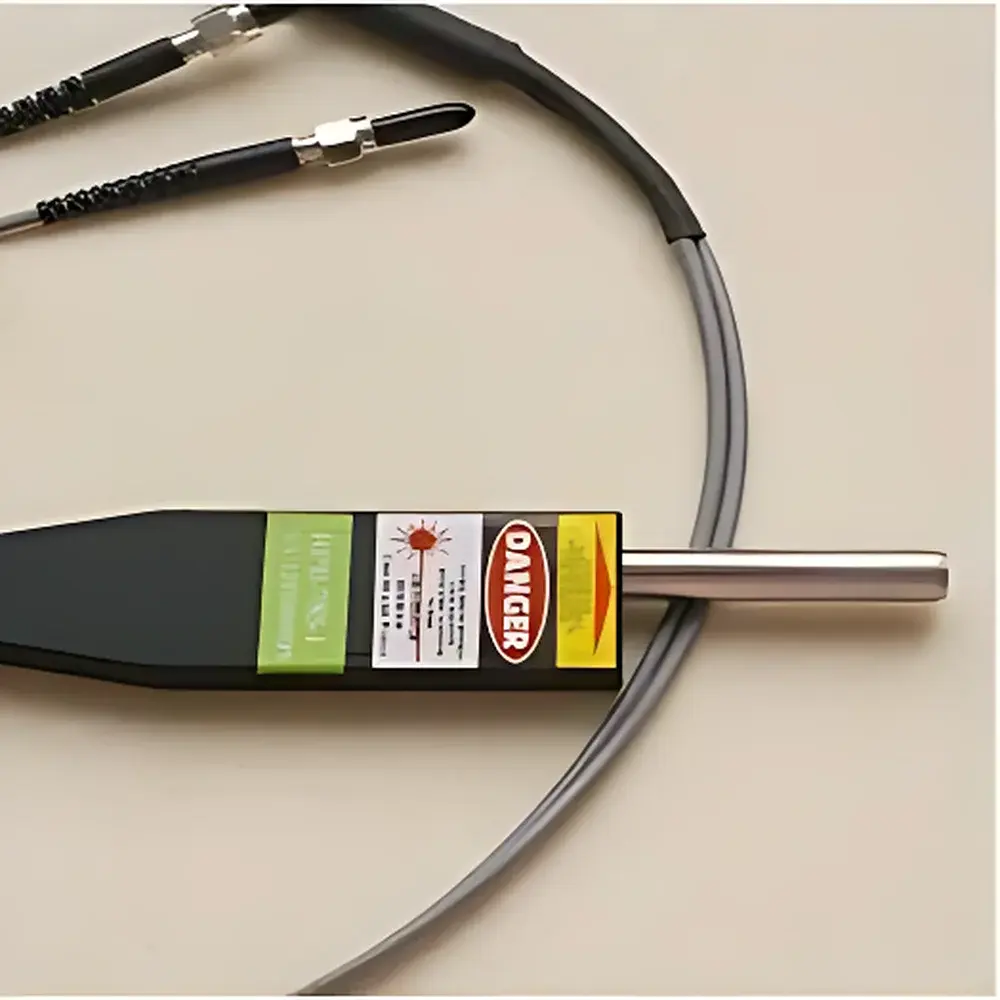
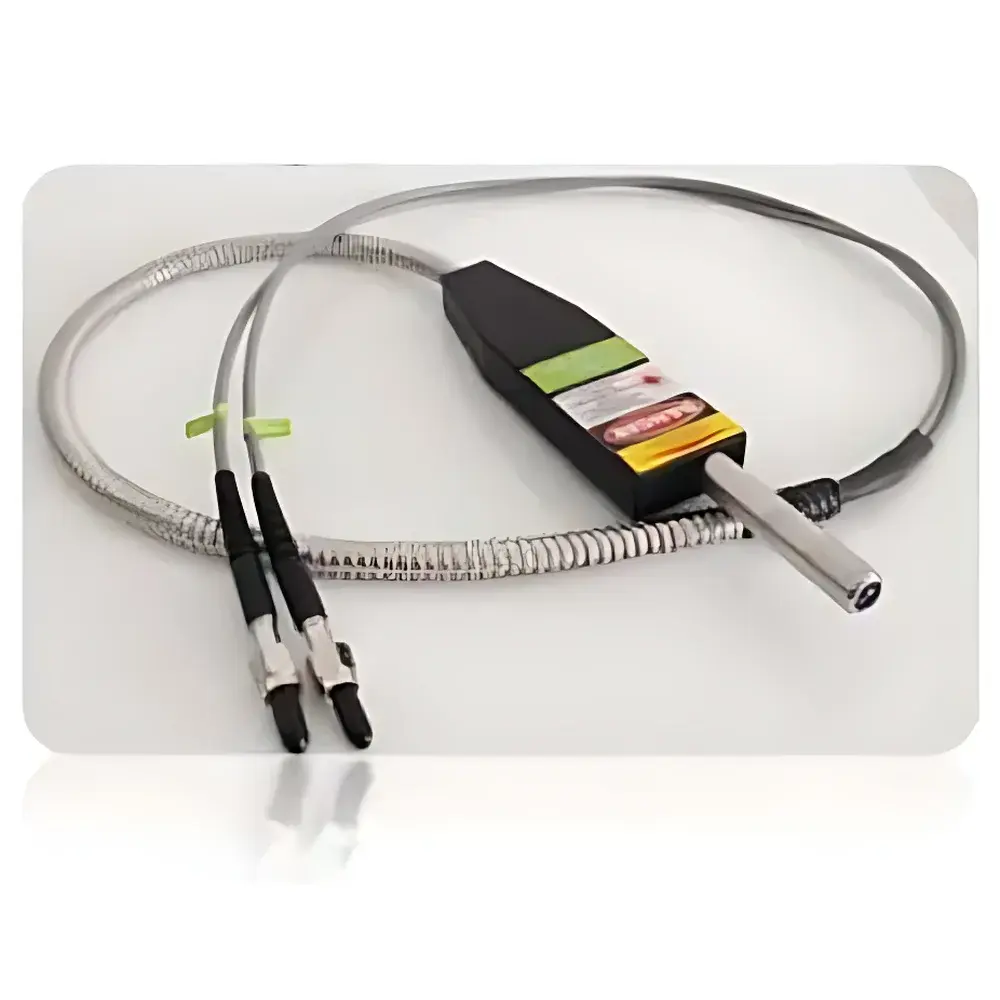
SPL RPB-785 Compact Fiber-Coupled Raman Probe
| Brand | SPL Photonics |
|---|---|
| Origin | Shanghai, China |
| Model | SPL-RPB-785 |
| Spectral Range | 795–1125 nm |
| Excitation Wavelength | 785 nm (FWHM < 0.2 nm) |
| Raman Shift Range | 220–4000 cm⁻¹ |
| Probe Dimensions | 120 × 38 × 18 mm |
| Fiber Configuration | Dual-fiber, 100 µm excitation / 200 µm collection (NA = 0.22, PVC jacketed) |
| Laser Rejection | OD > 6 @ 785 nm |
| Focal Length | 7.5 mm (standard) |
| Operating Temperature | 0–40 °C |
| Connector | SMA 905 |
Overview
The SPL RPB-785 is a compact, fiber-coupled Raman probe engineered for high-fidelity spectral acquisition in laboratory and field-deployable Raman spectroscopy systems. It operates on the principle of inelastic light scattering—where monochromatic 785 nm laser radiation interacts with molecular vibrational modes, generating Stokes-shifted photons that encode chemical fingerprint information. The probe’s optical architecture is fully rigidized and alignment-free, eliminating thermal drift and mechanical misalignment during extended measurements. Its 795–1125 nm detection range corresponds to Raman shifts from 220 cm⁻¹ to 4000 cm⁻¹ when paired with a 785 nm excitation source—covering fundamental vibrational bands of organic molecules, carbon allotropes (e.g., graphene G and 2D peaks), pharmaceutical polymorphs, and inorganic lattice modes. Designed for seamless integration with modular fiber-optic spectrometers and CW diode lasers, the RPB-785 enables quantitative, repeatable point-sampling of solids, liquids, gels, and powders without sample preparation.
Key Features
- Fully monolithic optical design ensures long-term stability and measurement reproducibility (RSD < 1.5% over 8-hour continuous operation)
- Optimized edge-filtering optics provide >6 orders of magnitude rejection at 785 nm, minimizing Rayleigh leakage and enabling low-noise detection of weak Raman signals
- Compact aluminum housing (120 × 38 × 18 mm), black-anodized and matte-finished for reduced stray light and EMI shielding
- Dual-fiber configuration: 100 µm core excitation fiber (NA 0.22) and 200 µm core collection fiber (NA 0.22), both permanently aligned and strain-relieved
- Standard 7.5 mm working distance objective optimized for 12.5 mm pathlength cuvettes and flat solid surfaces; optional focusing attachments available for micro-spot (<50 µm) or standoff (up to 100 mm) configurations
- SMA 905 interface compatible with industry-standard spectrometers and laser sources; no active electronics or power supply required
Sample Compatibility & Compliance
The SPL RPB-785 supports non-destructive, contact or near-contact sampling across diverse material classes—including crystalline and amorphous solids, aqueous and organic solvents, polymer films, biological tissues, and heterogeneous composites. Its robust mechanical design meets IEC 61326-1 requirements for electromagnetic compatibility in laboratory environments. While the probe itself is not an analytical instrument per se, its optical performance is validated against ASTM E1840-22 (Standard Guide for Raman Shift Standards) and ISO/IEC 17025:2017 traceability frameworks when used within calibrated Raman systems. For regulated environments (e.g., pharmaceutical QC labs), the probe’s passive, non-electronic construction simplifies qualification under FDA 21 CFR Part 11 and EU Annex 11 when integrated into validated software-controlled platforms such as Analyze IQ Lab.
Software & Data Management
The RPB-785 is protocol-agnostic and functions transparently with third-party spectral acquisition software (e.g., OceanView, SpectraSuite, or custom LabVIEW/Python drivers). When deployed with SPL’s recommended Analyze IQ Lab platform, users gain access to chemometric tools including PLS regression, PCA-based clustering, and proprietary spectral deconvolution algorithms optimized for overlapping Raman bands. Analyze IQ Lab supports audit-trail logging, user-access controls, and electronic signature functionality compliant with GLP/GMP documentation standards. All raw spectra are stored in vendor-neutral formats (e.g., .spc, .jdx, .csv), facilitating interoperability with LIMS and enterprise data repositories.
Applications
- Graphene and 2D material characterization: precise identification of layer count, strain, doping, and defect density via G/2D peak intensity ratios and linewidth analysis
- Pharmaceutical solid-state analysis: polymorph screening, API-excipient interaction mapping, and counterfeit drug detection
- Chemical process monitoring: real-time tracking of reaction intermediates and endpoint determination in batch or flow reactors
- Forensic material identification: rapid classification of dyes, explosives, narcotics, and pigments without extraction
- Academic research in catalysis, battery materials, and soft matter physics where spatially resolved vibrational contrast is critical
FAQ
Is the SPL RPB-785 compatible with non-SPL spectrometers?
Yes—it uses standard SMA 905 connectors and requires no proprietary firmware or drivers.
Can the probe be used for fluorescence-suppressed measurements?
The 785 nm excitation wavelength inherently minimizes fluorescence interference in most organic and biological samples; additional notch or edge filters may be added upstream if needed.
What is the typical signal-to-noise ratio (SNR) achievable with this probe?
SNR depends on laser power, integration time, and sample properties; with a 500 mW 785 nm laser and 10 s integration on ethanol, SNR > 120:1 (at 880 cm⁻¹) is routinely observed using a back-illuminated CCD spectrometer.
Does the probe support polarization-resolved Raman measurements?
No—the current design uses unpolarized excitation and collection; polarization-selective variants require custom optical train integration.
Is OEM customization available?
Yes—SPL Photonics offers mechanical rehousing, fiber length adjustment, custom focal lengths, and OEM labeling under NDA and volume agreements.



