
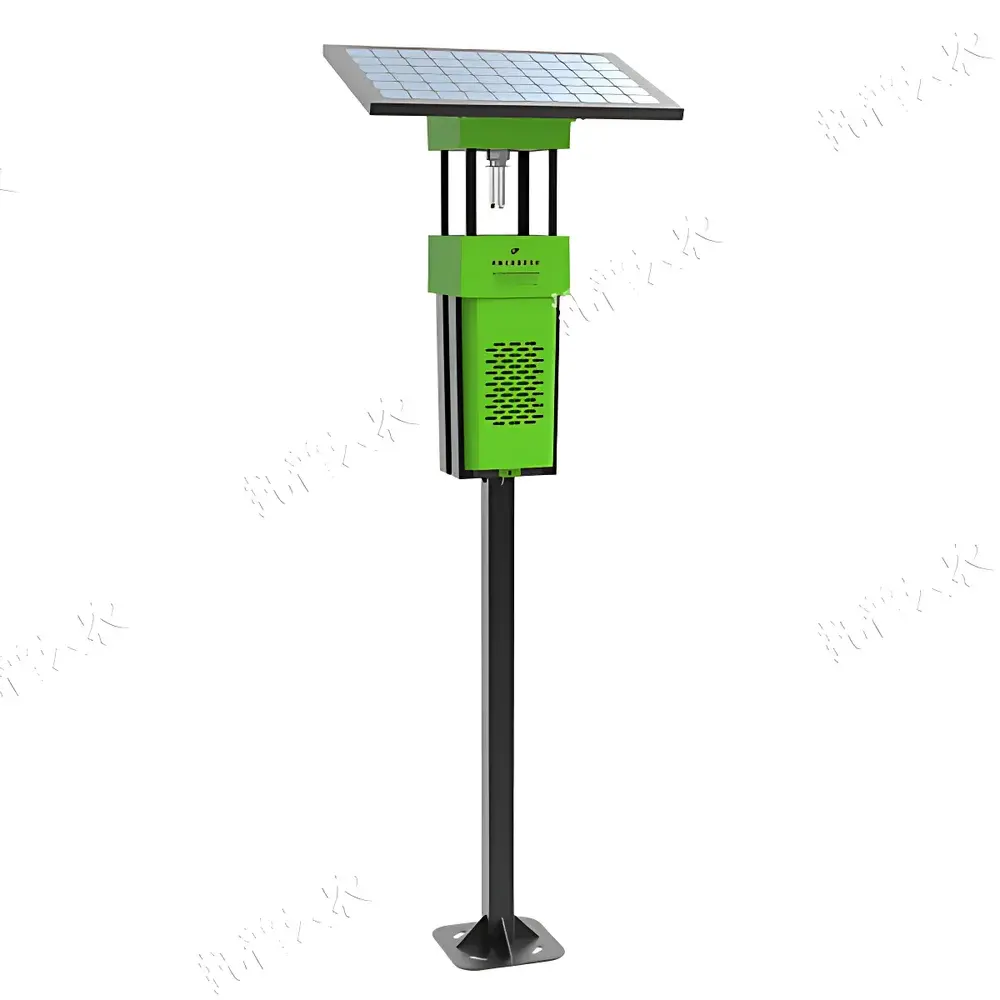
Top Cloud-agri TPSC-8Z Solar-Powered Wind-Suction Insect Trap with IoT Connectivity
| Brand | Top Cloud-agri |
|---|---|
| Origin | Zhejiang, China |
| Manufacturer Type | Direct Manufacturer |
| Regional Category | Domestic (China) |
| Model | TPSC-8Z |
| Instrument Type | Pest Monitoring and Trapping Device |
| Power Supply | DC 12 V |
| Total Power Consumption | <20 W |
| Solar Panel Capacity | 40 W |
| UV LED Emission Wavelength | 385–420 nm |
| UV LED Power | 10 W |
| LED Lifespan | 5,000 h |
| Fan Power | 7 W / 12 V |
| Fan Speed | 2,200 rpm |
| Fan IP Rating | IP68 |
| Fan Lifespan | 20,000 h |
| Effective Control Radius | ≥120 m (open farmland), ≥80 m (forest/woodland) |
| Coverage per Unit | 15–20 mu (≈1–1.33 ha) |
Overview
The Top Cloud-agri TPSC-8Z Solar-Powered Wind-Suction Insect Trap is an intelligent, solar-driven pest monitoring and physical control instrument engineered for precision entomological surveillance in agricultural ecosystems. Unlike conventional phototactic traps relying solely on electrocution or sticky boards, the TPSC-8Z integrates narrow-band ultraviolet (UV-A) LED illumination (385–420 nm) with a high-efficiency axial fan system to actively draw flying adult insects into a secure collection chamber. This wind-suction mechanism ensures reliable capture across a broad size spectrum—from small Diptera and Thysanoptera to larger Lepidoptera and Coleoptera—while minimizing non-target mortality, particularly of beneficial arthropods such as parasitoid wasps and pollinators. Designed for unattended, long-term deployment in orchards, paddy fields, tea plantations, cotton fields, and forested margins, the device operates autonomously using integrated solar energy harvesting and supports remote telemetry via NB-IoT or GSM-based cellular connectivity. Its operational logic adheres to established principles of behavioral ecology and integrated pest management (IPM), aligning with FAO-recommended practices for low-risk, residue-free crop protection.
Key Features
- Solar-powered architecture with 40 W monocrystalline panel and deep-cycle lithium battery backup, enabling continuous operation through extended overcast periods.
- Narrow-spectrum UV-A LED source optimized for peak insect phototaxis while reducing spectral spill into visible bands that attract non-target species.
- IP68-rated brushless DC fan (2,200 rpm, 7 W) generating laminar airflow to entrain insects within a defined capture radius—≥120 m in open agronomic settings and ≥80 m in semi-shaded forest edges.
- Triple-mode operational scheduling: light-controlled (auto on/off based on ambient lux), time-controlled (customizable daily ON/OFF windows), and low-power communication-only sleep mode.
- Real-time telemetry including GPS geolocation, SIM card status (ICCID, remaining data volume, expiry date), battery voltage, signal strength (RSRP/SINR), trap activation count, and fan/LED health diagnostics.
- Web-based dashboard and native iOS/Android application supporting multi-device fleet management under a single authenticated account.
Sample Compatibility & Compliance
The TPSC-8Z is validated for use in regulated agricultural environments where physical pest monitoring must coexist with Good Agricultural Practice (GAP) and organic certification requirements (e.g., USDA NOP, EU Regulation (EC) No 834/2007). It contains no chemical agents, emits no hazardous byproducts, and leaves no residues—making it suitable for deployment during flowering, fruit set, and harvest windows. Data logs—including timestamped trap events, environmental metadata, and firmware version history—are stored locally and synchronized to secure cloud infrastructure with configurable retention policies. While not a diagnostic laboratory instrument per se, its output supports quantitative pest population trend analysis aligned with ISO 22000 traceability frameworks and national phytosanitary reporting standards (e.g., China’s GB/T 24689.2–2009 for plant protection equipment).
Software & Data Management
The embedded firmware implements MQTT-based publish-subscribe communication over LTE-M/NB-IoT networks, ensuring low-bandwidth, high-reliability transmission of structured JSON payloads. The cloud platform provides GIS-integrated visualization: users navigate interactive maps to select individual units, inspect real-time status overlays, export CSV-formatted trap event histories, and configure alert thresholds (e.g., low battery, signal loss, zero activity over 72 h). All user actions—including remote reboot, mode switching, and parameter updates—are logged with ISO/IEC 27001-aligned audit trails. Role-based access control (RBAC) supports hierarchical permissions for farm managers, agronomists, and regulatory auditors. Data exports comply with FAOSTAT-compatible schemas for cross-platform integration with farm management software (FMS) and national pest surveillance databases.
Applications
- Dynamic pest pressure mapping in tea gardens: Enables species-specific abundance tracking of Empoasca onukii (tea green leafhopper) and Adoxophyes honmai (oriental tea tortrix) across elevation gradients.
- Early-warning deployment in rice paddies: Monitors seasonal emergence of Cnaphalocrocis medinalis (rice leafroller) and Scirpophaga incertulas (yellow stem borer) to inform targeted biological intervention timing.
- Forest-edge pest surveillance: Detects invasive species incursions—including Lymantria dispar (gypsy moth) and Thaumetopoea pityocampa (pine processionary moth)—in buffer zones adjacent to commercial timber stands.
- Organic orchard IPM validation: Generates defensible evidence of pest population suppression without synthetic insecticides, satisfying third-party certification audits.
- Research-grade phenology studies: Supports longitudinal analysis of adult flight periods correlated with degree-day accumulation models for climate-resilient pest forecasting.
FAQ
What communication protocols does the TPSC-8Z support?
It uses NB-IoT or GSM/GPRS (dual-mode fallback) with MQTT v3.1.1 over TLS 1.2 for encrypted data transport. LoRaWAN and Sigfox variants are not supported.
Can the device operate during prolonged rainfall?
Yes—the entire housing meets IP66 ingress protection, and the fan motor carries IP68 certification, ensuring uninterrupted function in heavy rain and high-humidity conditions.
Is historical trap data exportable for statistical analysis?
Yes—CSV and Excel-compatible exports include timestamps, GPS coordinates, cumulative kill counts, battery voltage, and signal quality metrics, all aligned to UTC+0 timezone for cross-regional correlation.
Does the system support integration with existing farm management platforms?
API documentation (RESTful endpoints with OAuth 2.0 authentication) is available under NDA for certified FMS partners; direct SCADA-level Modbus integration is not implemented.
How frequently is firmware updated, and what is the update mechanism?
Over-the-air (OTA) updates are issued quarterly for security patches and feature enhancements, delivered via signed binary packages verified using ECDSA-256 signatures prior to installation.






