
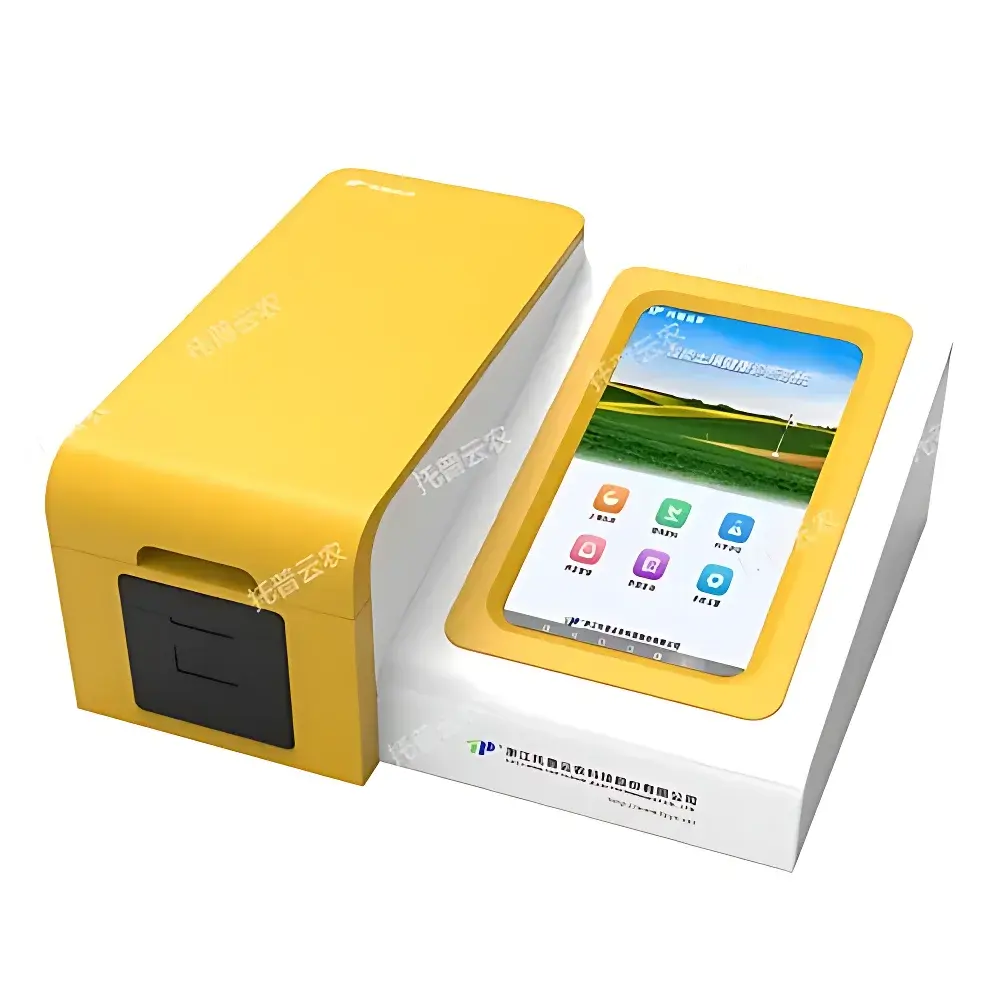
Top Cloud-agri TP-SNT-12A Soil Nutrient and Trace Element Analyzer
| Brand | Top Cloud-agri |
|---|---|
| Origin | Zhejiang, China |
| Manufacturer Type | Direct Manufacturer |
| Instrument Class | Laboratory-Based |
| Model | TP-SNT-12A |
| Detection Channels | 12 |
| Test Capabilities | Nitrogen (NH₄⁺-N, NO₃⁻-N, alkali-hydrolyzable N, total N), Phosphorus (available P, total P), Potassium (available K, total K), Organic Matter, Secondary & Trace Elements (S, Mn, Fe, Cu, Si, B, Zn, Mo), Heavy Metals (Pb, Cd, Cr, As, Al, Ti), Plant Tissue Nutrients, Fertilizer Composition (N-P-K, humic acid, micronutrients) |
| Optical Range | 0.000–4.000 A (Absorbance), Resolution: 0.001 A |
| Transmittance Accuracy | ±2.0% |
| Photocurrent Drift | ≤0.5% (3 min) |
| Display | 10" Capacitive Touchscreen (800×1280 IPS) |
| Storage | 8 GB Internal |
| Power | 220 V ±10%, 12 V/5 A, 20 W |
Overview
The Top Cloud-agri TP-SNT-12A Soil Nutrient and Trace Element Analyzer is a laboratory-grade, multi-channel spectrophotometric analyzer engineered for quantitative determination of macro-, secondary-, and trace-level elements in soil, plant tissue, fertilizer, and related agricultural matrices. It operates on the principle of visible and near-UV absorption spectroscopy—utilizing standardized colorimetric reactions to convert analyte concentration into measurable absorbance values (A) across calibrated wavelength pairs. Each of its 12 detection channels is grouped into six dual-wavelength configurations, minimizing inter-channel optical variance and enhancing measurement reproducibility. Designed for compliance with established agronomic testing protocols—including those aligned with ISO 11260 (soil phosphorus extraction), ISO 14253-1 (measurement uncertainty in agricultural analysis), and national Chinese standards for soil testing (NY/T 1121 series)—the instrument supports full method traceability from sample preparation through result generation.
Key Features
- 12-Channel Dual-Wavelength Architecture: Six independent optical channel pairs enable simultaneous dual-sample analysis per group, reducing batch-to-batch wavelength drift and improving inter-assay precision.
- Integrated 10-Inch Capacitive Touchscreen: High-resolution (800×1280) IPS display with intuitive graphical interface for real-time calibration, method selection, data review, and report generation—no external PC required for routine operation.
- Comprehensive Reagent Kit Support: Pre-formulated, quality-controlled reagents cover all standard assays—including ammonium, nitrate, Olsen-P, ammonium acetate–extractable K, DTPA-extractable Zn/Cu/Mn/Fe, Mehlich-3–based heavy metal extraction, and organic matter oxidation—eliminating manual blank and standard solution preparation.
- Onboard Data Management: Stores up to 10,000 test records locally; supports direct USB export to Excel (.xlsx) format and wireless transmission via built-in Wi-Fi to the Top Cloud-agri AgriData Cloud Platform.
- Cloud-Enabled Decision Support: Integrated agronomic database includes >100 crop-specific nutrient requirement models. Inputting crop type, target yield, soil test results, and fertilizer composition triggers algorithmic recommendation of balanced application rates per nutrient—aligned with regional soil fertility guidelines.
- Georeferenced Sampling Integration: Optional GPS-enabled field sampling terminal synchronizes spatial metadata (latitude/longitude, timestamp, elevation) with lab results, enabling GIS-compatible mapping of nutrient distribution across fields or experimental plots.
Sample Compatibility & Compliance
The TP-SNT-12A accepts homogenized, filtered, or digested extracts from air-dried soil (0.15 mm sieve), dried plant tissue (ground to ≤0.5 mm), liquid fertilizers, and compost leachates. Sample introduction is performed via standard 10-mm pathlength cuvettes compatible with ISO 7027-compliant photometry. The system adheres to GLP-aligned operational practices: each assay sequence logs operator ID, calibration date, standard curve R² value, and instrument self-diagnostic status. Audit trails are preserved in cloud-stored reports, supporting regulatory readiness for internal QA reviews or third-party verification under ISO/IEC 17025 frameworks. While not FDA 21 CFR Part 11-certified out-of-the-box, audit log export functionality enables integration into validated laboratory information management systems (LIMS) meeting GxP documentation requirements.
Software & Data Management
Firmware v3.2+ includes embedded AgriData Suite software, offering three-tiered data handling: (1) Real-time spectral visualization during assay kinetics; (2) Automated calibration curve fitting using linear, quadratic, or logarithmic regression models with residual error reporting; (3) Structured export templates compliant with FAO’s Soil Health Index metadata schema. Cloud platform access provides role-based permissions (analyst, supervisor, agronomist), customizable dashboard views (nutrient heatmaps, temporal trend charts), and API endpoints for integration with farm management software (e.g., Climate FieldView™, Granular). All uploaded datasets retain immutable timestamps and digital signatures, ensuring data integrity across the analytical lifecycle.
Applications
- Quantitative assessment of extractable NPK, organic carbon, and cation exchange capacity (CEC)-associated micronutrients in routine soil fertility surveys.
- Validation of fertilizer formulation consistency—particularly for chelated micronutrient blends and slow-release nitrogen products.
- Monitoring phytoavailability shifts in long-term field trials evaluating liming, biochar amendment, or cover cropping effects on micronutrient mobility.
- Supporting precision agriculture programs by generating geo-referenced nutrient deficiency maps used to guide variable-rate application (VRA) prescriptions.
- Academic and extension service laboratories conducting method validation studies against ICP-OES or AAS reference methods (per AOAC 985.21 or EPA Method 6010D).
FAQ
What extraction methods are recommended for trace element analysis?
Standard protocols include DTPA for Zn, Cu, Mn, and Fe; Mehlich-3 for Cd, Pb, and available P/K; and aqua regia digestion for total elemental screening. Extraction procedures must follow ISO 11466 or EPA 3050B for regulatory comparability.
Can the instrument be used for water or sediment analysis?
Yes—when paired with appropriate filtration (0.45 µm membrane) and dilution protocols, it supports analysis of irrigation water, runoff samples, and sediment porewater for nutrients and heavy metals, provided matrix interference is corrected via standard addition.
Is method validation documentation included?
The instrument ships with a comprehensive technical manual containing linearity ranges, LOD/LOQ estimates per analyte, intra-day and inter-day precision data (CV ≤3.2%), and cross-reactivity assessments for common interferents (e.g., chloride, iron oxides, humic substances).
How is calibration maintained across extended use?
Built-in auto-zero and dark-current compensation routines execute at startup and every 30 minutes during active use. NIST-traceable neutral density filters and certified reference materials (CRMs) such as SRM 2710a (Montana Soil) are recommended for quarterly performance verification.
Does the cloud platform support multi-user collaboration?
Yes—administrators can assign hierarchical roles (data entry, review, approval, export), define custom workflow stages, and configure automated email alerts for outlier results or calibration expiry notifications.







