
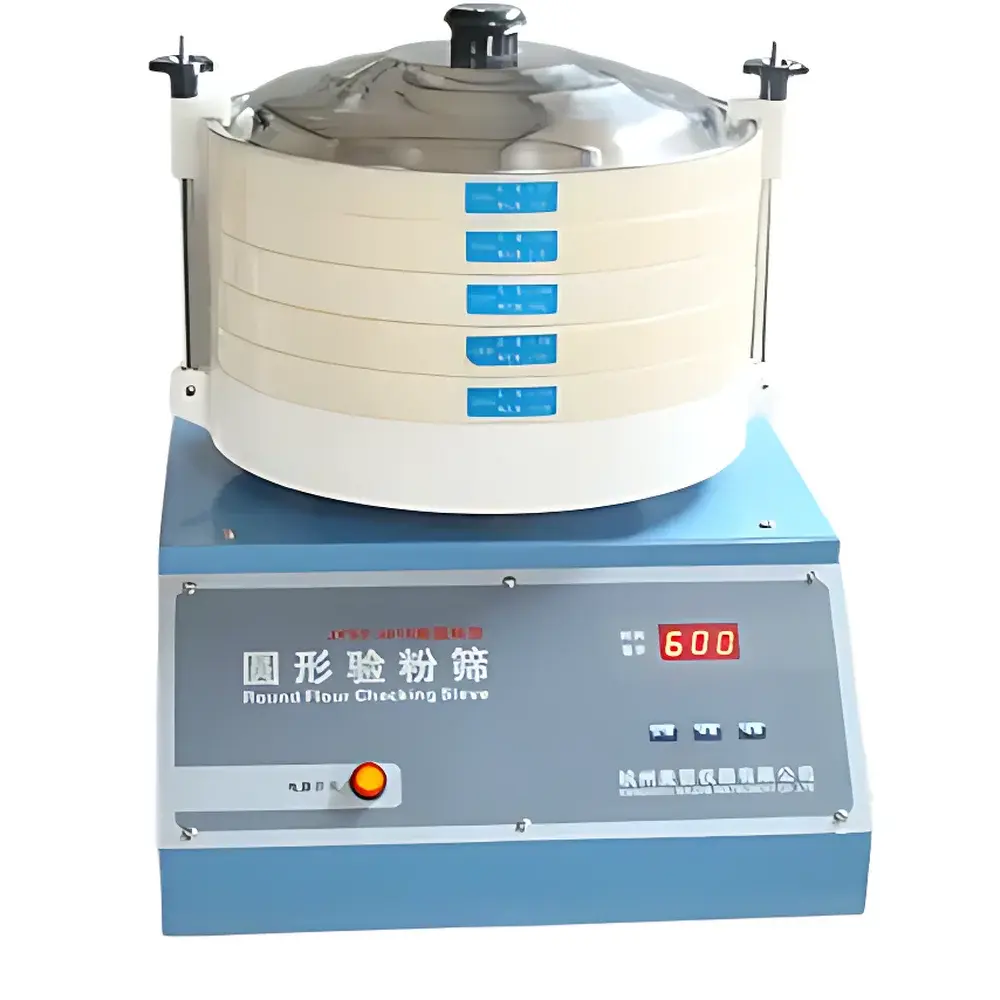
Top Cloud-agri JYSY30×8 Circular Flour Sieve
| Brand | Top Cloud-agri |
|---|---|
| Origin | Zhejiang, China |
| Manufacturer Type | Direct Manufacturer |
| Country of Origin | China |
| Model | JYSY30×8 |
| Price | USD 920 (FOB) |
Overview
The Top Cloud-agri JYSY30×8 Circular Flour Sieve is a precision mechanical sieving instrument engineered for standardized particle size distribution analysis of milled cereal products—primarily wheat flour, rice flour, cornmeal, and other grain-based powders. It operates on the principle of horizontal circular motion driven by an eccentric mechanism coupled with gear-reduced motor transmission, enabling controlled, reproducible sieve agitation in accordance with the deterministic kinematics required by GB/T 5507–2008, the People’s Republic of China National Standard for “Grain and Oil Inspection—Determination of Coarseness and Fineness of Flour.” Unlike vibratory or sonic sieving methods, this device implements a low-amplitude, high-stability orbital motion that minimizes particle aggregation and stratification effects, ensuring consistent mass-based fractionation across nested standard sieve stacks (typically ISO 3310-1 or GB/T 6003.1 compliant test sieves). Its design targets routine quality control in agricultural commodity laboratories where regulatory compliance, inter-laboratory reproducibility, and traceable methodology are mandatory—not optional.
Key Features
- Compliant mechanical architecture: Fully satisfies all dimensional, motion, and timing requirements specified in GB/T 5507–2008—including rotational frequency tolerance (±2 rpm), amplitude control (≤3 mm), and operational stability under full sieve load.
- Integrated microcontroller-based timer: Offers programmable run duration (1–99 minutes, 1-minute increments), real-time elapsed time display, emergency stop functionality, and automatic reset upon cycle completion—ensuring strict adherence to standardized test durations without operator dependency.
- Robust mechanical drive system: Features a sealed gear-reduction motor with thermal overload protection, delivering consistent torque output over extended operational cycles; eliminates belt slippage or speed drift common in friction-driven alternatives.
- Two-point clamping mechanism: Secures sieve frames firmly onto the rotating tray via dual spring-loaded locking hooks, preventing lateral displacement during operation and maintaining coaxial alignment critical for uniform particle exposure across the sieve surface.
- Balanced dynamic assembly: Incorporates counterweighted eccentric shaft and precision-machined base plate to suppress vibration transmission, achieving ≤0.15 mm/s RMS vibration at operating frequency—essential for stable placement on shared lab benches and compatibility with adjacent sensitive instrumentation.
Sample Compatibility & Compliance
The JYSY30×8 is validated for dry, free-flowing, non-cohesive granular materials with particle diameters ranging from 45 µm to 2,000 µm (325 mesh to 10 mesh per ISO 3310-1). It accommodates up to eight stacked sieves (Ø300 mm × 8 layers), supporting sequential fractionation protocols required for coarse/fine ratio determination in flour grading. All mechanical performance parameters—including rotational consistency, timer accuracy (±0.5% deviation over 10-min interval), and frame retention force (>120 N)—are verified against GB/T 5507–2008 Annex A verification procedures. The instrument meets general laboratory equipment requirements under ISO/IEC 17025:2017 for method validation, and its documented operational parameters support GLP-compliant recordkeeping when paired with external logbooks or LIMS-integrated data capture.
Software & Data Management
As a standalone electromechanical instrument, the JYSY30×8 does not incorporate embedded software or network connectivity. However, its timer interface provides unambiguous digital readout and repeatable start/stop logic, enabling direct integration into paper-based or electronic QC workflows. Users may document test parameters (sieve sequence, sample mass, run time, ambient temperature/humidity) manually or via LIMS-compatible templates. For audit readiness, laboratories are advised to retain calibration records for the timer module (traceable to national time standards) and annual mechanical verification reports (vibration amplitude, rotational speed, clamp retention force), aligning with FDA 21 CFR Part 11 principles for manual data entry systems.
Applications
- Routine flour coarseness testing in national grain inspection stations and provincial commodity quality supervision institutes.
- In-process quality monitoring at milling facilities for real-time adjustment of grinding parameters based on standardized fineness profiles.
- Seed processing labs performing purity and uniformity assessments of milled feedstock prior to pelleting or extrusion.
- Academic research on cereal endosperm fragmentation behavior under mechanical stress—used as a reference sieving platform in comparative studies with air-jet or laser diffraction methods.
- Regulatory verification of labeled flour specifications (e.g., “Type 405” or “All-Purpose”) in conformity with GB 1355–2021 and international trade documentation requirements.
FAQ
What sieve standards are compatible with the JYSY30×8?
ISO 3310-1, GB/T 6003.1, and ASTM E11 test sieves with nominal aperture sizes from 10 µm to 2 mm and Ø300 mm diameter are mechanically and dimensionally compatible.
Is the instrument suitable for wet sieving or abrasive samples?
No—it is designed exclusively for dry, non-corrosive, non-abrasive food-grade powders; use of moisture or mineral particulates voids warranty and compromises timing accuracy and mechanical longevity.
Does it meet international standards such as ISO 565 or ASTM C136?
While optimized for GB/T 5507–2008, its motion profile and dimensional tolerances fall within the broader scope of ISO 565:2022 for mechanical sieving apparatus, though formal conformance certification requires third-party verification per ISO/IEC 17025.
Can multiple operators share calibration settings?
Yes—the timer retains its last programmed value across power cycles, and mechanical calibration (e.g., rotational speed verification) is invariant; however, each user must log their individual test parameters per GLP practice.
What maintenance intervals are recommended?
Gear oil replacement every 12 months or 1,000 operating hours; visual inspection of clutch engagement and clamp hook spring tension before each daily use; annual metrological verification of timer accuracy and rotational speed using calibrated tachometer and stopwatch.



