
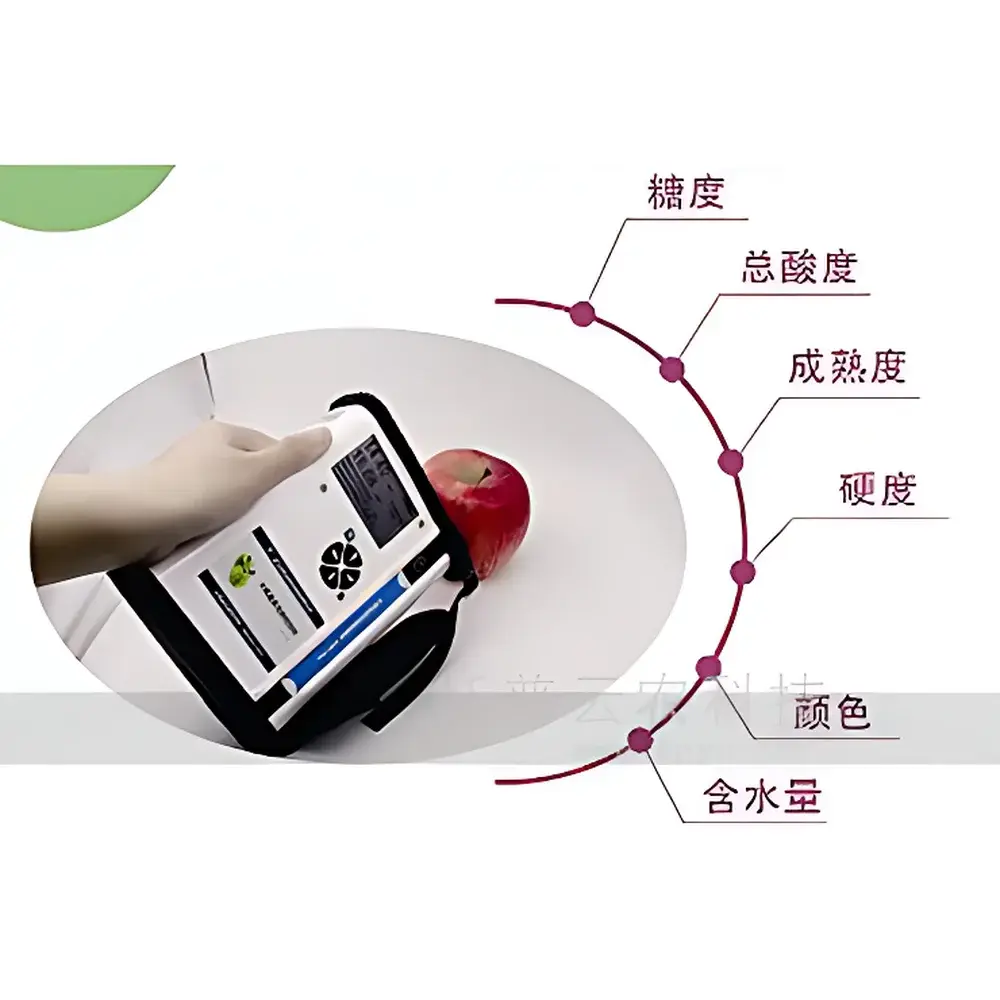
Top Cloud-agri TPF-750 Non-Destructive Fruit Sugar Analyzer
| Brand | Top Cloud-agri |
|---|---|
| Origin | Zhejiang, China |
| Manufacturer Type | Direct Manufacturer |
| Country of Origin | China |
| Model | TPF-750 |
| Price | USD 12,500 (FOB) |
| Measurement Principle | Near-Infrared (NIR) Reflectance Spectroscopy |
| Sample Contact | Non-contact surface probe |
| Measurement Time | ≤2 s per sample |
| Measurable Parameters | Soluble Solids Content (SSC/Brix), Dry Matter (DM), Internal Color (L*a*b*), External Color (L*a*b*), Titratable Acidity (TA) |
| Supported Fruits | >200 species (apple, pear, citrus, melon, peach, tomato, strawberry, mango, papaya, longan, etc. |
| Accuracy | ±0.1 °Brix for SSC |
| Operating Temperature | 10–30 °C |
| Weight | 1.5 kg |
| Power Supply | Removable rechargeable Li-ion battery |
| Max Power Consumption | 2.5 W |
| Data Storage | SD card (up to 32 GB) |
| Display | Backlit LCD screen |
| Connectivity | USB 2.0, Wi-Fi 802.11 b/g/n, SD card export |
| Built-in GPS | Yes |
| Compliance | CE-marked (EMC & LVD), ISO/IEC 17025-compatible calibration traceability |
Overview
The Top Cloud-agri TPF-750 Non-Destructive Fruit Sugar Analyzer is an industrial-grade handheld spectrometer engineered for rapid, in-situ quantification of key quality attributes in intact fruit. It operates on the principle of near-infrared (NIR) reflectance spectroscopy—illuminating the fruit surface with a calibrated NIR light source (700–1050 nm range) and analyzing spectral absorption patterns correlated with chemical composition via pre-established multivariate calibration models. Unlike destructive refractometry or titration methods, the TPF-750 requires no sample preparation: the probe is placed gently against the fruit epidermis, acquiring a full spectral scan in under two seconds. This enables real-time decision-making across harvest logistics, postharvest sorting, breeding trials, and quality assurance protocols—without compromising fruit integrity, shelf life, or market value.
Key Features
- True non-destructive measurement: No cutting, coring, or juice extraction required—preserves sample viability for downstream evaluation or commercial sale.
- Dual-color assessment: Simultaneous quantification of external skin color (CIE L*a*b*) and internal flesh color (via subsurface NIR penetration), supporting ripeness staging and varietal authenticity verification.
- Multi-parameter output: Delivers calibrated values for soluble solids content (°Brix), dry matter (% w/w), titratable acidity (g/L citric acid equivalent), and color metrics—all traceable to NIST-traceable reference standards.
- Field-deployable architecture: Ruggedized aluminum housing (IP54 rated), integrated GPS geotagging for spatial mapping of orchard-level quality gradients, and 8-hour battery runtime per charge.
- User-expandable calibration library: Supports development and validation of custom PLS or MLR models for novel cultivars using the included PC-based calibration software suite (compatible with ASTM E1655 and ISO 12099 workflows).
Sample Compatibility & Compliance
The TPF-750 is validated for direct measurement on over 200 fruit species—including pome fruits (apple, pear), drupes (peach, plum), citrus (orange, mandarin), berries (strawberry, blueberry), tropical fruits (mango, papaya), and vegetables with high water content (tomato, cucumber). Its optical design accommodates variable surface topography (waxy, fuzzy, or netted skins) through adaptive signal normalization. All factory calibrations are developed per ISO 21502:2020 (fruit quality spectroscopy) and aligned with USDA AMS Grade Standards. The instrument meets CE electromagnetic compatibility (EN 61326-1) and safety (EN 61010-1) directives. While not FDA 21 CFR Part 11 certified out-of-box, audit-ready data export (CSV + encrypted binary logs) and full operator audit trail support GLP/GMP-aligned deployment in regulated research and contract testing laboratories.
Software & Data Management
Bundled TPF-Analyzer Suite v3.2 provides full lifecycle management—from raw spectral acquisition and outlier detection to model training, cross-validation (using Venetian blinds or Monte Carlo sampling), and report generation compliant with ISO/IEC 17025 documentation requirements. Data synchronization occurs via Wi-Fi to cloud-hosted dashboards (AWS-hosted instance optional) or local network servers. All measurements are automatically timestamped, geotagged, and linked to user-defined batch IDs, orchard zones, and harvest dates. Export formats include CSV (for Excel/SPSS), XML (for LIMS integration), and PDF summary reports with embedded spectral plots and statistical confidence intervals (95% CI for Brix predictions).
Applications
- Pre-harvest maturity monitoring: Enables dynamic harvest scheduling by tracking spatial-temporal SSC and TA trends across orchards—reducing premature picking and optimizing sugar-acid balance.
- Postharvest grading & pricing: Integrates with automated packing lines for real-time fruit classification into premium, standard, and processing grades based on objective, instrument-derived quality thresholds.
- Cultivar development: Accelerates phenotyping in breeding programs by enabling high-throughput, non-lethal screening of progeny populations for sugar accumulation kinetics, dry matter inheritance, and color stability traits.
- Supply chain QA/QC: Verifies contractual quality specifications at receiving docks, cold storage facilities, and distribution centers—supporting claims-based payments and reducing disputes.
- Extension & advisory services: Provides extension agents with field-portable tools to demonstrate agronomic interventions (e.g., irrigation timing, foliar nutrition) on fruit quality outcomes.
FAQ
Does the TPF-750 require daily recalibration?
No. Factory calibrations remain stable for ≥6 months under normal field use. A quick performance verification check using supplied ceramic reference tiles is recommended before each daily session.
Can it measure through fruit bags or packaging films?
No. Direct, unobstructed contact between the probe window and clean fruit skin is required. Surface contaminants (dew, dust, wax residues) must be removed prior to measurement.
Is spectral data export supported for third-party chemometric analysis?
Yes. Raw interferograms and preprocessed absorbance spectra (ASC format) are exportable via USB or SD card for advanced modeling in MATLAB, Python (scikit-learn), or Unscrambler X.
What is the minimum fruit size compatible with the probe geometry?
Fruits with diameters ≥35 mm (e.g., small apples, large cherries, mature strawberries) yield reliable results. Smaller specimens may be measured using the optional micro-focus adapter (sold separately).
How is measurement repeatability ensured across operators?
The probe incorporates a spring-loaded pressure sensor that confirms consistent contact force (0.5–1.2 N) prior to spectral acquisition—eliminating inter-operator variability from manual pressure differences.





