
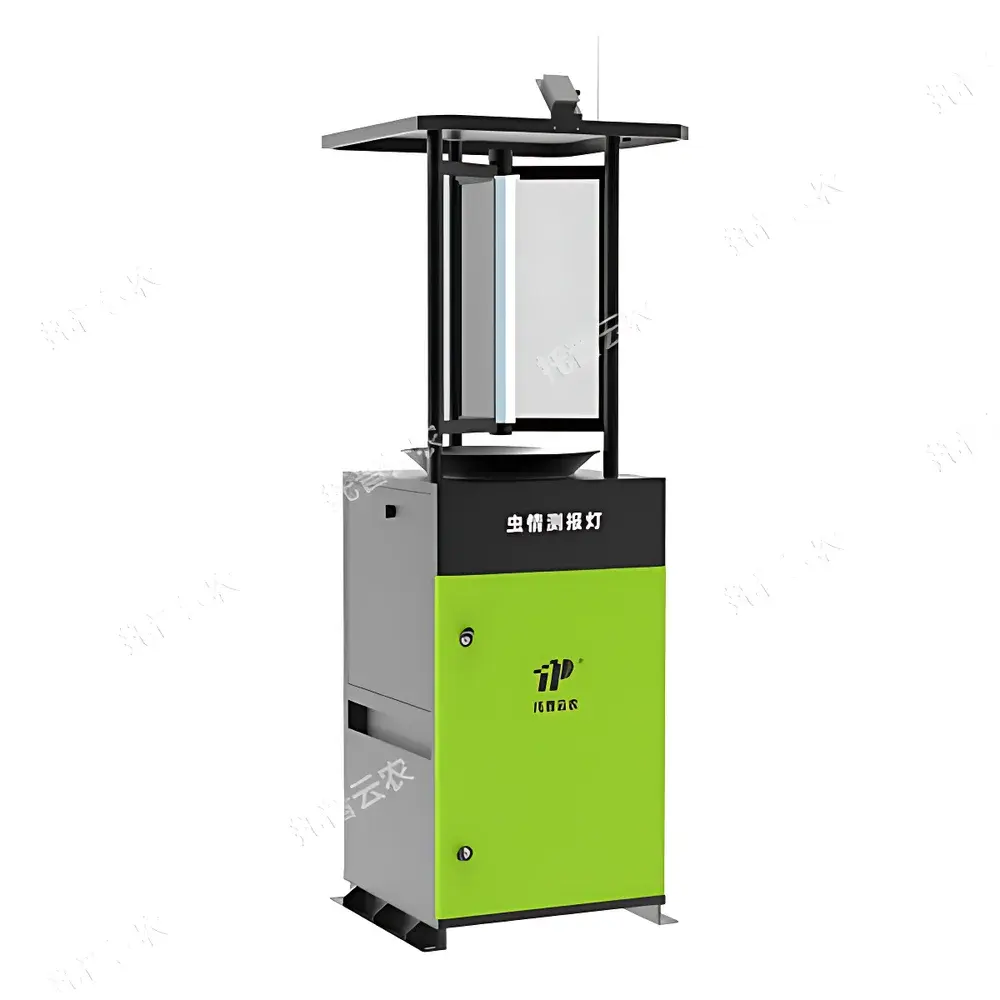
Top Cloud-agri TPCB-II-C4.0 Automatic Pest Monitoring and Identification Lamp
| Brand | Top Cloud-agri |
|---|---|
| Origin | Zhejiang, China |
| Manufacturer Type | Manufacturer |
| Country of Origin | Domestic (China) |
| Model | TPCB-II-C4.0 |
| Instrument Category | Pest Control Instrument |
| Power Supply | AC 220 V |
| UV Lamp | 20 W, peak wavelength 365 nm |
| Touchscreen | 7-inch capacitive LCD (Android 4.0 OS) |
| Insect Killing Method | Dual-layer far-infrared heating chamber (85 ± 5 °C, 1–60 min adjustable) |
| Mortality Rate | ≥98% |
| Specimen Integrity Rate | ≥95% |
| Time-segmented Collection | 8-position auto-rotating tray (1–24 programmable time slots) |
| Environmental Sensors Interface | Optional for temperature, humidity, wind speed/direction, light intensity, soil moisture |
| Communication | GPRS data transmission |
| Rain Control | Auto-drainage & rain detection logic |
| Voltage Stabilization Range | 160–280 V AC → stabilized 220 V output |
| Operating Temperature | 0–70 °C |
| Operating Humidity | ≤95% RH |
| Max Power Consumption | ≤210 W |
| Enclosure Material | Stainless steel per GB/T 4237 |
| Lightning Protection | Integrated surge protection module |
| Data Retention | Power-loss recovery with task continuity |
Overview
The Top Cloud-agri TPCB-II-C4.0 Automatic Pest Monitoring and Identification Lamp is an intelligent, field-deployable entomological surveillance instrument engineered for continuous, non-invasive monitoring of nocturnal flying insect populations in agricultural and ecological environments. It operates on the principle of phototactic attraction using ultraviolet (UV-A) radiation at a peak wavelength of 365 nm—optimized to elicit strong behavioral response from a broad spectrum of Lepidoptera, Coleoptera, Diptera, and Hemiptera species without inducing phototaxis fatigue or spectral saturation. Upon attraction, insects are captured via upward airflow induction, then transferred to dual-stage far-infrared (FIR) treatment chambers where controlled thermal exposure (85 ± 5 °C, duration programmable from 1 to 60 minutes) ensures ≥98% mortality while preserving ≥95% morphological integrity—critical for subsequent taxonomic identification, either manually or via integrated image-based AI classification modules (optional firmware upgrade). Unlike conventional chemical-based pest forecasting methods, this system delivers longitudinal, time-stamped capture data that correlates directly with environmental variables—including ambient temperature, relative humidity, wind vector, and solar irradiance—enabling statistical modeling of pest phenology under changing climatic conditions.
Key Features
- Stainless-steel enclosure fabricated per GB/T 4237 standards, ensuring corrosion resistance in high-humidity, outdoor agricultural settings.
- Programmable time-segmented collection using an 8-position rotating tray, supporting up to 24 discrete operational windows per day—aligned with known circadian activity peaks of target pests (e.g., Spodoptera frugiperda, Helicoverpa armigera).
- Dual-layer far-infrared insect processing chamber enables sequential killing and desiccation, minimizing specimen overlap and microbial degradation during extended field deployment.
- Integrated rain-sensing logic with automatic drainage channels prevents water accumulation and eliminates false positives caused by rain-induced debris ingress.
- Wide-input voltage stabilization (160–280 V AC) ensures reliable operation across rural power grids with frequent fluctuations.
- Capacitive 7-inch touchscreen interface running Android 4.0 OS supports bilingual (English/Chinese) configuration, local data logging, and real-time parameter adjustment—including manual override of lamp activation, tray rotation, and chamber purge cycles.
- Comprehensive electrical safety compliance: insulation resistance >2.5 MΩ; built-in lightning surge protection; fail-safe power-loss recovery with task resumption from last checkpoint.
Sample Compatibility & Compliance
The TPCB-II-C4.0 is validated for use with lepidopteran moths, coleopteran beetles, dipteran flies, and hemipteran leafhoppers commonly associated with staple crops (rice, maize, wheat), horticultural systems (tomato, citrus, tea), and forest ecosystems (pine, eucalyptus). Its non-destructive capture and FIR-based preservation method maintains key diagnostic features—wing venation, antennal segmentation, tibial spurs, and genitalia morphology—required for morphological verification per ISO 7816-3 and EPPO PM 7/102 diagnostic protocols. The device complies with IEC 60529 (IP65-rated enclosure), GB 4706.1 (household and similar electrical appliances safety), and supports GLP-aligned data integrity when paired with GPRS-transmitted logs containing timestamps, sensor metadata, and operator audit trails.
Software & Data Management
Data acquisition is managed through embedded Android 4.0 firmware with local SQLite storage (≥12 months of 15-minute interval records). GPRS-enabled telemetry transmits structured JSON payloads—including trap ID, UTC timestamp, environmental sensor readings, and collection slot index—to cloud-hosted platforms compatible with FAO’s Pest Risk Atlas architecture. Optional integration with third-party GIS engines (e.g., QGIS, ArcGIS Online) enables spatial interpolation of catch density maps. All firmware updates, configuration backups, and remote diagnostics are performed via secure HTTPS endpoints. Audit log entries record user-initiated actions (e.g., manual tray rotation, chamber purge), adhering to principles aligned with FDA 21 CFR Part 11 for electronic record integrity where deployed in regulatory monitoring programs.
Applications
This instrument serves as a core component in national and regional pest surveillance networks—particularly within China’s National Agricultural Technology Extension and Service Center (NATESC) framework—and is widely adopted by provincial plant protection stations, research institutes (e.g., CAAS, IRRI-affiliated field labs), organic certification bodies, and large-scale agribusinesses managing >500 ha of row crops or orchards. Use cases include early-warning detection of invasive species (e.g., Diaphorina citri in citrus zones), validation of pheromone trap efficacy, calibration of satellite-derived vegetation stress indices, and generation of baseline phenological datasets for climate adaptation modeling. Its modular sensor interface also supports experimental configurations—for instance, coupling with soil moisture probes to investigate root-feeding pest emergence timing in relation to vadose zone dynamics.
FAQ
Is the TPCB-II-C4.0 suitable for organic farming certification programs?
Yes—its pesticide-free monitoring methodology aligns with NOP (USDA), EU Organic Regulation (EC No 834/2007), and JAS standards for preventive pest management documentation.
Can historical catch data be exported in CSV or Shapefile format?
Yes—via USB mass storage mode or automated SFTP push to designated servers; geotagged records include WGS84 coordinates if GNSS module is installed.
Does the system support integration with existing farm management software (e.g., FarmLogs, Granular)?
API documentation and RESTful webhook templates are available upon request for middleware-level interoperability.
What maintenance intervals are recommended for long-term field deployment?
Biannual inspection of UV lamp output decay (measured via calibrated spectroradiometer), quarterly cleaning of FIR chamber reflectors, and annual verification of rain sensor threshold calibration.
Is firmware update capability available over-the-air (OTA)?
Yes—encrypted OTA updates are delivered via TLS 1.2-secured GPRS channel; rollback functionality preserves previous stable version.




