
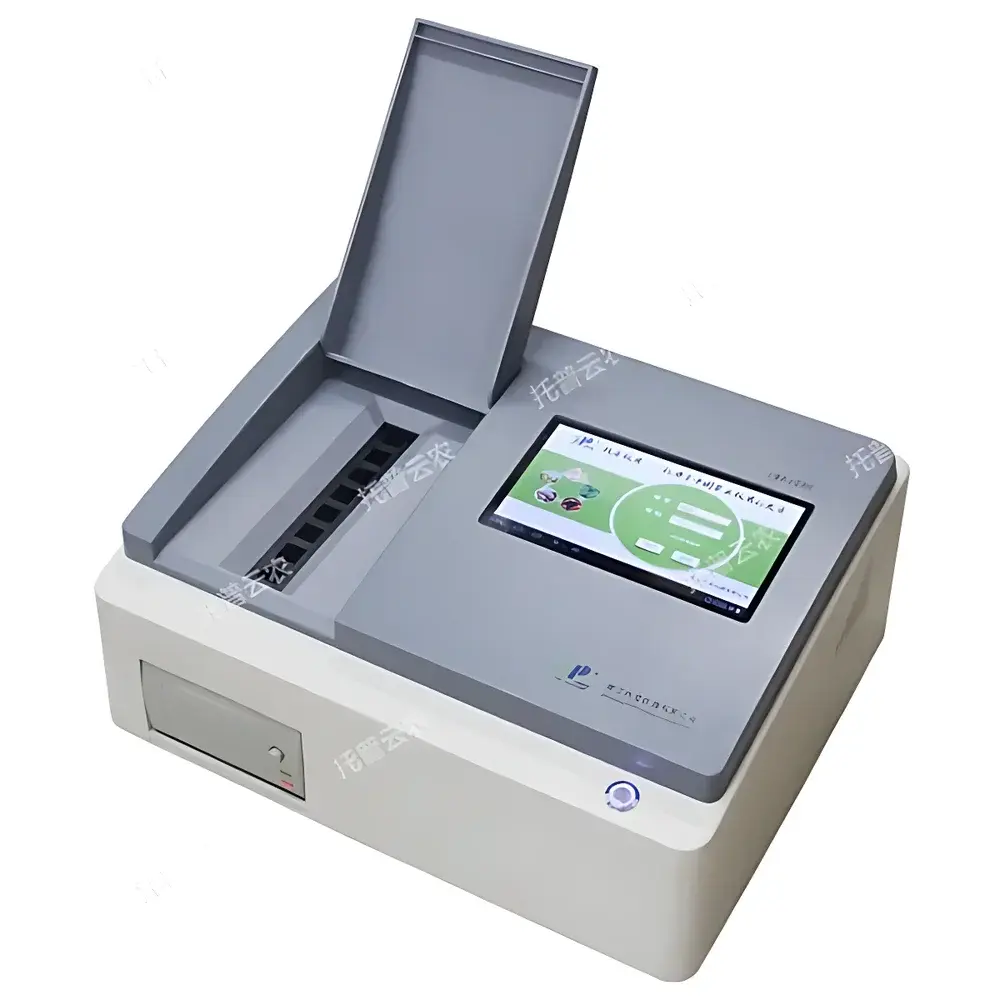
Top Cloud-agri TPY-8A Portable Soil Nutrient Analyzer
| Brand | Top Cloud-agri |
|---|---|
| Origin | Zhejiang, China |
| Manufacturer Type | Direct Manufacturer |
| Instrument Type | Fertilizer & Plant Nutrient Analyzer |
| Model | TPY-8A |
| Detection Parameters | Available N (Nitrate/NH₄⁺-N), Available P (Olsen-P), Available K (NH₄OAc-K), Total N, Total P, Total K, Organic Matter, pH (solid-state sensor), EC (0–20 mS/cm) |
| Optical System | Dual-wavelength photometric channels (620 ± 4 nm red, 440 ± 4 nm blue) |
| Stability | Drift < 0.003 absorbance units in 3 min |
| Repeatability | CV < 1.5% (absorbance < 0.005) |
| Linearity Error | < 3.0% |
| pH Accuracy | ±0.5 pH units (1–14 range) |
| EC Accuracy | ±2% FS (0–20 mS/cm) |
| Display | 7-inch capacitive touchscreen, Android OS |
| Onboard Storage | Internal non-volatile memory with timestamped records |
| Connectivity | Wi-Fi & 4G LTE |
| GPS | Integrated GNSS (latitude, longitude, altitude) |
| Power | Rechargeable Li-ion battery + AC adapter |
| Data Output | Thermal printer (built-in, ribbon-free), CSV export, cloud sync via TopCloud Platform |
| Compliance | Designed for field-deployable agricultural testing per ISO 11260, ISO 10390 (pH), ISO 11265 (EC), and aligned with FAO/IAEA soil testing guidelines for on-site nutrient assessment |
Overview
The Top Cloud-agri TPY-8A Portable Soil Nutrient Analyzer is a field-deployable, multi-parameter spectrophotometric instrument engineered for rapid, on-site quantification of key agronomic parameters in soil, fertilizers, organic amendments, and plant tissue. It operates on standardized colorimetric principles—utilizing dual-wavelength (620 nm red and 440 nm blue) photometric detection—to determine concentrations of available nitrogen (as nitrate and ammonium), Olsen-extractable phosphorus, ammonium acetate–extractable potassium, total nitrogen (via digestion-coupled reduction), total phosphorus and potassium (after acid digestion), organic matter (via dichromate oxidation), pH (using solid-state ion-sensitive sensors), and electrical conductivity (EC). Unlike traditional glass-electrode-based systems, its integrated solid-state pH and EC probes enable direct in-situ soil insertion without calibration drift or fragile component handling. The device complies with internationally referenced methodologies including ISO 11260 (available P), ISO 10390 (soil pH), and ISO 11265 (soil EC), supporting GLP-aligned data collection in extension services, cooperative farms, and agri-research stations.
Key Features
- 8-channel (or optional 16-channel) solid-state optical module with fixed-path photodiodes—eliminating mechanical filter wheels or moving parts to ensure long-term measurement stability and reproducibility.
- 7-inch high-resolution capacitive touchscreen running Android OS, enabling intuitive workflow navigation, real-time step-by-step guidance during analysis, and over-the-air firmware updates.
- Integrated GNSS receiver providing georeferenced metadata (latitude, longitude, altitude) automatically embedded into every test record—critical for spatial mapping of soil variability.
- Built-in thermal printer with no ink ribbons; generates traceable reports containing sample ID, test date/time, parameter values, crop type, fertilizer recommendation, application rate (kg/ha), and metric units—all compliant with national agricultural extension documentation standards.
- Dual-power architecture: rechargeable lithium-ion battery supports ≥8 hours of continuous field operation; AC adapter enables lab-based use without interruption.
- User-accessible onboard database with sorting (by date, parameter, crop), filtering, selective deletion, and CSV export—no external software required for basic data curation.
- Modular sensor interface supporting optional add-ons: soil moisture (TDR), soil temperature (PT100), ambient air temperature/humidity (capacitive), PAR (photosynthetically active radiation), and CO₂ (NDIR)—all synchronized with spectral measurements.
Sample Compatibility & Compliance
The TPY-8A accepts homogenized air-dried soil samples (2 mm sieve), liquid fertilizer dilutions, compost leachates, and digested plant tissue extracts. Its optical design accommodates turbid or colored matrices within defined absorbance limits (0.1–1.8 AU), minimizing interference from organic humic substances. All pH and EC measurements adhere to ISO 10390 and ISO 11265 protocols for field-moist soil testing. The instrument’s hardware and firmware architecture support audit-ready data integrity: timestamps are hardware-synchronized via internal RTC, GPS coordinates are logged at acquisition, and all modifications (e.g., record deletion) are immutably tagged with user ID and timestamp. While not FDA 21 CFR Part 11-certified out-of-box, the system meets baseline requirements for electronic record retention under FAO Good Agricultural Practices (GAP) and China’s NY/T 1121 series standards for soil testing laboratories.
Software & Data Management
The TPY-8A integrates natively with the TopCloud Agri Platform—a secure, role-based C/S cloud infrastructure accessible via web browser or Android mobile app. All instruments auto-sync encrypted measurement packets (including raw absorbance, calculated concentrations, GPS metadata, and operator ID) using TLS 1.2. The platform provides time-series visualization, spatial heatmaps (via KML export), comparative analytics across seasons or fields, and automated generation of fertilizer recommendation reports based on 100 preloaded crop-specific nutrient response models (e.g., rice, maize, apple, tea). Data backups are retained indefinitely with version-controlled revision history. Administrators may configure user permissions, define custom crop-nutrient thresholds, and schedule automated report distribution—enabling centralized oversight across provincial extension networks.
Applications
This analyzer serves as a primary tool in precision nutrient management programs: real-time validation of soil sampling grids prior to variable-rate application; on-farm verification of organic fertilizer composition; rapid screening of cover crop biomass nutrient content; and extension agent-led participatory soil testing in smallholder cooperatives. Its portability and battery life make it suitable for mobile soil health vans operating across fragmented landholdings. In research contexts, it supports longitudinal monitoring of conservation agriculture interventions (e.g., reduced tillage, biochar amendment) where frequent, low-cost measurements are prioritized over laboratory-grade absolute accuracy. The device is widely deployed by provincial agricultural bureaus in China under national soil testing and formula fertilization initiatives.
FAQ
Does the TPY-8A require laboratory calibration before field use?
No—factory calibration is retained across power cycles; however, users must perform a blank correction with deionized water or extraction reagent before each batch of samples.
Can the instrument differentiate between ammonium-N and nitrate-N without separate assays?
Yes—via sequential reagent addition and dual-wavelength kinetics, following modified Berthelot and cadmium reduction protocols embedded in firmware.
Is GPS data stored locally if network connectivity is unavailable?
Yes—GNSS coordinates are cached in internal memory and uploaded upon reconnection without data loss.
What is the minimum detectable concentration for available phosphorus?
0.5 mg/kg (Olsen method equivalent), validated against ICP-OES reference measurements with R² > 0.98 across 0–100 mg/kg range.
How does the system handle high-salinity soils that may saturate the EC sensor?
The EC module includes automatic range-switching (0–2, 2–20 mS/cm) and temperature compensation (0–50°C) per ISO 11265 Annex B.







