
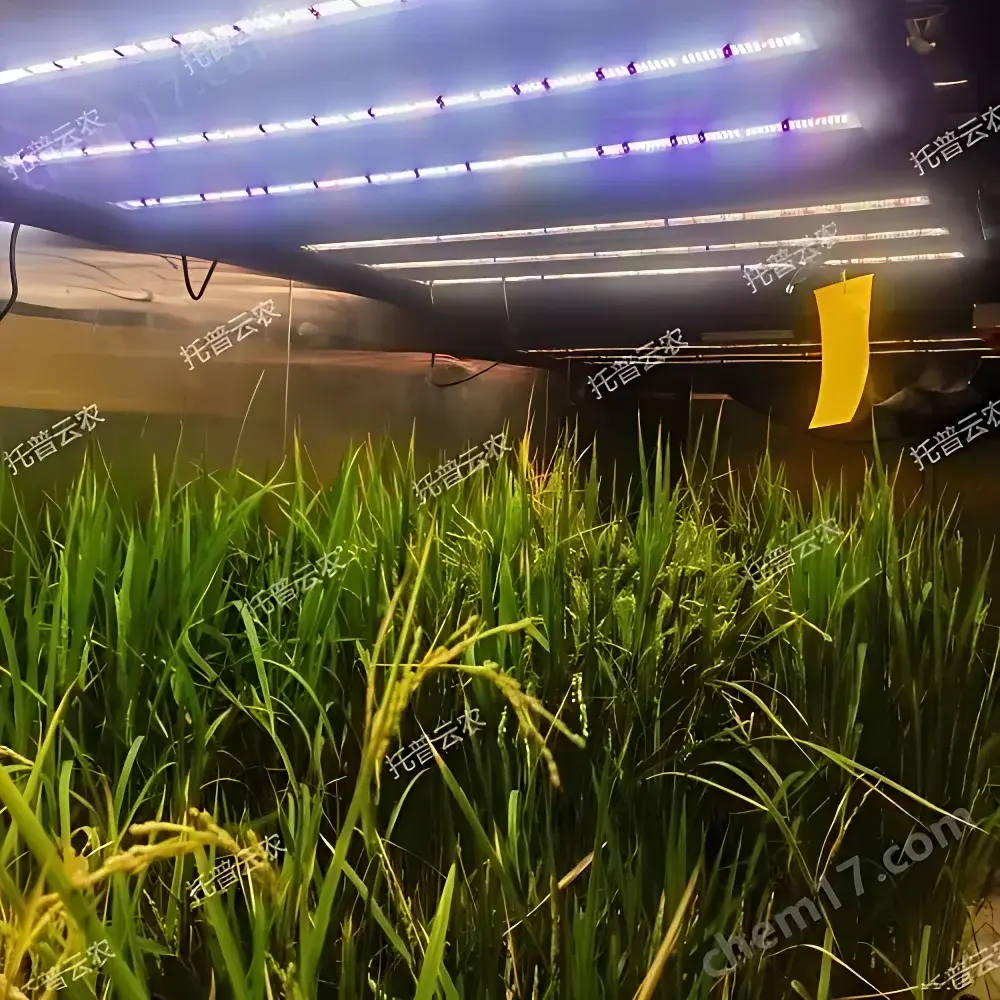
Top Cloud-agri Plant Generational Acceleration Chamber
| Brand | Top Cloud-agri |
|---|---|
| Origin | Zhejiang, China |
| Manufacturer Type | Direct Manufacturer |
| Product Origin | Domestic (China) |
| Model | Generational Acceleration Chamber |
| Pricing | Upon Request |
| Temperature Control Range | 10–35 °C |
| Humidity Control Range | ≥80% RH |
| Light Intensity | Customizable per experimental requirements |
| Lighting System | High-Efficiency Full-Spectrum LED Plant Growth Lamps |
| Ventilation | Integrated Fresh Air Exchange System with CO₂ Regulation |
| Control Interface | IoT-Enabled Cloud Platform with Mobile APP Remote Access |
| Structural Design | Modular Multi-Tier Cultivation Rack with Independent Layer-Level Lighting Control and Adjustable Shelf Height |
| Energy Efficiency | Optimized Thermal Insulation, Adaptive Lighting Dimming, and Demand-Based HVAC Cycling |
Overview
The Top Cloud-agri Plant Generational Acceleration Chamber is a purpose-engineered environmental control system designed specifically for plant breeding acceleration in controlled laboratory settings. Unlike standard growth chambers, this chamber integrates tightly regulated photoperiodic, thermohygrometric, and gaseous parameters to enable rapid generational turnover—critical for shortening breeding cycles in cereals, legumes, oilseeds, and horticultural crops. It operates on the principle of controlled-environment phenotyping: by precisely replicating and accelerating key developmental cues (e.g., vernalization, photoperiod induction, and thermal time accumulation), it supports year-round generation advancement without seasonal dependency. The chamber complies with foundational principles outlined in ISO 22000 (for controlled agricultural research environments) and aligns with FAO’s Good Practice Guidelines for Accelerated Breeding Facilities. Its architecture prioritizes reproducibility across replicate runs—essential for QTL mapping, backcrossing programs, and doubled haploid production.
Key Features
- Triple-parameter environmental regulation: independent PID-controlled temperature (10–35 °C), relative humidity (≥80% RH at setpoint), and full-spectrum LED lighting with adjustable intensity and photoperiod (0–24 h/day cycles).
- Modular multi-tier cultivation structure: stainless steel or powder-coated steel frames support up to six independently controllable lighting layers; shelf height is manually adjustable in 50-mm increments to accommodate rosette-stage seedlings through flowering canopy.
- Fresh air exchange system with programmable airflow rate (1–6 air changes per hour), integrated CO₂ sensors (400–2000 ppm range), and particulate filtration (MERV 13) to maintain optimal photosynthetic gas exchange and prevent pathogen buildup.
- IoT-native control architecture: embedded industrial-grade controller interfaces with Top Cloud-agri’s proprietary cloud platform, enabling real-time monitoring, historical trend analysis, alarm notifications, and remote parameter adjustment via iOS/Android mobile application.
- Energy-optimized operation: adaptive lighting dimming synchronized with photoperiod scheduling, high-efficiency EC fans, vacuum-insulated double-glazed doors, and demand-driven compressor cycling reduce average power consumption by ≥35% compared to conventional chambers.
Sample Compatibility & Compliance
The chamber accommodates a broad spectrum of plant materials—from Arabidopsis thaliana seedlings and rice tillers to wheat spikes and tomato fruiting clusters—without structural modification. Standard tray dimensions (600 × 400 × 70 mm) conform to international phytotron standards (ISO 17025 Annex A3). All electrical components meet CE and RoHS directives. Environmental logging adheres to GLP-compliant data integrity protocols: timestamped sensor records are stored locally (SD card) and redundantly synced to encrypted cloud storage with audit trail functionality compliant with FDA 21 CFR Part 11 requirements for electronic records and signatures.
Software & Data Management
The Top Cloud-agri SmartAgriOS™ platform provides role-based access control (admin, researcher, technician), configurable data export (CSV, Excel, NetCDF), and integration-ready RESTful APIs for LIMS or breeding management systems (e.g., BreedBase, FieldBook). Environmental logs include metadata tagging (experiment ID, genotype code, growth stage annotation) and automatic calibration traceability. Data retention is configurable (3–24 months), with optional on-premise server deployment for institutional IT governance compliance.
Applications
- Rapid generation advancement (RGA) in wheat, barley, oat, and Brassica species under non-vernalizing or accelerated vernalization protocols.
- Controlled-environment phenotyping for drought tolerance, heat resilience, and photoperiod sensitivity screening.
- Indoor seed increase of exotic germplasm prior to field introduction—supporting NBP (National Breeding Program) quarantine compliance.
- Support for CRISPR/Cas9 editing validation workflows requiring synchronous flowering and seed set across edited lines.
- Teaching and training modules in plant physiology and quantitative genetics laboratories.
FAQ
Can the chamber support long-day and short-day photoperiod switching within a single run?
Yes—the lighting controller supports up to four independent photoperiod profiles per day, including dawn/dusk simulation and dynamic ramping.
Is third-party calibration certification available?
Yes—NIST-traceable calibration certificates for temperature, humidity, and PPFD sensors are provided upon request (ISO/IEC 17025 accredited lab).
What is the maximum sustained light intensity achievable at canopy level?
Up to 800 µmol·m⁻²·s⁻¹ PAR (Photosynthetically Active Radiation) with standard configuration; higher intensities available with optional high-output lamp modules.
Does the system support integration with automated imaging stations?
Yes—RS-485 and Ethernet ports enable hardware synchronization with RGB/NIR phenotyping rigs and time-lapse camera arrays.
How is firmware updated and validated?
Over-the-air updates are digitally signed and verified prior to installation; rollback capability ensures system stability during critical experiments.
Related Products




