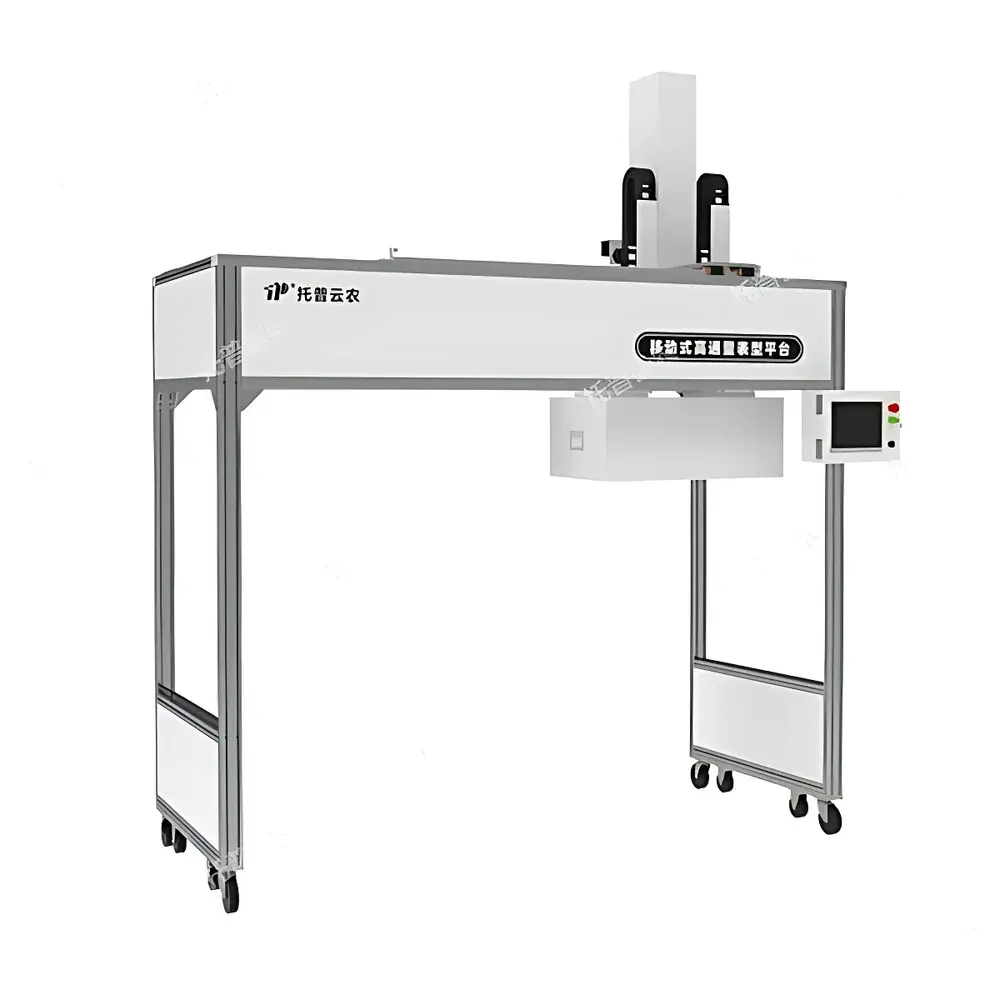
TopCloud-agri TP-MPR-I2/I3/I4 Mobile Single-Axis Gantry Plant Phenotyping System
| Brand | TopCloud-agri |
|---|---|
| Origin | Zhejiang, China |
| Manufacturer Type | Direct Manufacturer |
| Model Options | TP-MPR-I2, TP-MPR-I3, TP-MPR-I4 |
| Imaging Modules | Visible + Depth (I2) |
| Gantry Dimensions (L×W×H) | 2.7 m × 1.1 m × 2.9 m |
| Max Sample Height | ≤1 m |
| Operating Environment | 0–50 °C, ≤90% RH |
| RGB Sensor | 8 MP, 3840×2160 @ 5/15 fps |
| Hyperspectral Range | 400–1000 nm, Spectral Resolution: 2.5 nm, ≥1200 bands, Pixel Size: 5.86 µm |
| Thermal IR Detector | Uncooled microbolometer, 640×512 res., 7.5–14 µm, NETD ≤40 mK, Temp Range: –20 to +150 °C (extended: 0–650 °C), Accuracy: ±2 °C or ±2% of reading |
| Control Interface | 10.1″ capacitive touchscreen |
| Data Security | Local encrypted storage, audit-ready metadata logging, configurable export (CSV, TIFF, ENVI, JSON) |
| Compliance | Designed for GLP-aligned workflows |
Overview
The TopCloud-agri TP-MPR-I2/I3/I4 Mobile Single-Axis Gantry Plant Phenotyping System is an engineered platform for non-destructive, high-throughput phenotypic characterization of plants under controlled indoor or greenhouse conditions. It operates on a modular imaging architecture grounded in multi-spectral optical metrology and thermographic physics—integrating visible-light photogrammetry, time-of-flight depth mapping, push-broom hyperspectral reflectance spectroscopy (400–1000 nm), and calibrated long-wave infrared radiometry (7.5–14 µm). Unlike fixed-rail systems, its single-axis gantry enables rapid repositioning across heterogeneous experimental plots without structural modification to facility infrastructure. The system captures spatially registered, co-registered datasets across modalities, enabling quantitative derivation of morphological traits (e.g., projected leaf area, canopy height), structural parameters (e.g., point-cloud-based volume estimation), physiological proxies (e.g., NDVI, PRI, anthocyanin index from hyperspectral cubes), and thermal heterogeneity metrics (e.g., canopy temperature differential, stomatal conductance surrogates). All acquisitions are synchronized to hardware-triggered timestamps and georeferenced to plant position via integrated encoder feedback.
Key Features
- Modular Single-Axis Gantry Architecture: Lightweight aluminum frame with precision linear motion rails and stepper-driven vertical lift mechanism. Manual mobility supported by industrial casters; optional motorized drive upgrade available. Horizontal travel range: 2.5 m; vertical adjustment range: 0.3–2.0 m (software-limited to ≤1 m for standard plant height compliance).
- Multi-Modal Imaging Integration: Interchangeable sensor modules mount on a common optical bench with mechanical and electronic registration. Each module includes factory-calibrated lens, illumination geometry, and spectral throughput validation reports. Thermal and hyperspectral units feature active cooling and real-time non-uniformity correction (NUC).
- Adaptive Positioning & Synchronization: Encoder-based closed-loop positioning ensures repeatability within ±0.5 mm horizontally and ±0.3 mm vertically. Auto-height detection uses real-time depth-map feedback to adjust sensor standoff distance prior to acquisition, minimizing perspective distortion and ensuring consistent ground sampling distance (GSD).
- Onboard Edge Processing: Integrated industrial-grade controller runs deterministic acquisition firmware with sub-millisecond trigger latency. Preprocessing (flat-field correction, radiometric calibration, geometric rectification) occurs in real time; raw and processed data streams are concurrently logged to redundant NVMe storage.
- Hardware-Level Safety Protocols: Dual-channel emergency stop circuitry, mechanical end-stop limit switches, torque-limiting actuators, and continuous motor current monitoring ensure fail-safe operation. All safety logic complies with IEC 61508 SIL2 requirements for laboratory automation equipment.
Sample Compatibility & Compliance
The TP-MPR series accommodates potted plants, trays, hydroponic rafts, and soil-filled mesocosms up to 1 m in height and 1.0 m × 0.8 m footprint. It supports longitudinal studies across developmental stages—from seedling emergence through reproductive maturity—without requiring plant relocation. Calibration protocols follow ASTM E1933-22 (infrared thermography) and ISO 17123-8 (optical measurement of vegetation structure). Raw image metadata embed EXIF-compliant tags including exposure settings, sensor temperature, ambient RH/temperature (if meteorological sensors installed), and operator ID. Data provenance meets OECD Guidance Document 110 (Plant Biotechnology) and aligns with FAO Crop Ontology standards for trait definition interoperability.
Software & Data Management
Acquisition and analysis are managed via TopPheno™ v4.2 software—a Windows-based application with role-based access control (RBAC), audit trail logging (per FDA 21 CFR Part 11 Annex 11 principles), and version-controlled algorithm modules. Users define acquisition protocols using drag-and-drop workflow builder; scheduled tasks support unattended overnight scanning. ROI selection tools include polygon, rectangle, and semantic segmentation masks trained on common crop species (maize, wheat, tomato, Arabidopsis). Export formats include ENVI-compatible .hdr/.dat for hyperspectral cubes, TIFF stacks with embedded GeoTIFF tags, CSV time-series tables with ISO 8601 timestamps, and interactive HTML reports with embedded WebGL visualizations. Local database (PostgreSQL) stores all raw frames, metadata, and derived parameters with SHA-256 hash integrity verification.
Applications
- Quantitative evaluation of drought, salinity, heat, and nutrient-stress responses via temporal trajectories of canopy temperature differentials, chlorophyll fluorescence proxies, and structural plasticity indices.
- High-resolution mapping of disease progression (e.g., powdery mildew, late blight) using hyperspectral anomaly detection at early asymptomatic stages (before visible symptom onset).
- Genotype-by-environment interaction (G×E) studies requiring repeated measurements across dozens of genotypes under replicated environmental treatments.
- Validation of remote sensing indices (e.g., NDVI, TCARI/OSAVI) against ground-truthed spectral signatures under controlled illumination conditions.
- Calibration and benchmarking of AI-based phenotyping models—providing pixel-accurate, multi-modal training datasets with known ground truth labels.
FAQ
What imaging modalities are natively supported, and how are they physically integrated?
The system supports four core modalities: visible-light RGB (8 MP, global shutter), depth (ToF-based, 0.1–3 m range), hyperspectral (push-broom, 400–1000 nm, 2.5 nm resolution), and thermal IR (640×512 uncooled microbolometer). All modules share a rigid optical mounting plate with kinematic alignment pins and M42 electrical/data interfaces, enabling sub-pixel spatial registration without post-hoc co-registration.
Is the system compatible with third-party analysis pipelines such as PlantCV or Python-based deep learning frameworks?
Yes. Raw data exports include standardized formats: TIFF (RGB/depth), BIL/BIP (hyperspectral), and radiometrically calibrated thermal matrices (float32). Metadata follows Frictionless Data Package specifications, enabling direct ingestion into PlantCV, PyTorch, or TensorFlow workflows. SDK documentation and REST API endpoints are provided for programmatic control.
How is thermal measurement accuracy maintained across varying ambient conditions?
Each thermal acquisition includes reference blackbody calibration at system startup and every 30 minutes during continuous operation. Emissivity correction is applied per-species default values (adjustable), and atmospheric transmittance compensation uses real-time RH/temperature inputs from optional onboard气象 sensors.
Can the gantry be retrofitted with additional sensors after purchase?
Yes. The mechanical and electrical interface architecture is designed for modularity. Additional modules—including UV fluorescence, chlorophyll fluorescence (PAM), or LiDAR—can be integrated via factory-certified adapters and firmware updates. All upgrades retain full software compatibility and calibration traceability.
Does the system support GLP or GMP-regulated research environments?
While not certified as a medical device, the TP-MPR platform implements design controls aligned with ISO 9001 and data integrity practices consistent with GLP (OECD Principles) and GMP Annex 11. Full audit trails, electronic signatures, and 21 CFR Part 11–compliant user authentication are enabled out-of-the-box.