
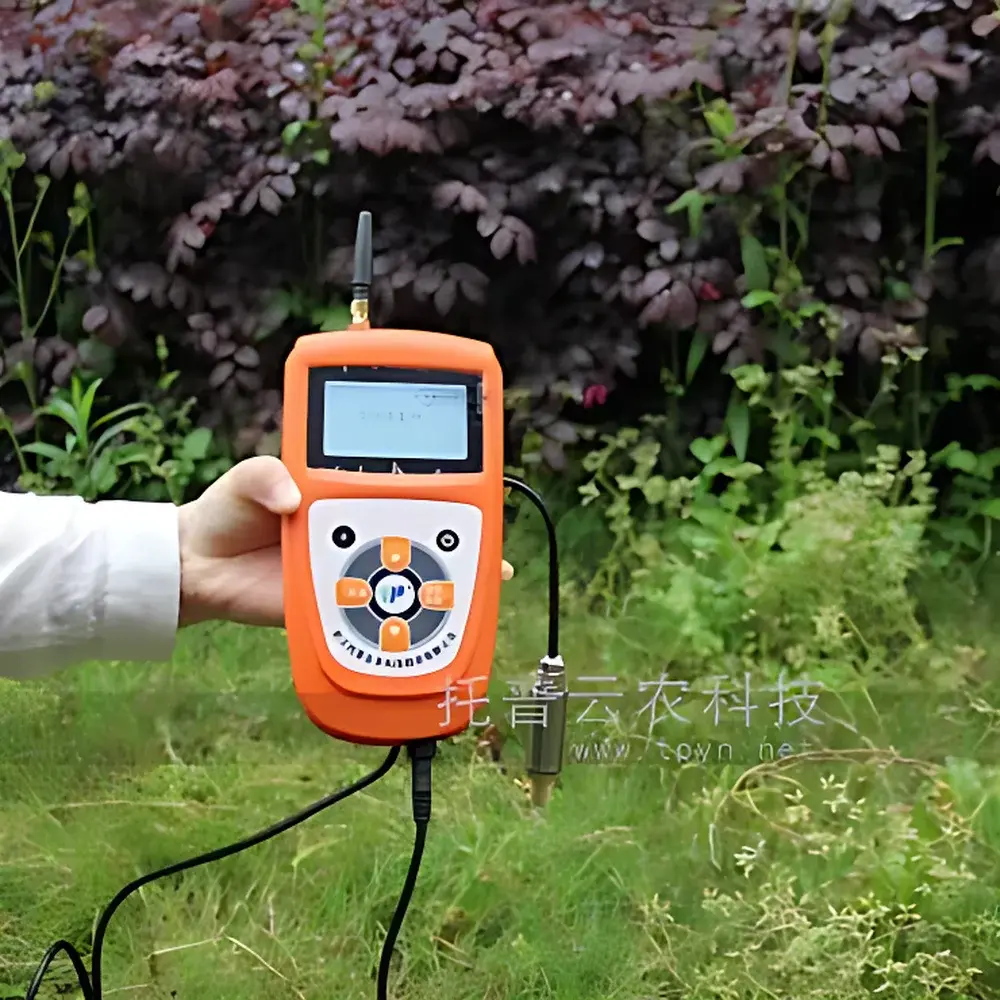
Top Cloud-agri TPJ-20-LG Wireless Environmental Data Logger (Temperature & Humidity with Dew Point)
| Brand | Top Cloud-agri |
|---|---|
| Origin | Zhejiang, China |
| Manufacturer Type | Direct Manufacturer |
| Country of Origin | China |
| Model | TPJ-20-LG |
| Price | USD 435 (approx. ¥3100) |
| Communication | 2G/4G Cellular |
| Local Storage | 30,000 records in internal Flash + optional 4GB microSD (unlimited archival) |
| Power | Rechargeable 7.4V 2.8Ah Li-ion battery (with low-voltage warning & charge protection) |
| DC input | 8.4V ≥1000mA |
| Display | Backlit Chinese LCD showing real-time date/time, sensor readings, storage status, and record count |
| Sampling Interval | Configurable from 5 minutes to 99 hours |
| GPS | Integrated module for automatic geotagging of each data point |
| Expandability | Up to 32 sensors via IP67-rated hub (modular analog/digital interface) |
| Alarm | Voice alert (Mandarin) with configurable threshold-triggered playback |
| Software | Cloud-based C/S platform supporting web and mobile (iOS/Android), FDA 21 CFR Part 11–compatible audit trail, GLP/GMP-ready data export (CSV, PDF, Excel), curve/table visualization, report generation, and OTA firmware updates |
Overview
The Top Cloud-agri TPJ-20-LG Wireless Environmental Data Logger is an ISO/IEC 17025-aligned continuous monitoring instrument engineered for long-term, unattended acquisition and transmission of ambient temperature, relative humidity, and derived dew point values. It operates on the principle of high-stability capacitive humidity sensing coupled with precision NTC thermistor-based temperature measurement—both calibrated traceably to national standards. The device integrates a dual-channel analog front-end, embedded ARM Cortex-M4 microcontroller, industrial-grade 2G/4G LTE modem, and GNSS receiver (GPS+BeiDou) to ensure spatially referenced, time-synchronized environmental logging under field-deployed conditions. Designed for compliance-critical environments—including agricultural cold chain validation, pharmaceutical warehouse monitoring, seed storage facilities, and ecological research stations—the TPJ-20-LG meets foundational requirements for data integrity per ISO 14644-3, ASTM E2911, and WHO Technical Report Series No. 961 Annex 9.
Key Features
- Triple-parameter simultaneous logging: temperature (−40 °C to +85 °C), relative humidity (0–100 %RH), and calculated dew point (−40 °C to +120 °C)
- Real-time cellular telemetry via 2G/4G networks with configurable upload intervals; fallback to USB mass-storage mode for offline data retrieval
- On-device voice alerting in Mandarin with programmable over-limit triggers and adjustable volume levels
- Dual-layer non-volatile storage: 30,000 entries retained in internal Flash memory plus scalable archiving on removable 4GB microSD card (FAT32 formatted)
- Integrated GPS/GLONASS/BeiDou receiver enabling automatic geotagging (WGS84 coordinates) with ≤5 m CEP accuracy under open-sky conditions
- Modular sensor expansion architecture supporting up to 32 heterogeneous probes (e.g., CO₂, soil moisture, light intensity) through an IP67-rated junction box with isolated signal conditioning
- Low-power design optimized for extended field deployment: typical standby current draw <10 mA; battery life exceeds 12 months at 30-minute sampling intervals
- Backlit monochrome LCD with localized Chinese UI displaying live measurements, timestamp, battery status, memory utilization, and GPS fix indicator
Sample Compatibility & Compliance
The TPJ-20-LG is intended for ambient air monitoring only—not for direct immersion, corrosive gas exposure, or pressurized chamber use. Its sensor housing complies with IP65 ingress protection when mounted per manufacturer instructions. Calibration certificates are provided per unit, referencing NIM (National Institute of Metrology, China) traceable standards. All recorded metadata—including timestamps (UTC-synced via NTP), sensor IDs, GPS coordinates, and operator-defined event markers—are preserved immutably within the cloud database. Platform-level access controls, user role permissions, electronic signatures, and full audit trails satisfy baseline requirements for GLP, GMP, and FDA 21 CFR Part 11 Subpart B adherence when deployed in regulated workflows.
Software & Data Management
The proprietary Instrument Cloud Platform employs a client-server architecture with TLS 1.2 encryption, OAuth 2.0 authentication, and daily automated backups to geo-redundant AWS S3 storage. Users access time-series data via responsive web dashboards or native iOS/Android applications. Each dataset includes granular filtering by sensor ID, location tag, date range, and alarm state. Visualization tools generate overlay plots, statistical summaries (min/max/mean/stdev), and deviation heatmaps. Export functions support CSV (UTF-8), PDF (print-optimized), and XLSX formats—with column headers compliant with ISO/IEC 19794-5 metadata schemas. Firmware updates occur over-the-air without interrupting active logging sessions. Platform logs all user actions—including login attempts, configuration changes, and report exports—for regulatory review.
Applications
- Pharmaceutical logistics: Monitoring temperature excursions during vaccine transport and warehouse storage per ICH Q5C and EU GDP Annex 9
- Agricultural post-harvest management: Tracking grain bin microclimates to prevent mold growth and aflatoxin formation
- Ecological field studies: Long-term climatological profiling across remote habitats using solar-charged deployments
- Museum and archive conservation: Ensuring stable RH/temperature regimes for artifact preservation per ISO 11799
- Greenhouse climate optimization: Correlating environmental trends with crop phenology metrics and irrigation scheduling
- Building commissioning: Verifying HVAC performance against ASHRAE Standard 110 and EN 15237 benchmarks
FAQ
What communication protocols does the TPJ-20-LG support for data transmission?
It uses AT-command-based PPP over 2G/4G cellular networks (SIM800L/EC25 modules), with fallback to USB CDC ACM virtual COM port for local configuration and manual data dump.
Can the device operate without cellular coverage?
Yes—local logging continues uninterrupted into internal Flash and/or microSD card. Data uploads resume automatically upon network restoration.
Is third-party software integration possible?
The cloud platform exposes RESTful APIs (JSON over HTTPS) for programmatic data ingestion, alarm forwarding, and device fleet management—documentation available under NDA.
How often should calibration be performed?
Annual recalibration is recommended for ISO/IEC 17025 conformance; field verification using NIST-traceable reference hygrometers is advised prior to critical validation campaigns.
Does the system support multi-user collaboration with role-based permissions?
Yes—administrators can assign granular permissions (view-only, edit, export, configure alarms) per user group, with session timeouts and password complexity enforcement.
Related Products







