Top Cloud-agri TOP-900 Portable Stress Wave Tomography System for Non-Destructive Tree Internal Defect Imaging
| Brand | Top Cloud-agri |
|---|---|
| Origin | Zhejiang, China |
| Manufacturer Type | Direct Manufacturer |
| Country of Origin | China |
| Model | TOP-900 |
| Pricing | Upon Request |
| Tree Longitudinal Measurement Range | 100–3000 mm |
| Tree Diameter Measurement Range | 100–2000 mm |
| Stress Wave Velocity (v) Range | 0–3000 m/s |
| Stress Wave Transit Time (t) Range | 0–65535 µs |
| Measurement Accuracy | ≤1% |
| Repeatability Error | ≤0.5% |
| Data Storage Capacity | 100 test groups |
| Power Supply | 4.2 V Li-ion Battery (Operating), 5–12 V (Charging) |
| Continuous Operation Time | 10 h |
| Rated Power | <800 mW |
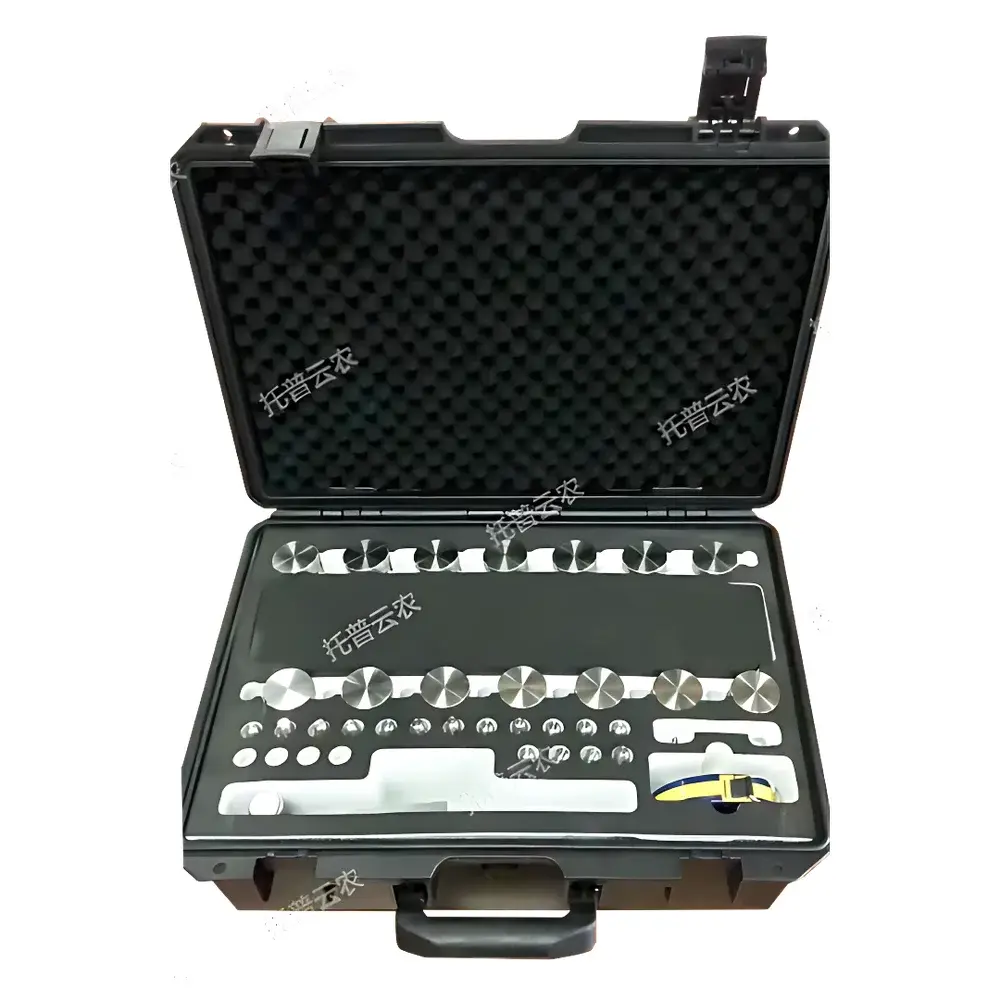
| Instrument Case Dimensions (L×W×H) | 310±5 × 225±5 × 136±5 mm |
| Tool Case Dimensions (L×W×H) | 455±5 × 420±5 × 115±5 mm |
| Operating Temperature | −10 to 40 °C |
| Operating Relative Humidity | ≤90% RH |
Overview
The Top Cloud-agri TOP-900 Portable Stress Wave Tomography System is an engineered solution for non-invasive internal defect assessment of living trees. Based on the physical principle of stress wave propagation—where mechanical impulses travel at velocities inversely correlated with wood density and structural integrity—the system enables cross-sectional tomographic reconstruction of decay, cavities, cracks, and other internal anomalies without felling, coring, or otherwise compromising tree vitality. Designed specifically for arborists, urban forestry departments, heritage conservation teams, and ecological monitoring programs, the TOP-900 delivers field-deployable, physics-based diagnostics aligned with ISO 17225-3 (wood quality assessment) and ASTM D358 (standard practice for sampling round timber) principles. Its pulse excitation methodology—using controlled hammer strikes on strategically placed sensors—captures time-of-flight data across multiple chordal paths, forming the raw input for inverse reconstruction algorithms that generate spatially resolved defect maps.
Key Features
- Configurable Sensor Array: Supports up to 12 piezoelectric sensors mounted circumferentially on the trunk cross-section, enabling high-resolution angular sampling and improved spatial resolution in tomographic inversion.
- Real-Time Signal Monitoring: Displays raw transit times, amplitude decay profiles, and signal-to-noise ratios during acquisition—allowing immediate validation of sensor coupling and impulse consistency in variable field conditions.
- Multi-Modal Data Visualization: Presents reconstructed defect distributions as grayscale tomograms, chordal time-difference matrices, and vectorized line-segment overlays—facilitating both qualitative interpretation and quantitative thresholding.
- Automated Reporting Engine: Generates auditable PDF reports containing defect severity classification (e.g., sound, early decay, advanced cavity), absolute defect area (cm²), relative defect ratio (% of total cross-sectional area), and geometric centroid coordinates.
- Field-Ready Hardware Architecture: Enclosed in IP54-rated instrument and tool cases; powered by a rechargeable 4.2 V Li-ion battery delivering ≥10 h continuous operation under typical load; operational across −10 to 40 °C and ≤90% RH.
- Metadata Integration Framework: Allows manual entry and storage of botanical identifiers (species, age, DBH), geospatial tags (GPS coordinates, site ID), and contextual metadata (urban vs. forest setting, observed crown symptoms)—enabling longitudinal cohort analysis and GIS integration.
Sample Compatibility & Compliance
The TOP-900 is validated for use on standing hardwood and softwood species with diameters from 100 mm to 2000 mm and stem lengths between 100 mm and 3000 mm—covering common urban canopy species (e.g., Quercus robur, Platanus × acerifolia, Acer saccharum) and historic monumental trees. It complies with GLP-aligned data integrity requirements: all measurements are timestamped, sensor configurations logged, and raw transit-time datasets preserved in open binary format (.swt) for third-party reprocessing. While not FDA-regulated, its measurement traceability (≤1% accuracy, ≤0.5% repeatability per NIST-traceable calibration protocol) supports ISO/IEC 17025-compliant laboratory accreditation when deployed within certified dendrological service frameworks.
Software & Data Management
The included TreeTomography Pro software (Windows 10/11, 64-bit) implements filtered back-projection and algebraic reconstruction techniques (ART) optimized for circular symmetry constraints. It supports batch processing of multi-tree datasets, automated outlier rejection based on coefficient-of-variation thresholds, and export of defect masks in GeoTIFF and DXF formats for integration with ArcGIS or AutoCAD workflows. Audit trails record user actions, parameter modifications, and report generation events—meeting basic ALCOA+ (Attributable, Legible, Contemporaneous, Original, Accurate, Complete, Consistent, Enduring, Available) criteria for field data governance. Raw data files are unencrypted and human-readable via provided Python API documentation, ensuring long-term archival interoperability.
Applications
- Urban forestry risk assessment prior to pruning or removal decisions
- Heritage tree conservation monitoring under UNESCO or national monument protection statutes
- Post-storm structural integrity screening of public green infrastructure
- Long-term research on fungal decay progression in natural forest stands
- Validation of ground-penetrating radar (GPR) or electrical resistance tomography (ERT) findings
- Teaching modules in dendrology, forest pathology, and environmental science curricula
FAQ
What types of internal defects can the TOP-900 reliably detect?
It identifies low-density zones associated with heart rot, hollow cavities, radial cracks, and advanced sapwood decay—provided the defect occupies ≥8% of the cross-sectional area and exhibits ≥30% velocity reduction relative to sound wood.
Is calibration required before each use?
A single factory calibration suffices for routine operation; however, field verification using a reference log of known geometry and species is recommended before critical assessments.
Can the system be used on irregular or buttressed trunks?
Yes—sensor placement follows chordal geometry rather than strict circular assumption; the software accommodates elliptical or polygonal approximations via user-defined boundary points.
Does the software support multi-language interfaces?
English and Chinese language packs are included; additional locales may be added via XML-based localization files.
How is data security handled during wireless transfer?
The system uses wired USB-C connection only; no onboard Wi-Fi or Bluetooth transceivers are present—eliminating remote attack vectors and ensuring air-gapped data integrity.