
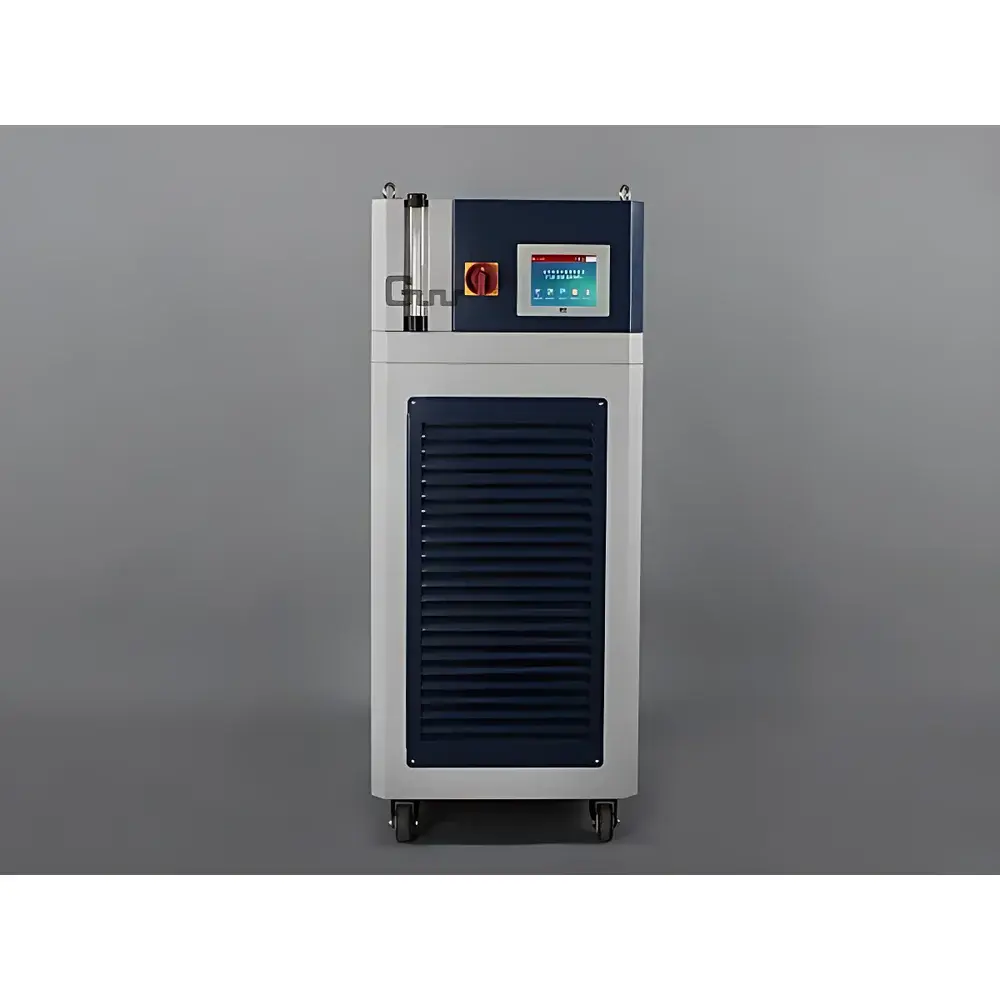
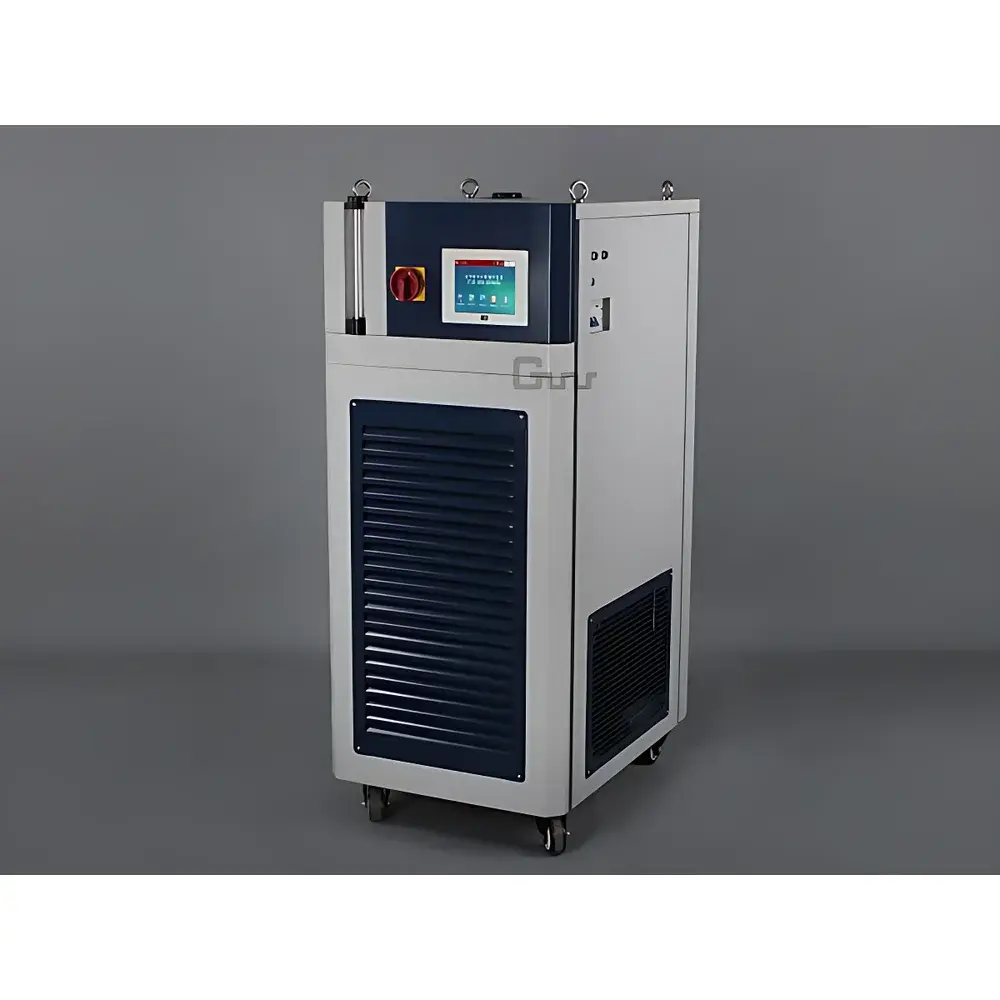
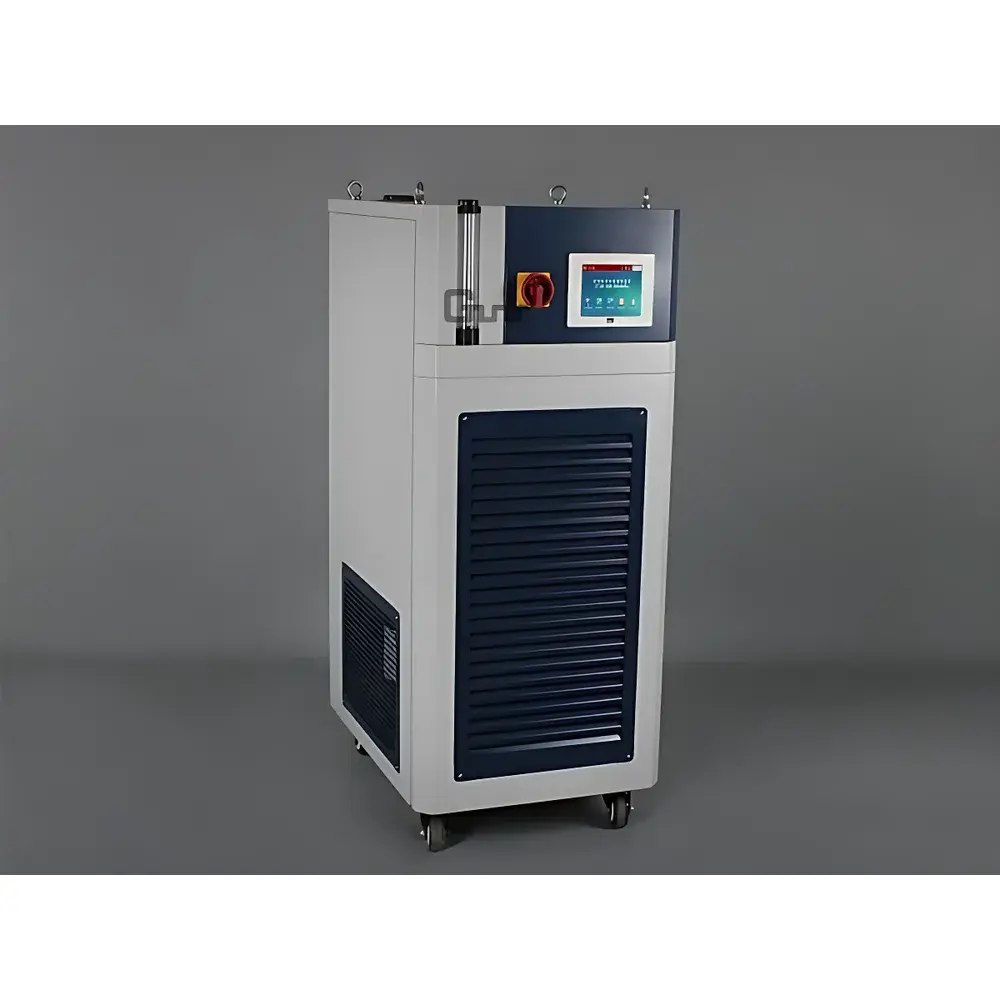
The Great Wall ZT-100-200-80H Closed-Loop Cryogenic & High-Temperature Circulating Chiller
| Brand | The Great Wall |
|---|---|
| Origin | Henan, China |
| Manufacturer Type | Direct Manufacturer |
| Model | ZT-100-200-80H |
| Temperature Range | -80 °C to +200 °C |
| Temperature Stability (at Reactor) | ±0.5 °C |
| Ambient Operating Conditions | 5–35 °C, ≤70% RH |
| Power Supply | 3-phase 380 V, 50 Hz |
| Total Power | 35.1 kW |
| Heating Power | 12 kW |
| Refrigeration Capacity | 2.5–31 kW (varies with setpoint) |
| Pump Flow Rate | 40 L/min |
| Max. Discharge Pressure | 1.2 bar |
| Compressor | 2× Danfoss “M series” hermetic piston compressors |
| Refrigerants | R404A / R23 |
| Expansion Valve | Danfoss thermostatic, serviceable without line break |
| Evaporator | AUS316 plate-type, design temp. −160 °C to +200 °C |
| Circulation Loop Materials | SUS304 stainless steel |
| Reservoir Volume | 25 L |
| Dimensions (W×D×H) | 1010 × 1740 × 1620 mm |
| Net Weight | 714 kg |
| Control Interface | 7″ TFT color touchscreen, MODBUS RTU over RS-485 |
| Programmability | 120 programs × 100 segments |
| Safety Protections | Delay start, overcurrent, overtemperature, high/low pressure, dry-run, thermal overload |
Overview
The Great Wall ZT-100-200-80H is a fully sealed, dual-mode circulating temperature control system engineered for precise, stable, and repeatable thermal management of external process loads—including jacketed reactors, calorimeters, distillation columns, and analytical instrumentation. It operates across an exceptionally wide temperature span of −80 °C to +200 °C under ambient conditions of 5–35 °C and ≤70% relative humidity. Its core architecture integrates a cascade refrigeration circuit with independent pre-cooling and electric heating subsystems, enabling rapid ramping, tight stability (±0.5 °C at the load interface), and long-term operational reliability in demanding laboratory and pilot-scale environments. Unlike open-bath chillers, the ZT-100-200-80H maintains full fluid containment—eliminating evaporation loss, oxidation, moisture ingress, and contamination risks associated with volatile heat transfer media such as silicone oils or ethylene glycol/water mixtures. This closed-loop design is essential for GMP-compliant synthesis, exothermic reaction control, and temperature-sensitive material testing where batch integrity and traceability are critical.
Key Features
- Cascade refrigeration system featuring two Danfoss M-series hermetic piston compressors with IP44-rated motor protection, delivering scalable cooling capacity from 2.5 kW (−78 °C) to 31 kW (+200 °C)
- AUS316 stainless steel plate evaporator rated for −160 °C to +200 °C, offering superior corrosion resistance, low fouling coefficient, and 70–80% weight reduction versus shell-and-tube alternatives
- Dual-stage thermal management: dedicated air-cooled pre-cooler bypasses compressor activation during high-to-ambient transitions, extending compressor life and reducing energy consumption
- Flanged immersion-type electric heater compliant with JB/T 2379, optimized for synthetic heat transfer fluids and designed for uniform thermal distribution and minimal hot-spot formation
- SUS304 circulation loop including magnetically coupled pump (1.5 kW), expansion tank with level monitoring, non-return valves, and insulated 3/4″ external ports
- 7-inch industrial-grade TFT touchscreen with intuitive HMI supporting both setpoint and program-based control modes; stores up to 120 multi-segment temperature profiles (100 steps each)
- Comprehensive safety architecture including delayed startup, high/low pressure cutouts, overtemperature shutdown, dry-run detection, and real-time fault logging
Sample Compatibility & Compliance
The ZT-100-200-80H is compatible with a broad range of thermally stable, non-corrosive heat transfer media—including silicone oils, polyalkylene glycols (PAG), and specialized low-temperature cryogens—provided they remain non-viscous and chemically inert within the −80 °C to +200 °C operating envelope. All wetted components (reservoir, piping, valves, pump head, and evaporator plates) are constructed from SUS304 or AUS316 stainless steel, ensuring compatibility with USP Class VI–rated fluids and alignment with ISO 13485 cleanroom material requirements. While not certified to FDA 21 CFR Part 11 out-of-the-box, its MODBUS RTU interface enables integration into validated SCADA or LIMS environments where electronic audit trails, user-level access control, and parameter change logging can be implemented per GLP/GMP Annex 11 guidelines. System documentation supports IQ/OQ protocols, and mechanical design adheres to IEC 61000-6-2 (immunity) and IEC 61000-6-4 (emission) standards.
Software & Data Management
The embedded controller provides native support for real-time temperature curve visualization—displaying both bath and external load temperatures simultaneously on the touchscreen. All operational data—including setpoints, actual temperatures, power consumption, alarm events, and program execution status—are timestamped and stored internally for ≥30 days. Via the RS-485 port and MODBUS RTU protocol, the unit interfaces seamlessly with third-party SCADA systems (e.g., Ignition, Siemens Desigo, or LabVIEW), enabling centralized monitoring, remote parameter adjustment, and automated report generation. Optional OPC UA gateway modules (sold separately) extend compatibility with enterprise MES platforms. No proprietary cloud service or vendor lock-in is required; raw register mapping and command syntax are publicly documented for in-house software development.
Applications
- Precise thermal control of glass-lined or stainless-steel jacketed reactors during catalytic hydrogenation, polymerization, crystallization, and nitration reactions
- Calibration and performance verification of DSC, TGA, and rheometers requiring stable sub-zero or elevated-temperature baths
- Temperature cycling of battery cells, fuel cell stacks, and semiconductor packaging substrates per JEDEC JESD22-A104 and IEC 60068-2-14 standards
- Stabilized thermal environment for optical interferometry, laser cavity cooling, and cryo-microscopy stages
- Process validation studies under ICH Q5C (stability testing) and USP (thermal analysis of pharmaceuticals)
FAQ
What types of heat transfer fluids are recommended for operation at −80 °C?
Low-viscosity, low-pour-point silicone oils (e.g., Dow Corning DC-200 series) or specialty fluorinated ethers (e.g., Solvay’s Galden® HT series) are suitable. Avoid water-glycol mixtures below −20 °C due to freezing and phase separation.
Can the system maintain ±0.5 °C stability while heating a 50-L reactor at 180 °C?
Yes—when properly sized and insulated, the ZT-100-200-80H achieves this stability at the reactor wall interface under steady-state conditions, provided thermal mass and heat loss are accounted for in system design.
Is remote monitoring possible without additional hardware?
Basic telemetry (temperature, status, alarms) is accessible via MODBUS RTU over RS-485; Ethernet or Wi-Fi connectivity requires an external protocol converter.
Does the unit comply with ATEX or IECEx for use in hazardous areas?
No—the ZT-100-200-80H is rated for general-purpose indoor laboratory use only (IP20 enclosure). Explosion-proof variants are not available.
How often does the refrigerant require servicing or recharging?
Under normal operation and leak-free installation, the sealed cascade system requires no routine refrigerant replenishment; annual verification of charge integrity and oil analysis are recommended as part of preventive maintenance.



