
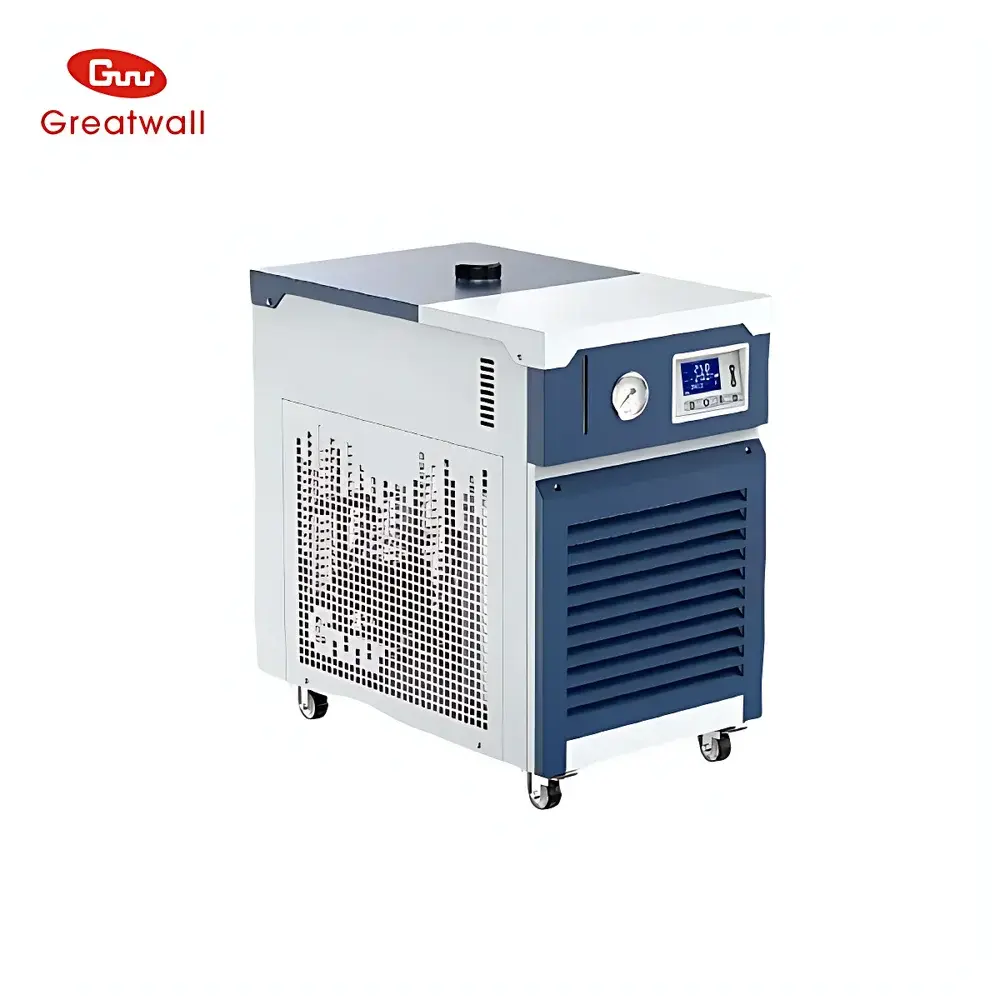
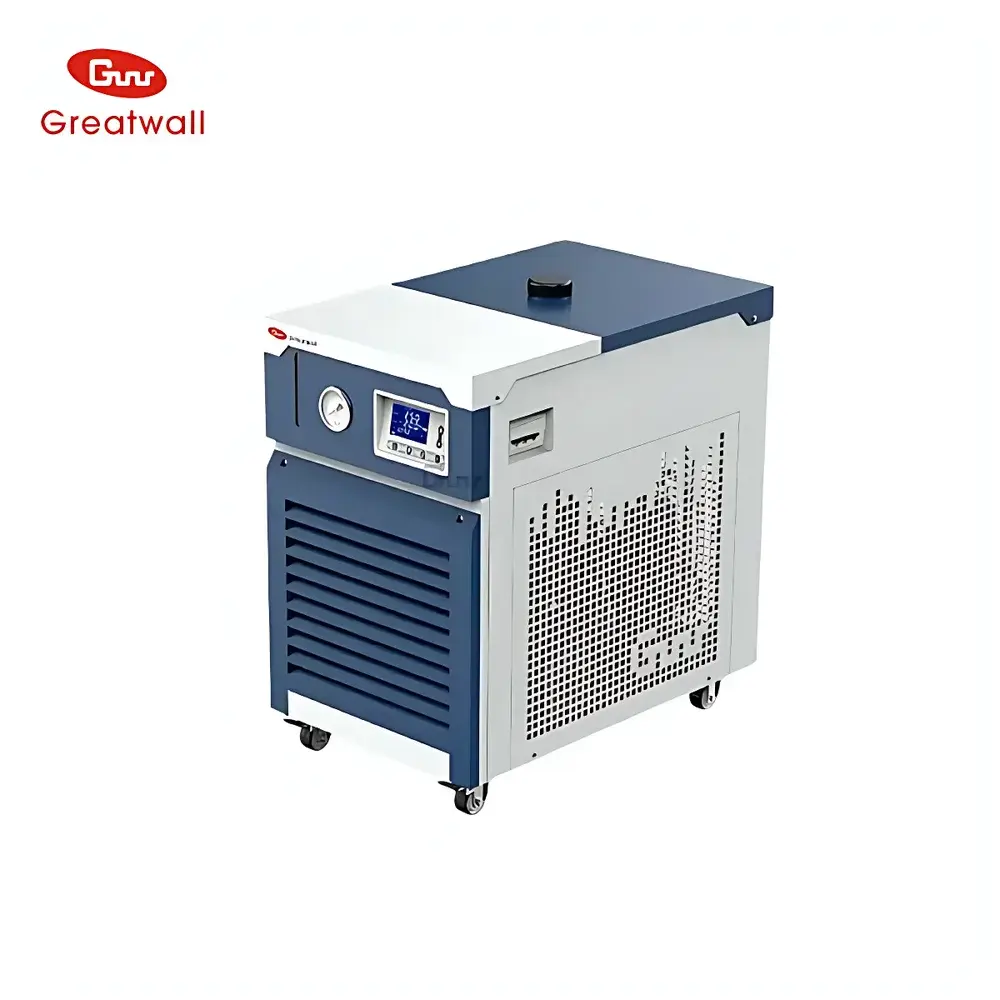
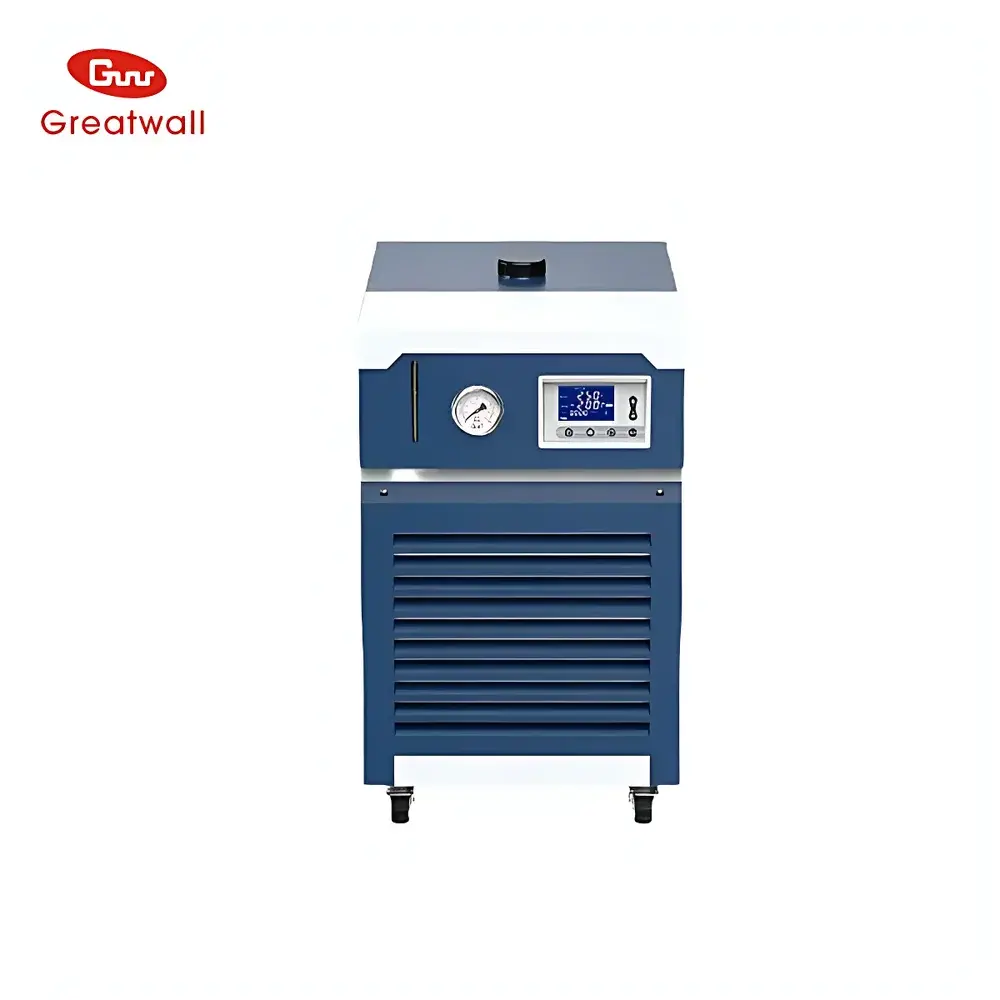
The Great Wall DL20-900 Circulating Chiller
| Brand | The Great Wall |
|---|---|
| Origin | Henan, China |
| Manufacturer Type | Direct Manufacturer |
| Country of Origin | China |
| Model | DL20-900 |
| Instrument Type | Vertical |
| Temperature Range | −20 °C to +25 °C |
| Minimum Empty-Tank Temperature | −20 °C |
| Temperature Stability | ±2 °C |
| Temperature Display | Digital (Pt100 Sensor) |
| Refrigerant | R410A |
| Cooling Capacity | 1650 W at 0 °C, 950 W at −10 °C, 500 W at −20 °C |
| Power Consumption | 1275 W |
| Circulating Pump | 100 W, 20 L/min @ 0.4 bar |
| Reservoir Volume | 10 L |
| Reservoir Material | 304 Stainless Steel |
| External Port | Rc 1/2 internal thread |
| Fill Port Diameter | Ø60 mm |
| Dimensions (W×D×H) | 435 × 690 × 720 mm |
| Net Weight | 70 kg |
| Ambient Operating Conditions | 5–35 °C, ≤70% RH |
| Safety Protections | Compressor delay start, high-pressure cut-off, thermal overload, overcurrent, leakage current, and real-time liquid level monitoring |
Overview
The Great Wall DL20-900 Circulating Chiller is a vertically configured, closed-loop refrigeration system engineered for precise temperature control in laboratory-scale process applications. It operates on a vapor-compression cycle using environmentally compliant R410A refrigerant and delivers stable cooling output across a wide operational range of −20 °C to +25 °C. Unlike open-bath chillers, the DL20-900 maintains a sealed circulation loop—minimizing evaporation loss and preventing moisture ingress into the heat-transfer fluid (e.g., water/glycol mixtures), thereby preserving fluid integrity and long-term thermal performance. Its design targets continuous-duty operation in demanding environments such as pharmaceutical synthesis, chemical reaction calorimetry, rotary evaporation condensation, material property testing under thermal stress, and semiconductor equipment thermal management.
Key Features
- Robust 304 stainless steel reservoir with 10 L capacity—resistant to corrosion from common heat-transfer fluids and compatible with GLP-compliant cleaning protocols.
- Digital Pt100 temperature sensing with ±2 °C stability across the full operating range; integrated display enables real-time setpoint verification and deviation monitoring.
- Multi-layer safety architecture: compressor delay start (prevents mechanical shock during power cycling), high-pressure protection switch, thermal overload relay, overcurrent circuit breaker, and residual-current device (RCD) for electrical safety.
- Visual liquid-level indicator—enables rapid verification of coolant volume without opening the system, supporting routine maintenance compliance and reducing downtime risk.
- High-efficiency circulating pump (100 W, 20 L/min @ 0.4 bar) with Rc 1/2 internal-thread external ports—designed for low-pressure-drop integration with jacketed reactors, condensers, and Peltier-based test fixtures.
- Compact vertical footprint (435 × 690 × 720 mm) optimized for benchtop or floor-standing placement in space-constrained labs; net weight of 70 kg ensures structural stability during vibration-sensitive operations.
Sample Compatibility & Compliance
The DL20-900 supports compatibility with standard aqueous and glycol-based heat-transfer media (e.g., 30% ethylene glycol/water), making it suitable for use with glassware-jacketed reactors, rotary evaporator condensers, differential scanning calorimeters (DSC), and environmental test chambers. Its sealed-loop architecture meets ISO 17025 requirements for measurement traceability in temperature-controlled experiments when paired with calibrated Pt100 sensors. While not certified to UL/CE by default, its electrical and refrigeration subsystems conform to IEC 61000-6-3 (EMC emissions) and IEC 60335-1 (household and similar electrical appliances safety) baseline standards. Users implementing the unit in regulated GMP or FDA-regulated workflows should validate temperature uniformity, stability, and alarm response per SOPs aligned with USP and ASTM E2582.
Software & Data Management
The DL20-900 operates via embedded hardware controls with no proprietary software dependency—ensuring plug-and-play reliability and eliminating licensing or OS compatibility constraints. All operational parameters—including setpoint, actual bath temperature, pump status, and fault codes—are accessible through the front-panel digital interface. For laboratories requiring audit trails, the unit’s discrete alarm outputs (e.g., low-level, overtemperature, compressor fault) can be interfaced with external PLCs or SCADA systems via dry-contact relays. When integrated into computer-controlled platforms, users may log temperature data externally using third-party DAQ hardware synchronized to the chiller’s analog 0–10 V output (optional accessory). No built-in data storage or 21 CFR Part 11 functionality is provided; however, the deterministic behavior of its control logic supports retrospective validation under GLP/GMP frameworks.
Applications
- Temperature regulation of jacketed glass reactors during exothermic or cryogenic synthesis (e.g., Grignard reactions, lithium-aluminum hydride reductions).
- Cooling of rotary evaporator condensers to maximize solvent recovery efficiency at sub-ambient temperatures.
- Thermal conditioning of polymer samples during dynamic mechanical analysis (DMA) or tensile testing per ASTM D638/D790.
- Stabilization of laser diodes, CCD detectors, and RF components in metrology and photonics R&D setups.
- Simulating low-temperature process conditions in pilot-scale bioreactor auxiliary systems and crystallization studies.
FAQ
What is the minimum achievable temperature with a full load of heat-transfer fluid?
The −20 °C specification refers to the empty reservoir condition. Under typical thermal load (e.g., 1–2 kW reactor jacket), sustained operation below −15 °C requires pre-cooling and careful flow-rate optimization; consult the application note “DL20 Series Thermal Load Derating” for empirical curves.
Can the unit be operated continuously at −20 °C ambient temperature?
No. The chiller must be installed in an environment maintained between 5 °C and 35 °C. Operation outside this range risks condensation-induced electrical faults and reduced compressor efficiency.
Is the reservoir compatible with propylene glycol solutions?
Yes—304 stainless steel construction resists corrosion from concentrations up to 50% propylene glycol/water. Avoid chloride-containing additives or phosphate-based inhibitors.
Does the unit support remote start/stop via digital signal?
Standard configuration includes only local control. Optional I/O module (part #DL20-IO-01) provides isolated 24 VDC trigger inputs and relay outputs for integration with central lab automation systems.



