
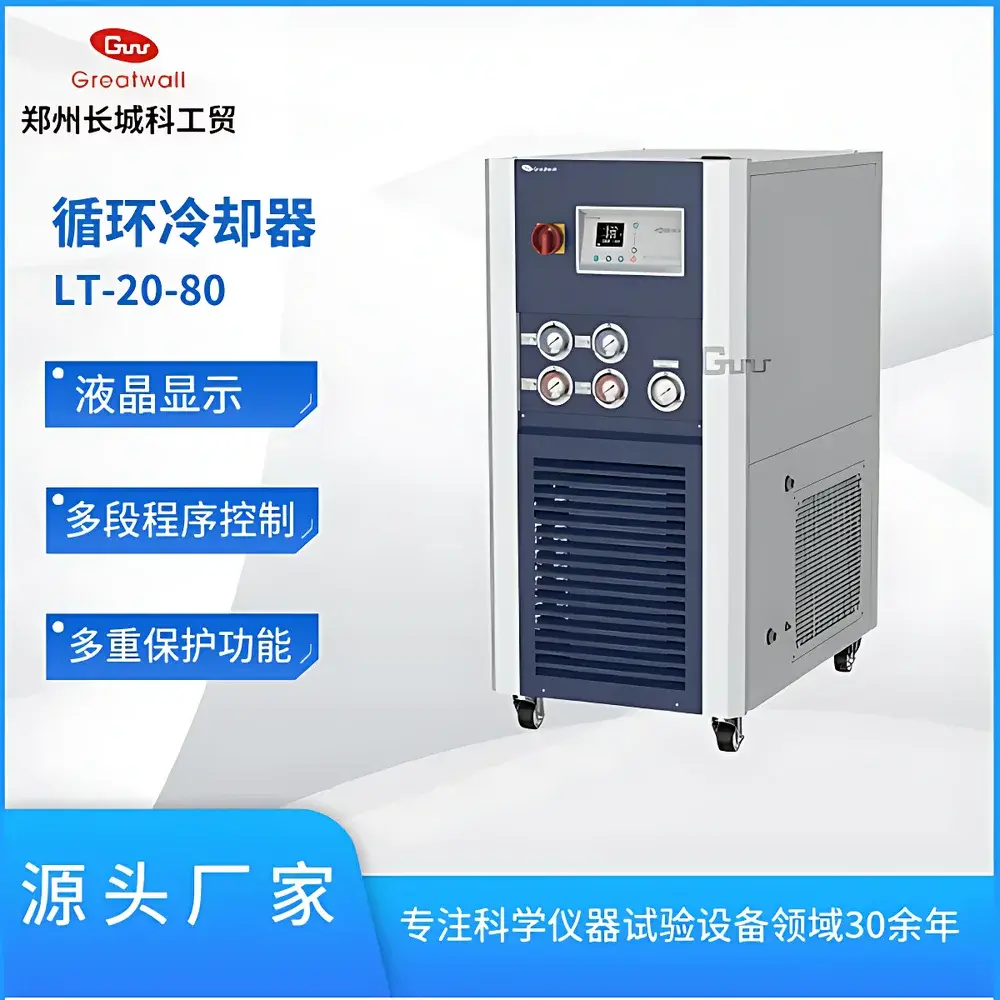
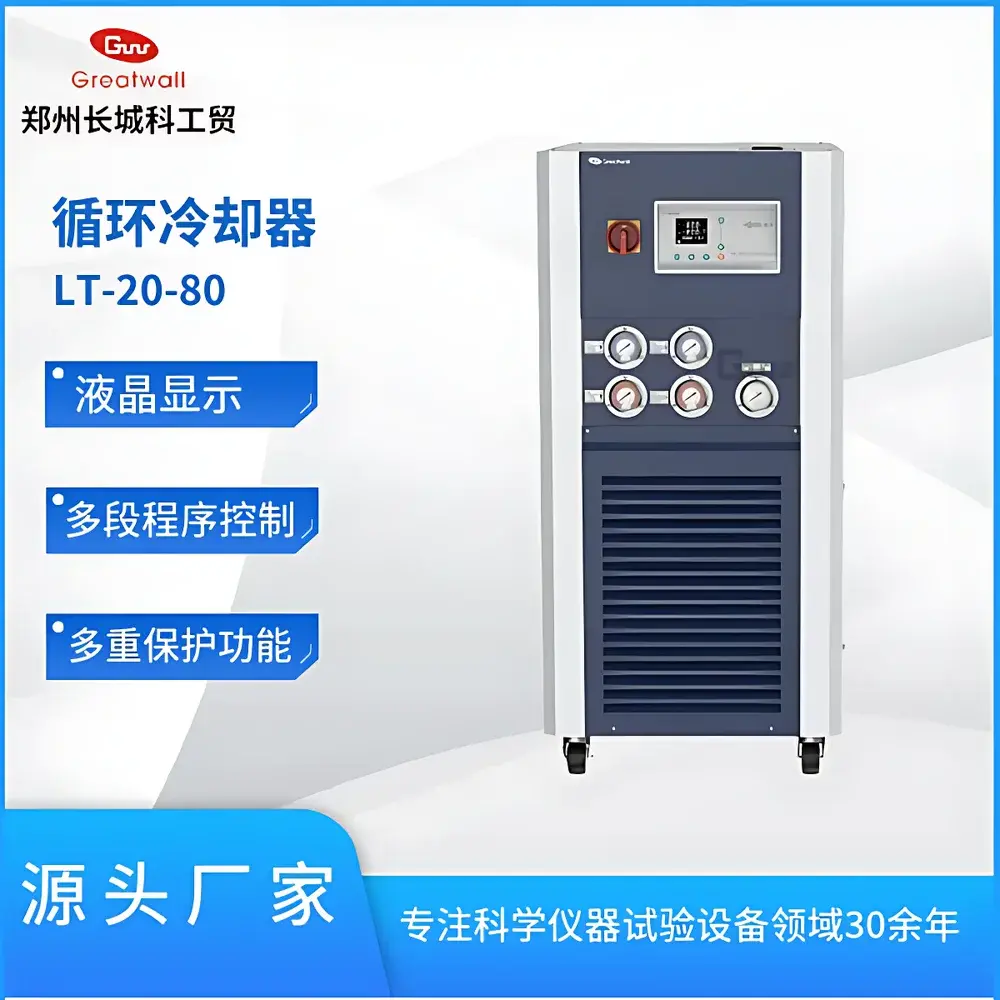
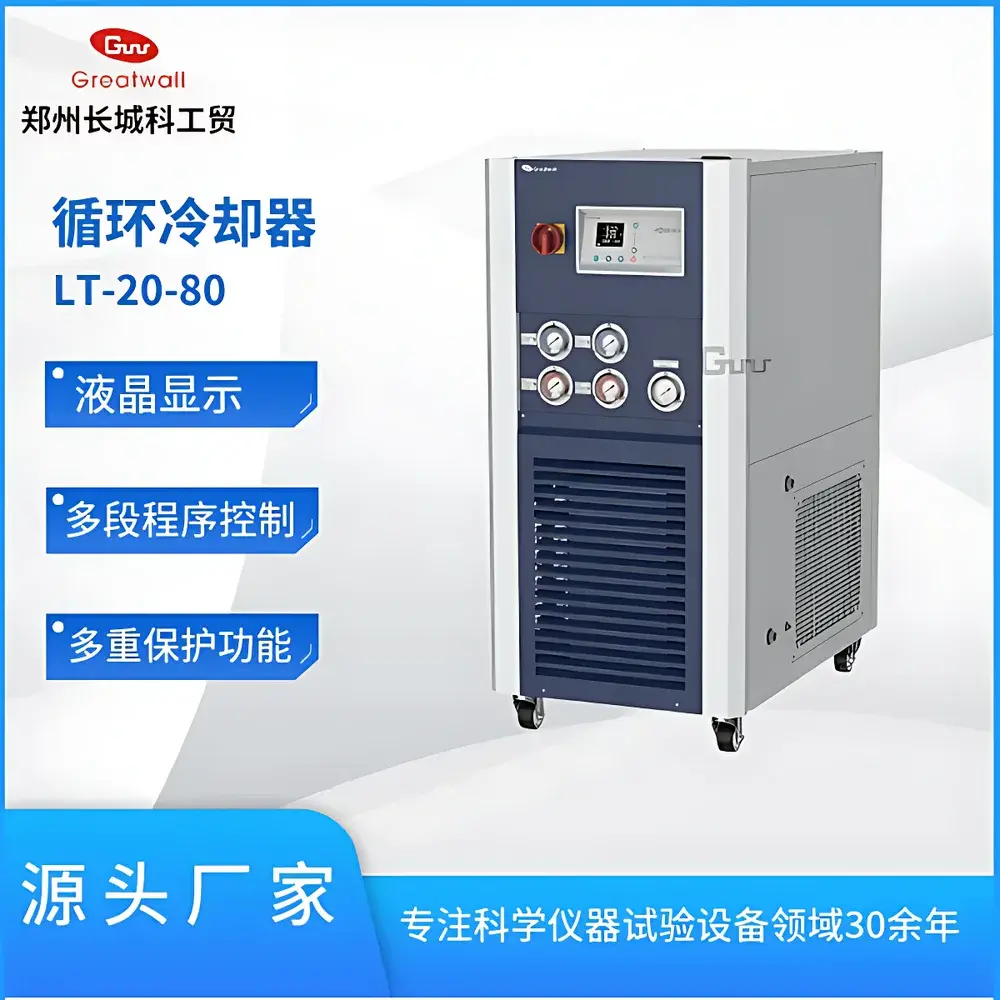
The Great Wall LT-20-80 Ultra-Low Temperature Circulating Chiller
| Brand | The Great Wall |
|---|---|
| Origin | Henan, China |
| Manufacturer Type | Direct Manufacturer |
| Product Type | Integrated Circulating Chiller |
| Cooling Method | Air-Cooled |
| Temperature Range | –80 °C to –40 °C |
| Refrigeration Capacity | 2000 W at –40 °C, 1400 W at –60 °C, 450 W at –80 °C |
| Temperature Stability | ±2 °C |
| Circulation Pump Pressure | 1 bar |
| Flow Rate | 30 L/min |
| Operating Mode | Continuous |
| Refrigerants | R404A & R23 |
| Heat Transfer Fluid Reservoir Volume | 10 L |
| Reservoir Material | SUS304 Stainless Steel |
| Dimensions (W×D×H) | 645 × 1060 × 1320 mm |
| Net Weight | 235 kg |
| Power Supply | 3-phase, 380 V, 50 Hz |
| Rated Power | 4900 W |
| Rated Current | 8.76 A |
| Ambient Operating Conditions | 5–35 °C, ≤70% RH |
| Sensor Type | Pt100 |
| Display | Digital LED |
| External Port | Rc 1/2 internal thread |
| Fill Port Diameter | Ø60 mm |
| Safety Protections | High/Low Pressure Switch, Phase Sequence Protection, Compressor Delay Start, Thermal Overload, Overcurrent, Overflow Drain |
Overview
The Great Wall LT-20-80 Ultra-Low Temperature Circulating Chiller is an engineered solution for precise, stable, and continuous thermal management in demanding laboratory and pilot-scale applications requiring sustained operation below –60 °C. Based on a dual-stage cascade refrigeration architecture utilizing R404A (high-stage) and R23 (low-stage) refrigerants, the system achieves reliable cooling down to –80 °C while maintaining tight temperature stability (±2 °C) across its operational range of –80 °C to –40 °C. Designed as a fully integrated, air-cooled unit, it eliminates dependency on external chilled water infrastructure and delivers high-capacity heat removal—2000 W at –40 °C—making it suitable for exothermic reaction control, cryogenic material testing, and low-temperature process simulation in pharmaceutical synthesis, polymer characterization, and advanced materials R&D.
Key Features
- Robust Cascade Refrigeration System: Dual-compressor design with dedicated high- and low-stage circuits ensures stable ultra-low temperature performance and extended compressor service life under continuous duty cycles.
- Hermetic Stainless Steel Reservoir: 10-liter SUS304 tank minimizes fluid oxidation and moisture ingress, preserving thermal fluid integrity over extended use—critical for long-term consistency in GMP-aligned processes.
- Comprehensive Safety Architecture: Includes high/low pressure cutouts, phase sequence detection, thermal overload relays, overcurrent protection, compressor start-delay logic, and automatic overflow drainage to prevent system damage during maintenance or fluid top-up.
- High-Flow, Low-Pulsation Circulation: 30 L/min flow rate at 1 bar delivery pressure supports large-volume jacketed reactors (e.g., 50–200 L vessels) and multi-point distribution manifolds without significant pressure drop or thermal lag.
- Precision Temperature Control: Pt100 resistance thermometer feedback coupled with digital PID regulation enables repeatable setpoint accuracy and minimal overshoot—even during rapid thermal transitions typical in crystallization or kinetic studies.
- Industrial-Grade Construction: Reinforced steel frame, vibration-dampened compressors, and IP54-rated electrical enclosures ensure reliability in shared lab environments with variable ambient conditions (5–35 °C, ≤70% RH).
Sample Compatibility & Compliance
The LT-20-80 is compatible with common low-temperature heat transfer fluids—including silicone oils, ethylene glycol/water blends (down to –80 °C), and specialized fluorinated solvents—provided viscosity and pour point align with pump specifications. Its sealed circulation path prevents fluid degradation from atmospheric moisture absorption, supporting ISO 17025 traceability requirements when paired with calibrated Pt100 sensors. While not certified to UL/CSA or CE for hazardous locations, the unit complies with IEC 61000-6-3 (EMC emission) and IEC 61000-6-2 (immunity) standards. It meets mechanical safety requirements per ISO 12100 and incorporates safeguards aligned with FDA 21 CFR Part 11 data integrity principles when used with validated external logging systems.
Software & Data Management
The LT-20-80 operates via an embedded digital controller with real-time LED display of setpoint, actual bath temperature, and system status codes. Though it does not include built-in Ethernet or USB data logging, its analog 0–10 V or 4–20 mA output interface enables integration into centralized SCADA or LIMS platforms for automated temperature recording, alarm escalation, and audit trail generation. When deployed in GLP or GMP environments, users commonly pair the chiller with third-party validated data acquisition systems to satisfy 21 CFR Part 11 electronic record requirements—including user authentication, change tracking, and secure archiving of calibration and operational logs.
Applications
- Temperature control of jacketed glass or stainless-steel reactors during low-temperature Grignard, lithiation, or hydrogenation reactions.
- Cryogenic conditioning of polymer films, composites, and battery electrode materials prior to tensile, DMA, or DSC analysis.
- Simulating extreme thermal profiles in accelerated aging studies per ASTM D7566 Annex A5 or ISO 11357-3.
- Stabilizing laser sources, CCD detectors, and superconducting magnet cryostats requiring consistent sub–60 °C cooling.
- Supporting continuous-flow chemistry platforms where residence time and thermal homogeneity are critical to selectivity and yield.
FAQ
What is the lowest achievable temperature with full load capacity?
At –80 °C, the system delivers 450 W of refrigeration capacity—sufficient for small-volume static baths or low-heat-load instrumentation. For high-duty applications (e.g., >1 kW exothermic reactions), optimal performance is achieved between –60 °C and –40 °C.
Can this chiller be used with flammable heat transfer fluids?
No. The LT-20-80 is designed for non-flammable, thermally stable fluids only. Use of hydrocarbon-based oils or alcohols violates safety interlocks and voids warranty.
Is remote monitoring supported out of the box?
The unit provides analog signal outputs (0–10 V / 4–20 mA) for external DAQ integration but lacks native Modbus TCP, RS485, or Wi-Fi connectivity.
What maintenance intervals are recommended?
Compressor oil and filter replacement every 12 months or 4000 operating hours; annual verification of pressure switch thresholds and sensor calibration traceable to NIST standards.
Does the system support external temperature feedback control?
Yes—via optional external Pt100 input mode, enabling process temperature control at the reactor wall or sample location rather than bath setpoint alone.



