
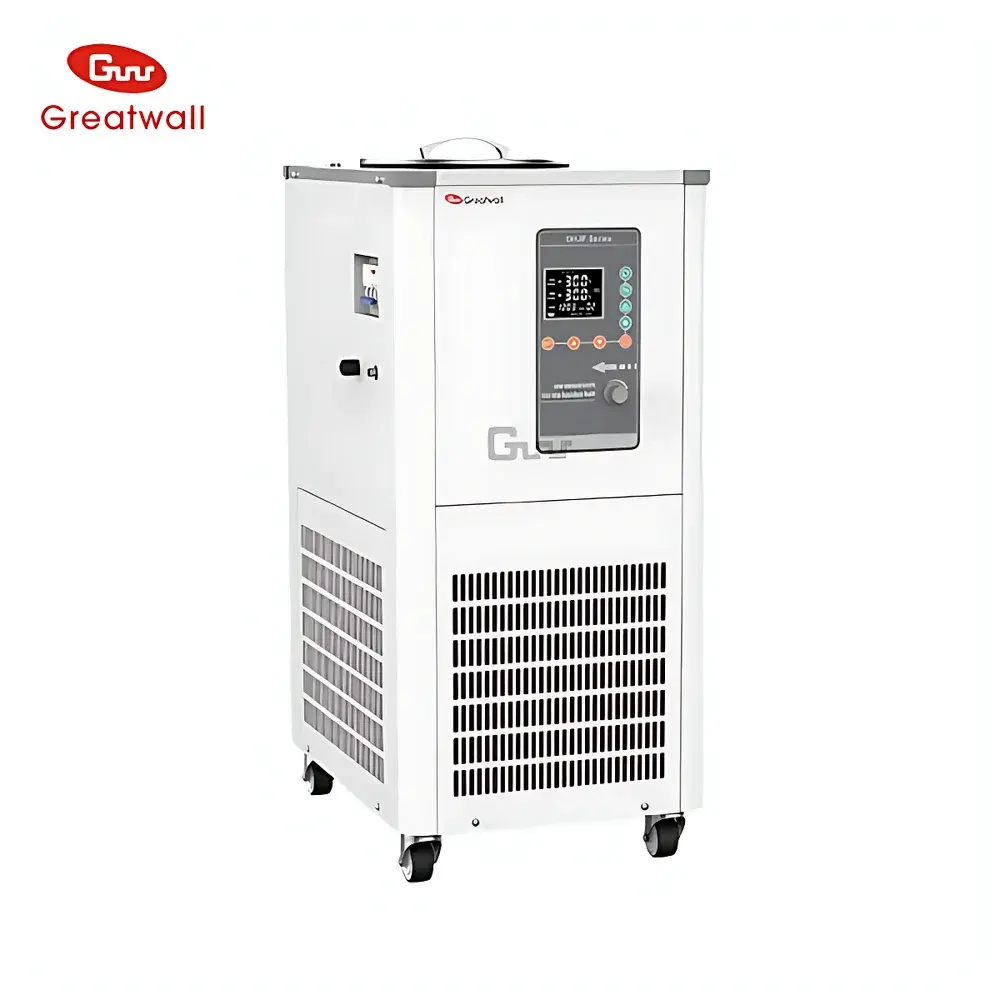
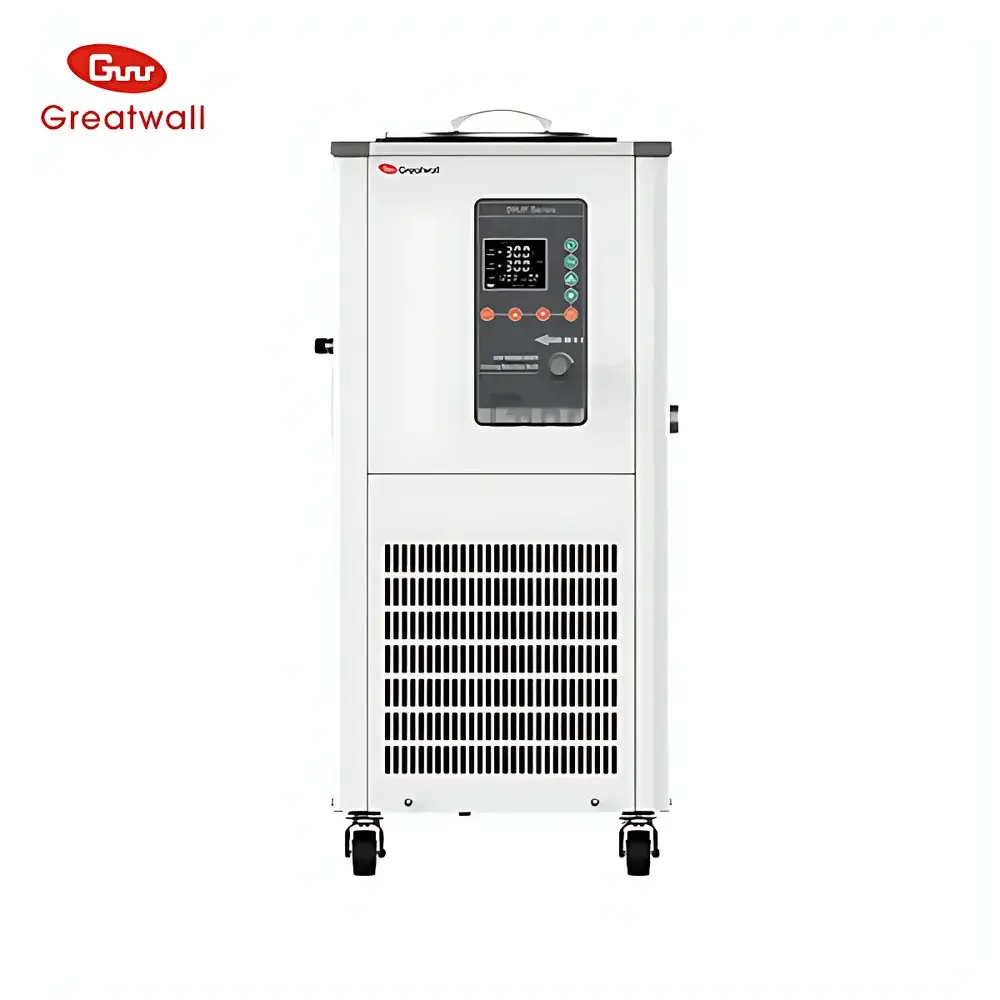
The Great Wall DHJF-3010 Cryogenic Circulating Thermostatic Bath with Integrated Magnetic Stirring
| Key | Brand: The Great Wall |
|---|---|
| Origin | Henan, China |
| Manufacturer Type | Direct Manufacturer |
| Equipment Type | Vertical |
| Temperature Range | −30 °C to 99 °C |
| Temperature Stability | ±0.5 °C |
| Stirring Function | Built-in Magnetic Stirrer (Dual-Position: Bath & Reaction Vessel) |
| Lid | Adjustable Telescopic Cover |
| Accessories | Universal Mounting Rack for Burettes, Probes, and Sensors |
| Safety | Dry-run Protection (Heating Models Only) |
Overview
The Great Wall DHJF-3010 Cryogenic Circulating Thermostatic Bath with Integrated Magnetic Stirring is an engineered laboratory platform designed for precise temperature control and active mixing in open or semi-closed reaction systems. Unlike passive cooling methods such as dry ice or liquid nitrogen baths—which introduce thermal gradients, handling hazards, and limited reproducibility—the DHJF-3010 delivers stable, programmable thermal environments across a broad operational range (−30 °C to 99 °C) using a closed-loop refrigeration-heating system with forced convection circulation. Its core architecture integrates a high-efficiency compressor-based cooling module, a PTFE-coated stainless-steel bath reservoir, and a dual-mode PID temperature controller calibrated to maintain ≤±0.5 °C stability under dynamic load conditions. This enables rigorous experimental repeatability in applications requiring simultaneous thermal regulation and homogeneous mixing—particularly where conventional jacketed reactors or external circulators lack spatial flexibility or real-time responsiveness.
Key Features
- Integrated dual-position magnetic stirring: A recessed stir motor beneath the bath floor drives both the internal bath stir bar and a separate stir bar inside the immersed reaction vessel—ensuring uniform thermal distribution without mechanical coupling or seal leakage risks.
- Adjustable telescopic lid: Precision-machined concentric rings allow incremental aperture reduction (from Ø120 mm down to Ø30 mm), minimizing cryogen evaporation at sub-zero temperatures and suppressing ambient heat ingress during extended low-T operation.
- Modular mounting rack: Anodized aluminum support frame with universal clamping slots (M6–M10 compatibility) accommodates burettes, Pt100/RTD probes, pH electrodes, condenser adapters, and digital thermocouple readers—enabling synchronized multi-parameter monitoring.
- Refrigeration-heating dual-mode system: Hermetically sealed R404A/R134a hybrid circuitry provides rapid ramp rates (≤1.8 °C/min from −30 °C to 25 °C) and stable hold performance, validated per ASTM E2777-21 for thermal uniformity mapping.
- Dry-run protection circuitry: On heating-enabled configurations, current-sensing logic interrupts power to the immersion heater if fluid level falls below the minimum operational threshold—preventing coil damage and ensuring compliance with IEC 61010-1 safety requirements.
Sample Compatibility & Compliance
The DHJF-3010 supports standard laboratory glassware including round-bottom flasks (50–2000 mL), jacketed test tubes, and beakers with diameters up to 110 mm. Its bath depth (180 mm) and internal volume (10 L) permit full immersion of 1-L vessels while maintaining ≥25 mm coolant clearance above the liquid meniscus. All wetted surfaces are electropolished 304 stainless steel with PTFE coating, ensuring chemical resistance to aqueous buffers, organic solvents (e.g., acetone, THF, ethanol), and mild acids (pH ≥2). Device firmware adheres to GLP data integrity principles: temperature setpoints, actual bath readings, and runtime logs are timestamped and non-erasable. While not FDA 21 CFR Part 11-certified out-of-box, audit trails can be exported in CSV/Excel format for integration into validated LIMS environments meeting ISO/IEC 17025:2017 clause 7.7 traceability requirements.
Software & Data Management
The DHJF-3010 operates via a front-panel membrane keypad with LED status indicators and a 4-digit red LED display showing real-time bath temperature, setpoint, and stir speed (0–1200 rpm). Optional RS485 Modbus RTU interface (add-on module) enables remote parameter setting, continuous data streaming (1 Hz sampling), and alarm triggering (e.g., overtemperature, low-level, stir failure) to SCADA or LabVIEW-based control systems. All logged data include UTC timestamps, device ID, and CRC-16 checksums—supporting retrospective analysis under ISO 15197:2013 Annex C validation protocols for analytical instrumentation.
Applications
- Enzyme kinetics studies requiring strict thermal control between 4 °C and 45 °C, with concurrent mixing to prevent protein aggregation.
- Synthesis of temperature-sensitive organometallic complexes (e.g., Grignard reagents) at −20 °C to −10 °C under inert atmosphere, using the telescopic lid to minimize argon purge loss.
- Calibration of differential scanning calorimeters (DSC) and thermogravimetric analyzers (TGA) against NIST-traceable reference materials.
- Stability testing of pharmaceutical formulations per ICH Q1A(R2), including freeze-thaw cycling protocols with defined ramp/hold profiles.
- Cell culture media preconditioning and cold-shock induction in molecular biology workflows.
FAQ
Does the DHJF-3010 support external temperature feedback control?
Yes—when equipped with the optional Pt100 probe input port, the unit accepts external sensor signals for cascade control, enabling jacketed reactor temperature referencing.
Can it operate continuously at −30 °C in ambient conditions above 30 °C?
Continuous operation at the lower limit requires adequate ventilation (≥200 cm² free airflow area) and ambient humidity <60% RH to prevent compressor overload; derating curves are provided in Section 4.2 of the technical manual.
Is the magnetic stirring torque sufficient for viscous reaction mixtures?
Maximum torque output is 45 mN·m at 600 rpm—validated for solutions up to 500 mPa·s (e.g., 30% w/v PEG 6000 in water) using standard PTFE-coated stir bars.
What coolant fluids are compatible with the circulating system?
Recommended working fluids include 30% ethylene glycol/water (for −30 °C operation), silicone oil (up to 99 °C), or certified low-volatility heat transfer fluids meeting ASTM D6793 specifications.
How is calibration traceability established?
Each unit ships with a factory calibration certificate referencing NIST SRM 1750 (Standard Platinum Resistance Thermometer), with uncertainty ≤±0.15 °C at 25 °C (k=2).



