
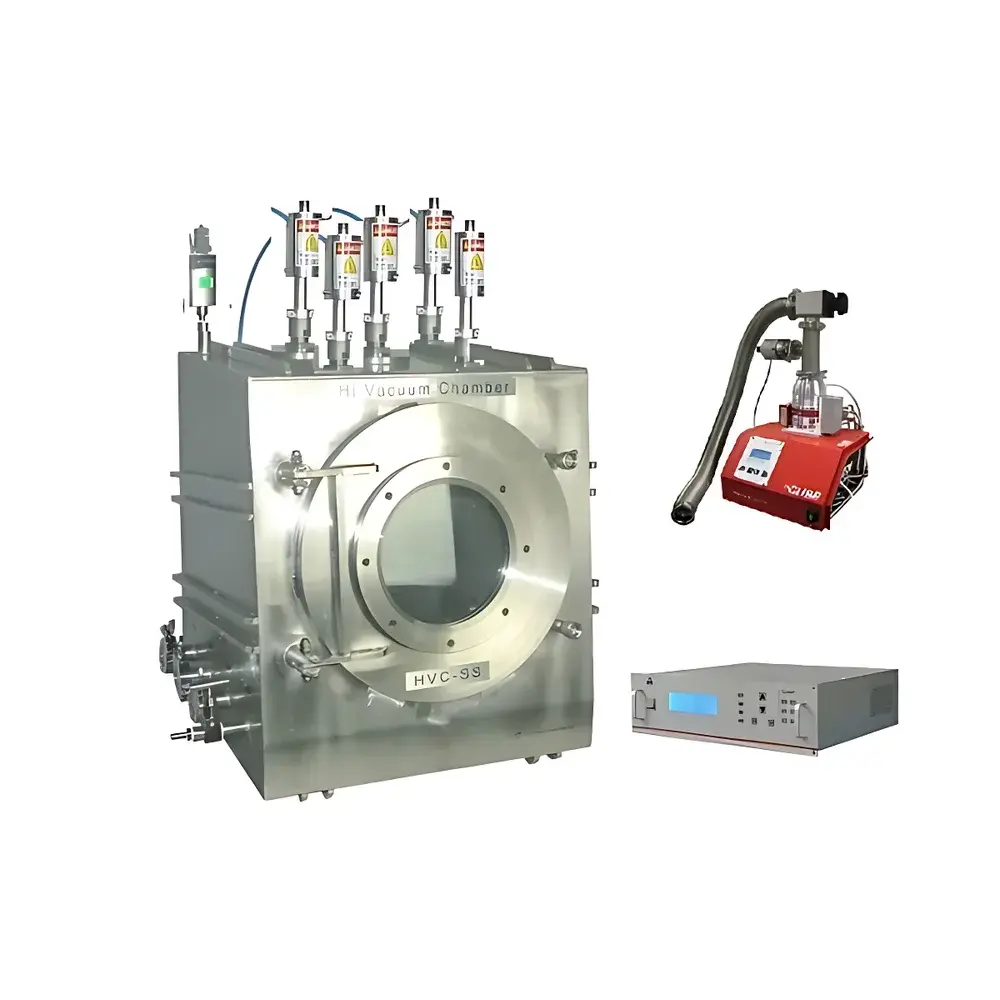
Hefei Kejing VTC-5RF Five-Target RF Magnetron Sputtering System for High-Throughput MGI Thin-Film Synthesis
| Brand | Hefei Kejing |
|---|---|
| Origin | Anhui, China |
| Model | VTC-5RF (Optimized for Materials Genome Initiative Thin-Film Research) |
| Target Material Options | Au, Ag, Cu |
| Target Diameter | 25.4 mm |
| Target Thickness Max | 3 mm |
| Sputtering Distance | 50–80 mm (adjustable) |
| Sputtering Angle | 0–25° (adjustable) |
| Chamber Dimensions | 470 mm L × 445 mm D × 522 mm H (~105 L) |
| Sample Stage Diameter | 150 mm |
| Rotation Capability | Programmable, 16-position indexing |
| Maximum Stage Temperature | 600 °C |
| RF Power Supply | 13.56 MHz, 300 W, auto-matching |
| Gas | High-purity Ar (99.999%) |
| Base Vacuum | ≤4×10⁻⁵ Torr (with turbomolecular pump, KF40 flange) |
| Cooling | Recirculating chiller, 10 L/min flow rate |
| Compliance | CE-certified |
| Weight | 60 kg |
Overview
The Hefei Kejing VTC-5RF is a precision-engineered five-target radio frequency (RF) magnetron sputtering system designed explicitly for high-throughput combinatorial thin-film synthesis in support of Materials Genome Initiative (MGI) workflows. It employs RF magnetron sputtering—a plasma-based physical vapor deposition (PVD) technique—where energetic argon ions bombard electrically insulated or semiconducting targets under controlled vacuum conditions, enabling stoichiometric transfer of non-conductive and conductive materials onto substrates. Unlike DC sputtering, RF excitation permits stable plasma generation with dielectric targets (e.g., Al₂O₃, ZnO, LiCoO₂), making the VTC-5RF uniquely suited for solid-state electrolyte discovery, oxide heterostructure engineering, and multi-component functional film libraries. Its modular architecture integrates five independently addressable 1-inch water-cooled magnetron heads, each configurable with distinct elemental or compound targets, allowing sequential or synchronized co-sputtering to generate composition-gradient or discrete 16-sample arrays on a single rotating substrate stage.
Key Features
- Five independent 1-inch RF magnetron sputter heads with integrated water-cooling jackets, compatible with metallic (Au, Ag, Cu) and ceramic (Al₂O₃, TiO₂, etc.) targets up to 25.4 mm diameter and 3 mm thickness
- Programmable 16-position rotating sample stage (Φ150 mm), enabling automated synthesis of compositionally distinct thin-film libraries without manual intervention
- Integrated 13.56 MHz, 300 W auto-matching RF power supply with front-panel rotary selector for rapid target activation; optional expansion to five independent RF or DC sources for concurrent multi-target deposition
- Stainless steel 304 vacuum chamber (105 L volume) with hinged Φ380 mm door and Φ150 mm quartz viewport; base pressure ≤4×10⁻⁵ Torr achieved via KF40-flanged turbomolecular pumping system
- Heated sample stage with programmable temperature control up to 600 °C, supporting reactive sputtering, epitaxial growth, and post-deposition annealing-in-situ
- Integrated recirculating chiller (10 L/min flow rate) and electrically actuated shutter system for precise layer-by-layer deposition control
- CE-certified construction with safety interlocks, emergency power cutoff, and grounded high-voltage shielding per IEC 61000-6-3/6-4 standards
Sample Compatibility & Compliance
The VTC-5RF accommodates standard single-crystal wafers (e.g., Si, Al₂O₃, SrTiO₃, MgO) up to 150 mm in diameter and supports pre-deposition surface preparation—including ultrasonic cleaning (acetone/ethanol), N₂ purging, and optional plasma pretreatment—to ensure reproducible nucleation. For insulating substrates or films requiring enhanced adhesion, optional buffer layers (Cr, Ti, Mo, Ta) can be deposited using auxiliary DC or RF sources. All sputtering processes comply with ISO 14001 environmental handling guidelines for Ar gas use and adhere to laboratory safety protocols outlined in ANSI Z9.11 and EU Directive 2014/30/EU (EMC). The system’s vacuum integrity and thermal stability are validated for GLP-compliant thin-film process documentation when paired with optional data-logging software.
Software & Data Management
While the base configuration utilizes analog instrumentation with manual parameter setting, the VTC-5RF supports digital integration via optional RS-232/USB interface modules. Third-party LabVIEW or Python-based control suites enable full automation of sputtering time, stage rotation sequence, RF power ramping, and temperature profiling. Optional quartz crystal microbalance (QCM) thickness monitor (±0.1 Å resolution, water-cooled) provides real-time film growth rate feedback and endpoint detection. All operational logs—including vacuum history, power delivery, stage position, and gas flow—are timestamped and exportable in CSV format for audit-ready traceability, aligning with FDA 21 CFR Part 11 requirements when configured with electronic signature capability.
Applications
- Combinatorial discovery of solid-state battery electrolytes (e.g., LiₓTaᵧZr₂₋ᵧO₁₂, Na₃PS₄ analogs) via 5-element co-sputtering and compositional mapping
- Growth of epitaxial ZnO, VO₂, and perovskite oxide heterostructures on lattice-matched substrates for tunable electronic phase transitions
- Development of transparent conducting oxides (TCOs) and plasmonic nanostructures using Au/Ag/Cu multilayer stacks
- Rapid screening of catalytic metal-oxide interfaces (e.g., Pt–CeO₂, Ni–Al₂O₃) for electrochemical and thermocatalytic performance
- Deposition of diffusion barrier layers (TiN, TaN) and seed layers for advanced microelectronics packaging
FAQ
What target materials are compatible with the VTC-5RF?
Metallic (Au, Ag, Cu), semiconductor (Si, Ge), and insulating (Al₂O₃, TiO₂, ZnO, LiCoO₂) targets up to 25.4 mm diameter and 3 mm thickness; non-conductive targets require backside copper bonding using conductive silver paste.
Is high vacuum required for oxide film growth?
No—base pressure of ≤4×10⁻⁵ Torr is sufficient for most MGI-oriented oxide synthesis; higher vacuum (<10⁻⁷ Torr) is not necessary unless ultra-low defect density is mandated.
Can the system deposit multilayer structures with sharp interfaces?
Yes—electrically actuated shutters, programmable stage rotation, and sub-second RF power modulation allow controlled layer stacking with interfacial roughness <0.3 nm RMS.
What cooling medium is recommended for the chiller?
Deionized water or specialized glycol-water coolant; tap water is prohibited due to mineral deposition risk in water-cooled magnetrons and RF matching networks.
Does the system support reactive sputtering with O₂ or N₂?
Yes—optional mass flow controllers (MFCs) for reactive gases can be integrated into the existing Ar line; process recipes include partial pressure regulation and plasma impedance monitoring.



