
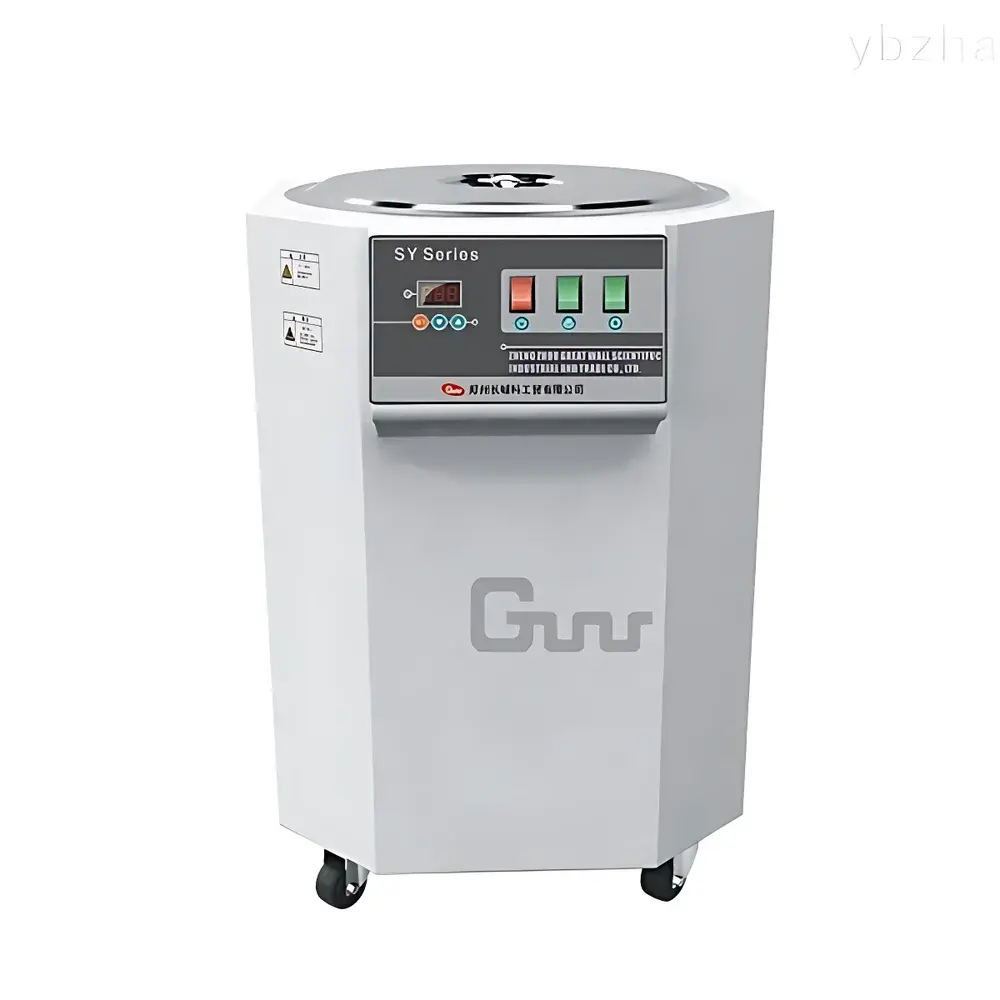
The Great Wall SY-50 High-Temperature Circulating Bath
| Brand | The Great Wall |
|---|---|
| Origin | Henan, China |
| Manufacturer Type | Manufacturer |
| Product Category | Domestic |
| Model | SY-50 |
| Instrument Type | Water/Oil Bath |
| Circulation Mode | Internal & External |
| Temperature Control | Heating-Only |
| Bath Volume | 20 L |
| Temperature Range | RT + 5 °C to 200 °C |
| Temperature Stability | ±0.5 °C |
Overview
The Great Wall SY-50 High-Temperature Circulating Bath is a precision-engineered liquid temperature control system designed for external heating applications in industrial and laboratory environments. Operating on resistive electric heating principles, it circulates thermally stable heat-transfer fluids—such as silicone oil, glycol-water mixtures, or high-flash-point synthetic oils—through closed-loop external systems via a robust stainless-steel circulation path. Unlike standard immersion baths, the SY-50 functions as a standalone thermal source capable of delivering controlled, pressurized flow to jacketed reactors, condensers, distillation columns, or custom process vessels. Its operational envelope spans from ambient +5 °C up to 200 °C with a certified stability of ±0.5 °C under steady-state conditions—a performance benchmark aligned with ASTM E1137/E1137M for laboratory temperature uniformity verification. The unit is engineered for continuous duty in pharmaceutical synthesis, fine chemical processing, polymerization studies, and pilot-scale reaction optimization where reproducible thermal input is critical to kinetic control and product consistency.
Key Features
- Stainless-steel fluid path (including pump housing, tubing connections, and internal reservoir) ensures long-term resistance to oxidation, thermal degradation, and chemical attack from common organic heat-transfer media.
- PID-based digital temperature controller with real-time setpoint adjustment, ramp/soak programming capability, and user-configurable alarm thresholds for overtemperature, low-level, and dry-run protection.
- High-efficiency circulation pump rated at 370 W, delivering up to 42 L/min at 2.8 bar maximum pressure—sufficient to overcome typical pressure drops across reactor jackets and heat exchangers.
- Hermetically sealed circulation system minimizes evaporation and oxidation of thermal fluid, extending service life and reducing maintenance frequency per ISO 6743-12 lubricant longevity guidelines.
- Integrated 3/4″ NPT stainless-steel insulated flexible hoses (2 m length) with quick-connect fittings facilitate rapid deployment and leak-resistant coupling to external equipment.
- Front-panel LED display with dual-parameter readout (actual temperature and setpoint), intuitive keypad navigation, and non-volatile memory for parameter retention after power interruption.
Sample Compatibility & Compliance
The SY-50 accommodates a wide range of thermally stable liquids—including mineral oils, polydimethylsiloxane (PDMS), and propylene glycol–water blends—with flash points exceeding 150 °C. It complies with IEC 61010-1:2010 for safety requirements of electrical equipment for measurement, control, and laboratory use. Its construction meets IP20 ingress protection standards and operates within ambient conditions of 5–40 °C and ≤60% RH. While not intrinsically rated for hazardous locations, the unit supports integration into GMP-compliant facilities when deployed with documented calibration procedures traceable to NIST standards and operated under SOPs aligned with FDA 21 CFR Part 11 data integrity expectations for thermal process records.
Software & Data Management
The SY-50 operates as a standalone instrument without proprietary software dependency. However, its analog 0–10 V or 4–20 mA process output (optional configuration) enables connection to third-party SCADA systems, PLCs, or data loggers for time-stamped temperature trending and audit-ready record generation. When integrated into validated workflows, users may implement electronic signatures, change control logs, and alarm event histories consistent with GLP/GMP Annex 11 principles. Calibration certificates—including as-found/as-left data, uncertainty budgets, and traceability statements—are provided upon request to support regulatory submissions.
Applications
- Heating and temperature maintenance of jacketed glass or stainless-steel reactors during exothermic/endothermic synthesis.
- Thermal conditioning of analytical instrumentation requiring stable bath temperatures (e.g., viscometers, densitometers, or refractometers).
- Process validation studies involving thermal ramping profiles in API manufacturing per ICH Q5C guidelines.
- Accelerated stability testing of formulations under elevated temperature stress conditions (e.g., ICH Q1A(R2)).
- Calibration of temperature sensors and transmitters using fixed-point reference baths or comparison methods.
- Supporting solvent recovery systems by maintaining optimal condenser coil temperatures during vacuum distillation.
FAQ
What is the maximum recommended operating temperature for the SY-50 model?
The SY-50 is rated for continuous operation up to 200 °C; exceeding this limit may compromise seal integrity and thermal fluid stability.
Can the SY-50 be used with water as the circulating medium?
Water is not recommended above 95 °C due to vapor pressure concerns and accelerated corrosion risk; silicone oil or specialized high-temperature heat-transfer fluids are strongly advised for operation above 100 °C.
Is the circulation system compatible with external pressure regulation?
Yes—the unit delivers up to 2.8 bar pressure and can interface with external back-pressure regulators or flow control valves to manage system hydraulics in complex loop configurations.
Does the SY-50 include a built-in cooling function?
No; the SY-50 is a heating-only system. For combined heating/cooling applications, a separate chiller or dual-temperature circulator is required.
How often should the thermal fluid be replaced?
Fluid replacement intervals depend on usage profile and thermal history; annual analysis of acid number, viscosity shift, and volatile content per ASTM D92/D97 is recommended to determine service life.



