
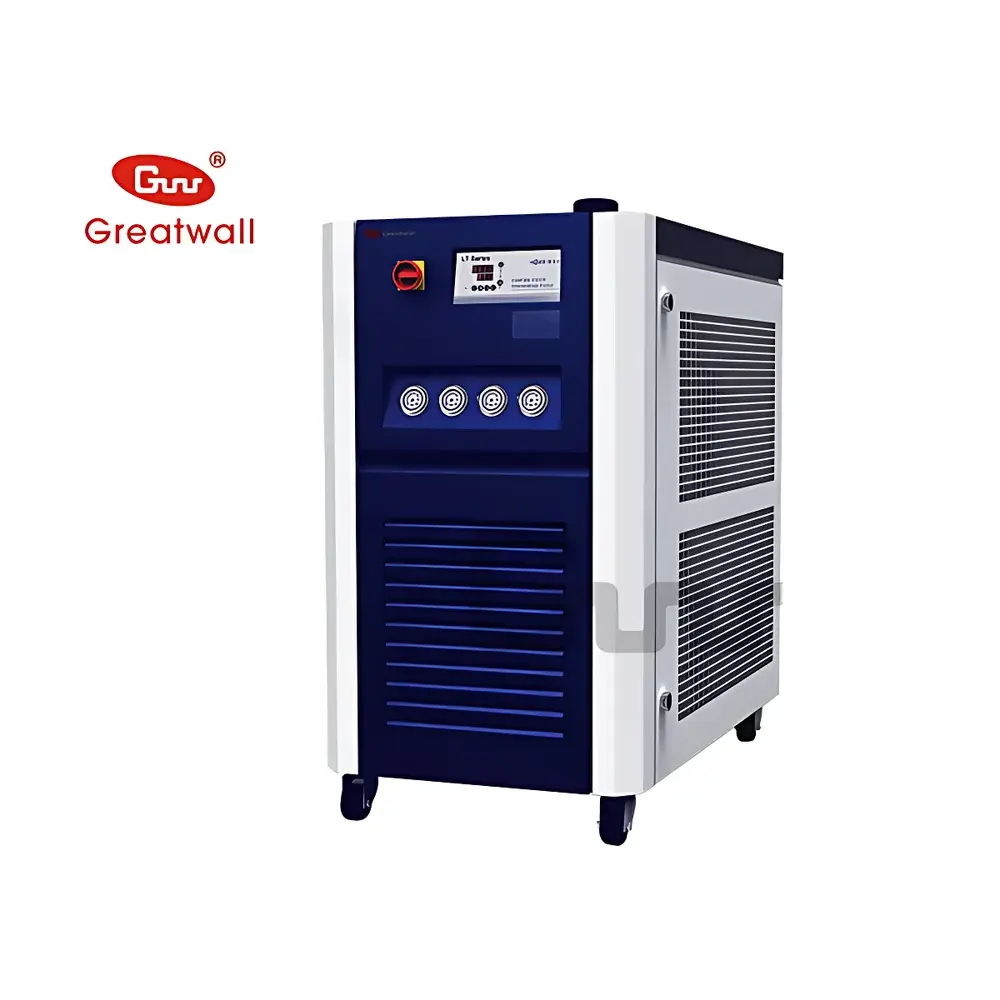
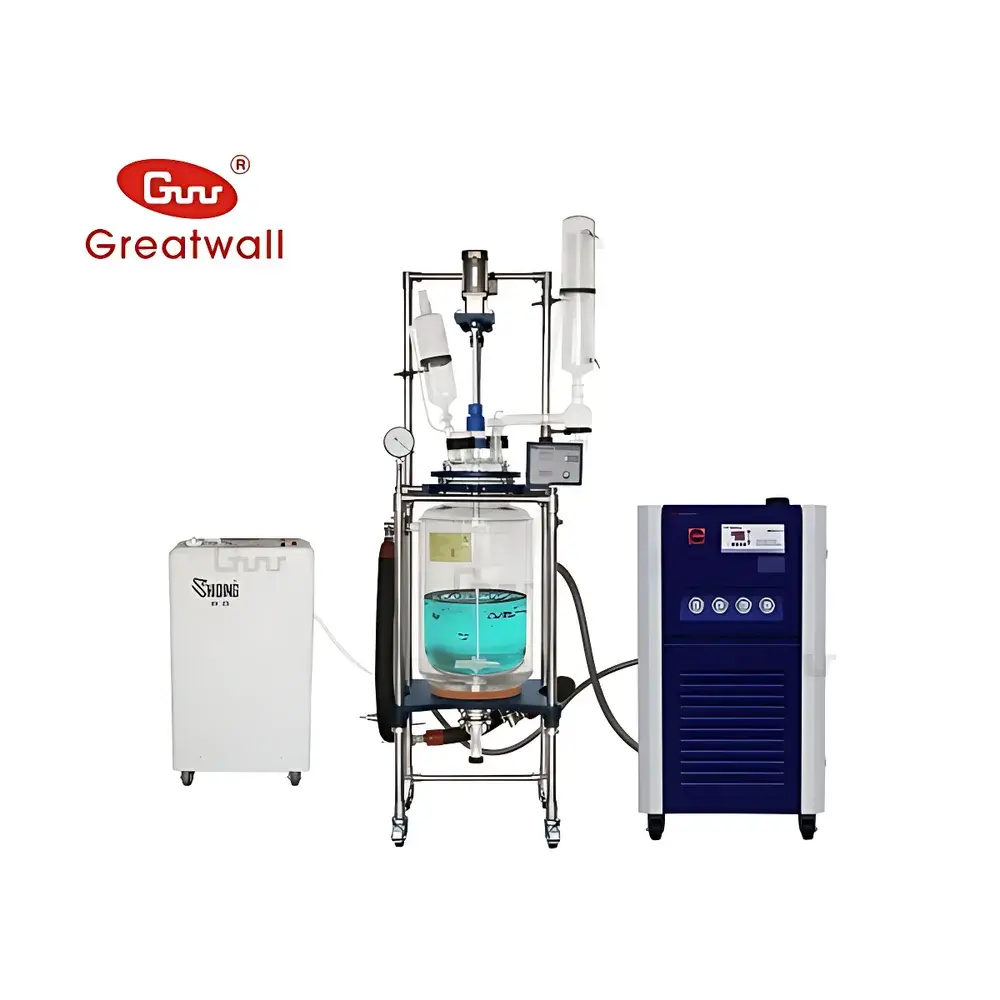
The Great Wall LT-100-80 Ultra-Low Temperature Circulating Chiller
| Brand | The Great Wall |
|---|---|
| Origin | Henan, China |
| Manufacturer Type | Direct Manufacturer |
| Product Type | Integrated Circulating Chiller |
| Cooling Method | Air-Cooled |
| Temperature Range | –80 °C to –40 °C |
| Refrigeration Capacity | 10 kW @ –40 °C |
| Temperature Stability | ±2 °C |
| Circulating Pump Pressure | 1.0 bar |
| Circulating Pump Flow Rate | 30 L/min |
| Reservoir Volume | 24 L |
| Operation Mode | Continuous Duty |
| Refrigerants | R404A / R23 |
| Sensor Type | Pt100 |
| Power Supply | 3-phase, 380 V, 50 Hz |
| Ambient Operating Conditions | 5–35 °C, ≤70% RH |
| Reservoir Material | SUS304 Stainless Steel |
| Dimensions (W×D×H) | 867 × 1475 × 1598 mm |
| Net Weight | 600 kg |
Overview
The Great Wall LT-100-80 Ultra-Low Temperature Circulating Chiller is an engineered thermal management solution designed for precise, stable, and continuous sub-ambient temperature control in demanding laboratory and pilot-scale industrial applications. Operating on a dual-refrigerant cascade system (R404A/R23), it achieves sustained output temperatures from –80 °C to –40 °C with high thermodynamic efficiency and long-term operational reliability. Unlike single-stage chillers, the cascade architecture enables deep-cold capability without excessive compressor strain or refrigerant charge inefficiencies. Its fully sealed, closed-loop circulation design minimizes moisture ingress and volatile loss of heat-transfer fluids—critical for maintaining fluid integrity during extended low-temperature operation in pharmaceutical synthesis, polymer characterization, cryogenic material testing, and controlled chemical reaction kinetics.
Key Features
- Integrated air-cooled cascade refrigeration system delivering up to 10 kW cooling capacity at –40 °C, with 2.5 kW residual capacity at –80 °C under standard ambient conditions (25 °C).
- Stainless steel (SUS304) reservoir and fluid pathways ensure corrosion resistance and compatibility with common synthetic heat-transfer media—including silicone oils, ethylene glycol/water blends, and specialized low-temperature organic fluids.
- Dual-safety architecture: includes high-pressure cut-off, phase-sequence monitoring, compressor thermal overload protection, delayed start logic, and overcurrent interruption—all compliant with IEC 61000-6-2/6-4 EMC and EN 60335-1 safety standards.
- Intelligent liquid-level management system with overflow detection and automatic discharge to prevent overfilling—a critical safeguard during manual fluid replenishment or system commissioning.
- High-flow, low-pulsation centrifugal circulation pump (30 L/min at 1.0 bar) optimized for low-viscosity cryogenic fluids and compatible with external jacketed reactors, calorimeters, and environmental test chambers.
- Digital Pt100-based temperature sensing with ±0.3 °C sensor accuracy and ±2 °C system stability across the full operating range, verified per ISO/IEC 17025 traceable calibration protocols.
Sample Compatibility & Compliance
The LT-100-80 supports a wide range of externally connected equipment, including glass or stainless steel jacketed reactors (up to 200 L volume), differential scanning calorimeters (DSC), rheometers with Peltier or cryo accessories, and vacuum chamber cooling manifolds. Its closed-loop design eliminates atmospheric exposure of heat-transfer fluids—reducing oxidation, hydrolysis, and viscosity drift over time. The unit complies with CE marking requirements (2014/30/EU EMC Directive and 2014/35/EU LVD Directive), conforms to RoHS 2011/65/EU restrictions on hazardous substances, and meets essential performance criteria outlined in ASTM E2500–21 (Good Practice for Specification of Pharmaceutical and Biotechnology Equipment). While not FDA 21 CFR Part 11–validated out-of-the-box, its digital interface and event-logging capability support integration into GxP environments when paired with qualified third-party data acquisition systems.
Software & Data Management
The chiller features a front-panel 7-inch TFT LCD touchscreen interface with real-time display of setpoint, actual outlet temperature, flow rate, refrigerant pressures, and fault diagnostics. All operational parameters—including run time, compressor cycles, and alarm history—are stored locally for ≥30 days with timestamped records. Optional RS485 Modbus RTU or Ethernet TCP/IP communication modules enable remote monitoring and integration into SCADA or LIMS platforms. Audit trail functionality (user login, parameter changes, alarm acknowledgments) satisfies basic GLP documentation requirements; full 21 CFR Part 11 compliance requires supplemental validation of the host supervisory system and electronic signature workflows.
Applications
- Controlled exothermic reaction quenching in API synthesis, where rapid heat extraction below –70 °C prevents thermal degradation or side-product formation.
- Cryogenic mechanical testing of advanced composites and battery electrode materials under programmable thermal ramp profiles.
- Stabilization of superconducting magnets and NMR probe pre-cooling circuits requiring steady-state sub-60 °C coolant supply.
- Environmental stress screening (ESS) of microelectronics packages using thermal cycling between –80 °C and ambient in climatic test enclosures.
- Low-temperature crystallization studies in biopharmaceutical formulation development, where nucleation kinetics are highly sensitive to thermal precision.
FAQ
What is the minimum achievable temperature at the fluid outlet, and under what ambient conditions is this rated?
The LT-100-80 is rated to deliver –80 °C at the outlet port when ambient temperature is ≤25 °C and relative humidity ≤70%. Performance degrades gradually above 30 °C ambient due to reduced condenser efficiency.
Can this chiller be used with flammable heat-transfer fluids such as pentane or acetone?
No. The unit is designed exclusively for non-flammable, thermally stable fluids meeting ISO 6743-22 classification (e.g., synthetic polyalphaolefins or silicone oils). Use of flammable solvents violates ATEX and IECEx safety directives and voids warranty.
Is the reservoir volume sufficient for connecting to a 100-L reactor with 15 m of insulated tubing?
Yes. With a 24-L reservoir and 30 L/min flow rate, the system maintains hydraulic stability and thermal inertia even with extended external loop volumes. Recommended minimum fluid volume in the total circuit is 45 L to ensure adequate subcooling margin and pump cavitation prevention.
Does the unit include factory calibration documentation traceable to national standards?
Each unit ships with a Certificate of Conformance and a temperature verification report (at –40 °C and –80 °C) referenced to NIST-traceable Pt100 standards. Full ISO/IEC 17025 calibration certificates are available upon request at additional cost.
What maintenance intervals are recommended for long-term reliability?
Compressor oil and filter replacement every 3,000 operating hours; refrigerant leak inspection annually; heat exchanger coil cleaning every 6 months in dusty environments; and full system performance verification every 24 months per manufacturer’s service bulletin SB-LT100-REV4.



