
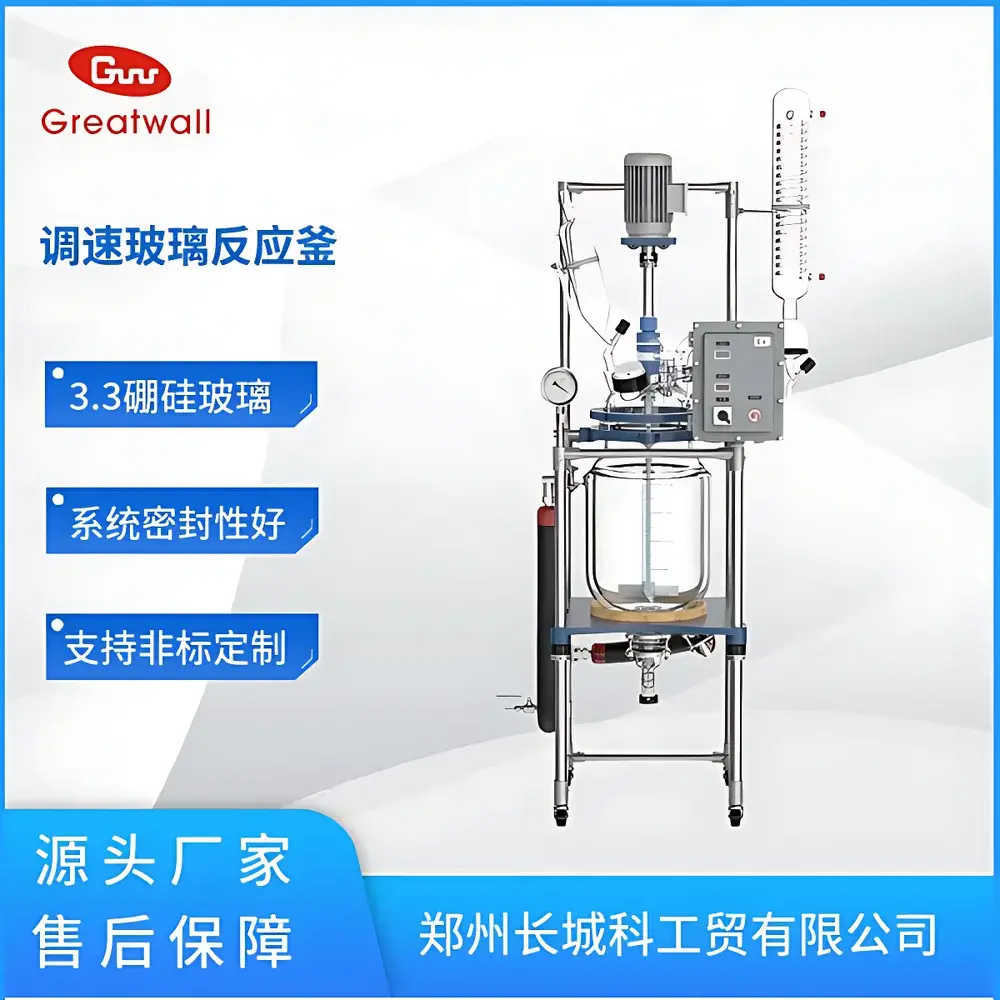
The Great Wall GR-20 Ex Explosion-Proof Glass Reactor
| Brand | The Great Wall |
|---|---|
| Origin | Henan, China |
| Manufacturer Type | Manufacturer |
| Country of Origin | Domestic (China) |
| Model | GR-20 Ex |
| Instrument Category | Reactor |
| Vessel Volume | 20 L |
| Vessel Material | Borosilicate Glass 3.3 |
| Operating Pressure Range | –0.1 MPa to 0 MPa (vacuum to atmospheric) |
| Jacket Pressure Rating | ≤ 0.03 MPa |
| Vacuum Level | 0.098 MPa |
| Temperature Range | –80 °C to +200 °C |
| Thermal Shock Resistance | 80 °C |
| Stirring Speed Range | 50–500 rpm |
| Speed Accuracy | ±1 rpm |
| Motor Power | 180 W |
| Motor Type | Flameproof Three-Phase Induction Motor (Ex db IIB T4 Gb) |
| Stirrer Shaft Material | 06Cr19Ni10 (AISI 304) with PTFE cladding |
| Impeller Material | PTFE-coated 06Cr19Ni10 |
| Sealing Type | Vacuum Mechanical Seal with PTFE Support |
| Jacket Inlet/Outlet | 35# stainless steel insulated flexible hose connections |
| Drain Valve | Zero-holdup PTFE-lined valve (φ21 mm internal diameter) |
| Frame Material | 06Cr19Ni10 + powder-coated aluminum alloy with locking casters |
| Temperature Sensor | PT100, digital display, ±0.1 °C accuracy |
| Condenser Surface Area | 0.341 m² (40/38 mm interface) |
| Addition Funnel Capacity | 2000 mL (40/38 mm interface) |
| Lid Opening Configuration | Six ports (five standard: 50#, S51, 35#, 40/38, 34/35 |
| one solid feed port | 80#) |
| Gasket Dimensions | φ264 × φ220 × 3 mm |
| Overall Dimensions (W×D×H) | ~825 × 720 × 1960 mm |
| Net Weight | ~80 kg |
Overview
The Great Wall GR-20 Ex Explosion-Proof Glass Reactor is an engineered solution for safe, scalable chemical synthesis under vacuum, inert, or controlled-pressure conditions in academic, pharmaceutical, and fine chemical laboratories. Built upon the foundational principles of jacketed batch reaction systems, it integrates borosilicate glass 3.3 vessel transparency with certified flameproof electrical architecture to enable real-time visual monitoring of exothermic, gas-evolving, or solvent-sensitive reactions—without compromising intrinsic safety. Its design conforms to IEC 60079-0 and IEC 60079-1 standards for explosive atmospheres, with motor and control cabinet rated Ex db IIB T4 Gb—suitable for Group IIB gases (e.g., acetone, ethanol, ethyl ether) and temperature class T4 (surface temperature ≤135 °C). The reactor operates exclusively within the safe envelope of vacuum to ambient pressure (–0.1 MPa to 0 MPa), eliminating risks associated with pressurized glass containment while supporting low-temperature cryogenic chemistry (down to –80 °C) and high-temperature reflux (up to +200 °C) via external thermal fluid circulation through its 9-L jacket.
Key Features
- Borosilicate glass 3.3 construction throughout all wetted components—including vessel body, lid, condenser, addition funnel, and receiver—ensures exceptional chemical resistance to strong acids, alkalis, and organic solvents, alongside high thermal shock tolerance (ΔT ≤ 80 °C).
- Flameproof motor (180 W, 50–500 rpm, ±1 rpm accuracy) with frequency-based speed control and LED digital tachometer enables precise shear management across viscous or heterogeneous reaction mixtures.
- Vacuum-compatible mechanical seal with PTFE support structure eliminates leakage pathways at the stirrer shaft entry point, maintaining integrity under continuous vacuum down to 0.098 MPa absolute.
- Zero-holdup bottom discharge valve with PTFE lining prevents cross-contamination and residue carryover between batches—critical for GMP-aligned process development and multi-step synthesis.
- Stainless steel (06Cr19Ni10) jacket inlet/outlet ports connected via insulated stainless steel flexible hoses eliminate thermal and mechanical stress transfer to the glass vessel during thermal cycling.
- Modular lid configuration with six standardized ground-glass joints (50#, S51, 35#, 40/38, 34/35, and 80#) supports simultaneous integration of temperature probe, condenser, dropping funnel, inert gas inlet, vacuum line, and solid charging port—enabling fully customizable reaction setups.
- Mobile frame fabricated from corrosion-resistant 06Cr19Ni10 and powder-coated aluminum alloy, equipped with lockable casters for flexible lab reconfiguration and stable positioning during operation.
Sample Compatibility & Compliance
The GR-20 Ex accommodates a broad spectrum of sample types: homogenous liquid-phase reactions, slurry-based catalytic hydrogenations, cryogenic lithiation, anhydrous Grignard preparations, and moisture-sensitive organometallic syntheses. Its glass-wetted path ensures no metal ion leaching—essential for catalyst studies and trace-metal-free API intermediate synthesis. All electrical components comply with ATEX Directive 2014/34/EU and IECEx certification requirements for Zone 1 hazardous areas. The system supports audit-ready documentation per GLP and GMP frameworks, including optional electronic log generation for temperature, stirring speed, and vacuum level when interfaced with validated data acquisition software. It meets relevant portions of ASTM E2500 (verification of laboratory equipment) and ISO/IEC 17025 (competence of testing and calibration laboratories) for instrument qualification.
Software & Data Management
While the GR-20 Ex operates as a standalone analog-digital hybrid system—with independent digital displays for temperature (PT100, ±0.1 °C) and rotational speed—the unit features RS-485 communication capability for integration into centralized lab automation platforms. Optional third-party SCADA or LIMS interfaces allow time-stamped logging of operational parameters, including setpoint deviations, thermal ramp profiles, and vacuum decay rates. All firmware adheres to FDA 21 CFR Part 11 principles when deployed with compliant software: electronic signatures, audit trails, and user-access controls are configurable to meet regulated environment requirements. No proprietary closed-loop control software is bundled; instead, open-protocol compatibility ensures long-term interoperability with existing lab infrastructure.
Applications
- Pharmaceutical process R&D: Solvent screening, crystallization optimization, and impurity profiling under inert/vacuum conditions.
- Academic synthetic methodology development: Air- and moisture-sensitive C–C bond formations (e.g., Suzuki, Heck, Negishi couplings) with real-time visual reaction monitoring.
- Polymerization kinetics studies: Free-radical, anionic, or ring-opening polymerizations where monomer conversion is tracked via refractive index or FTIR sampling through side ports.
- Catalyst evaluation: Heterogeneous catalysis under reduced pressure to enhance mass transfer or suppress side reactions.
- Green chemistry applications: Solvent-free melt reactions or low-boiling-point solvent recovery via integrated condensation and vacuum distillation workflows.
- Teaching laboratories: Demonstrating thermodynamic principles (Le Chatelier’s principle under vacuum), phase behavior, and safe handling of energetic reagents.
FAQ
Is the GR-20 Ex suitable for pressurized reactions?
No. This reactor is designed strictly for vacuum-to-atmospheric pressure operation (–0.1 MPa to 0 MPa). It is not rated for positive pressure and must never be sealed against overpressure.
Can the glass vessel withstand rapid temperature changes?
Yes—borosilicate glass 3.3 exhibits a maximum permissible thermal shock of 80 °C. Avoid direct immersion of hot glass into cold baths or vice versa; gradual ramping is recommended.
What certifications validate its explosion-proof rating?
The motor and control enclosure carry Ex db IIB T4 Gb marking per IEC 60079-1, indicating suitability for flammable vapors in Zone 1 environments with surface temperature limitation of 135 °C.
Is customization available for non-standard ports or jacket configurations?
Yes. The Great Wall engineering team supports OEM modifications—including custom ground-glass joint layouts, alternative sealing materials (e.g., Kalrez®), and jacket volume adjustments—subject to structural validation and safety review.
Does the system include temperature control hardware?
No. The GR-20 Ex requires external circulators (e.g., refrigerated/heated chillers) connected via the 35# jacket ports. Thermal fluid compatibility (e.g., silicone oil, ethanol/water mixtures) must be verified prior to use.



