
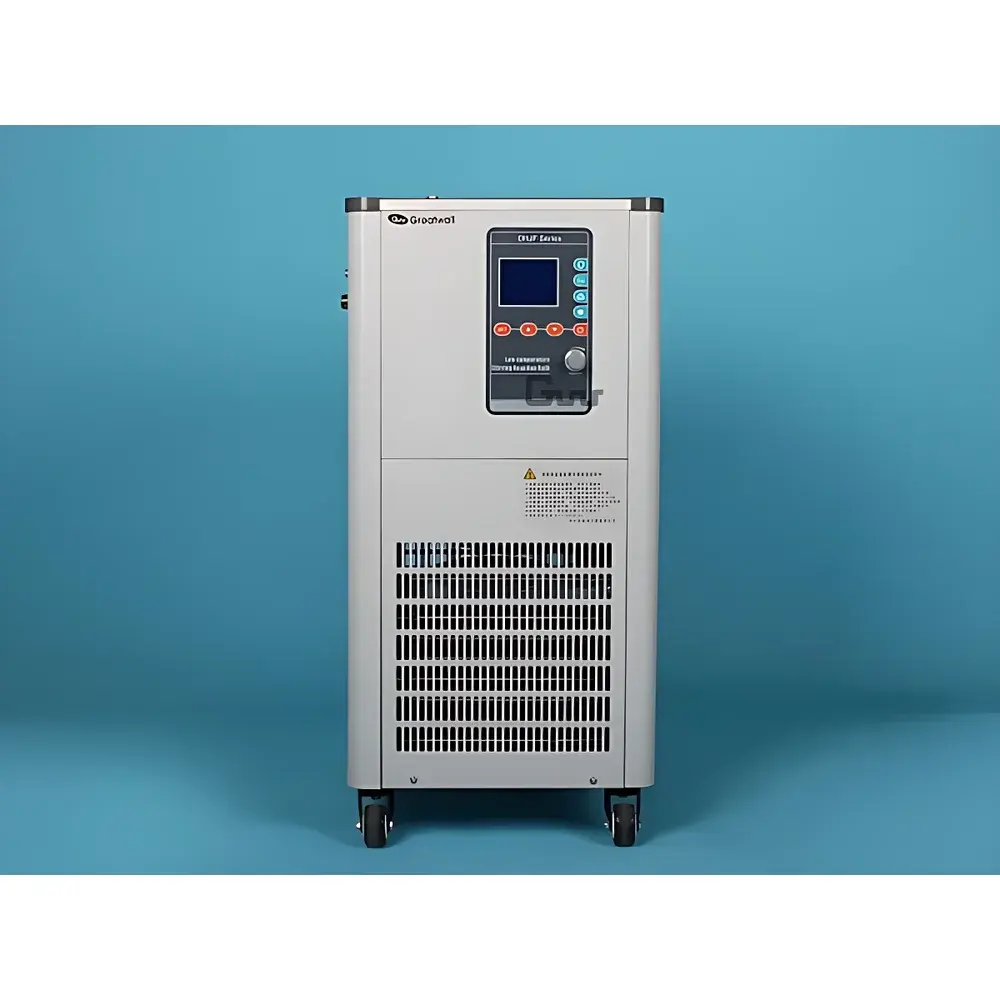
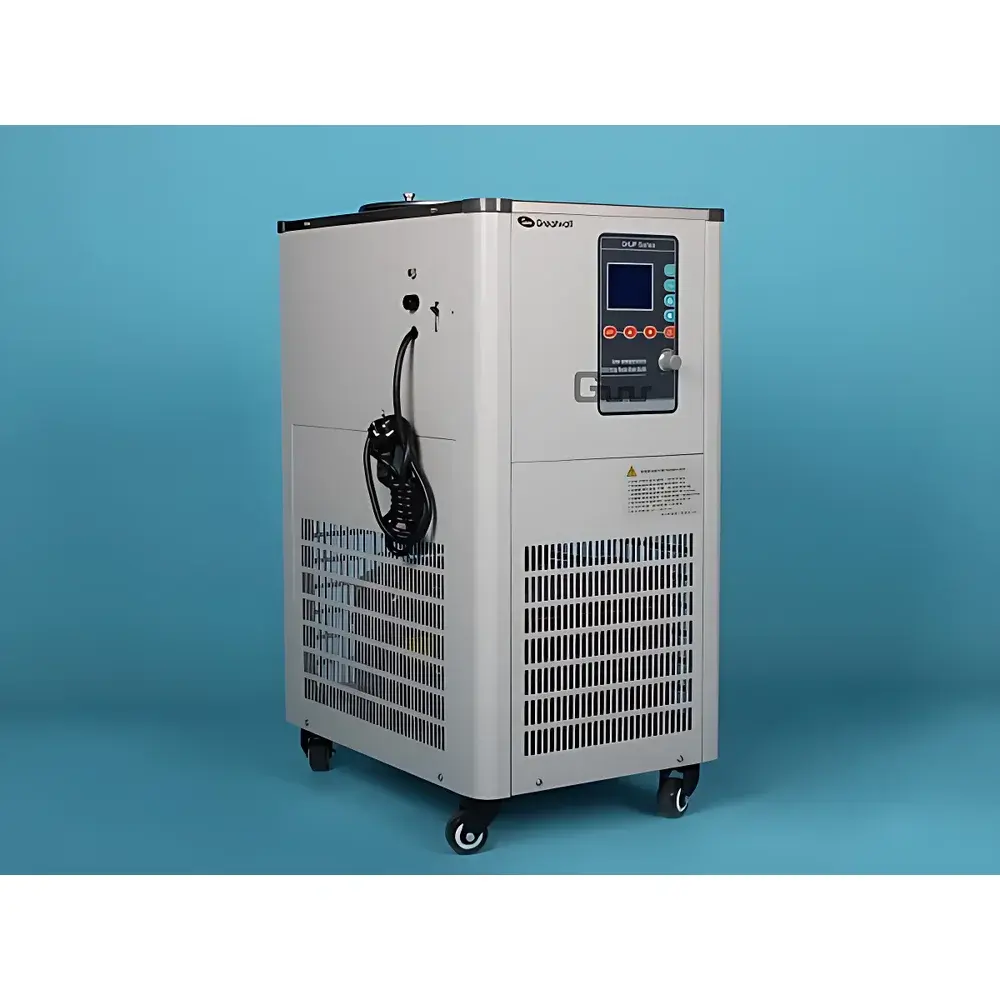
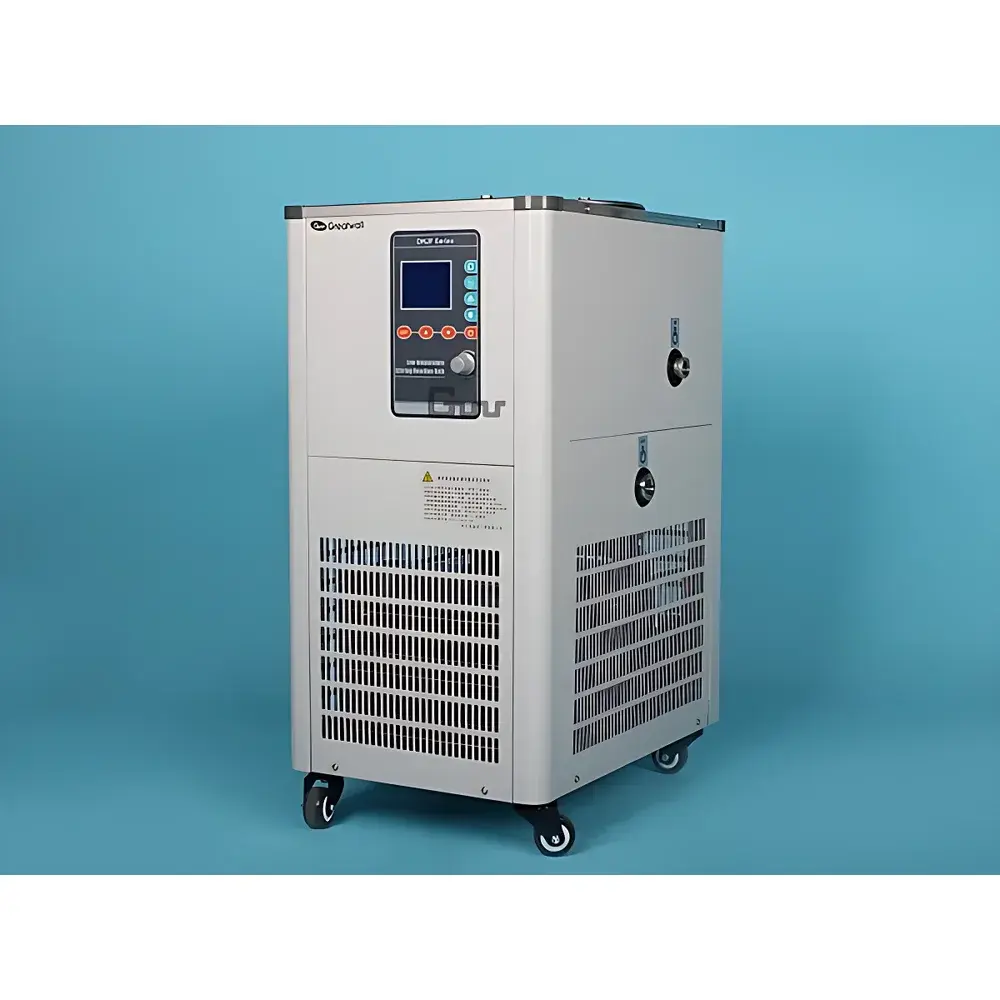
Zhengzhou Great Wall DHJF-4005 Cryogenic Circulating Thermostat
| Brand | The Great Wall |
|---|---|
| Origin | Henan, China |
| Manufacturer Type | Direct Manufacturer |
| Country of Origin | China |
| Model | DHJF-4005 |
| Price Range | USD 1,400–7,200 |
| Temperature Range | −40 °C to +99 °C |
| Temperature Stability | ±0.2 °C |
| Bath Volume | 5 L |
| Bath Dimensions (Ø × H) | 250 mm × 130 mm |
| Opening Diameter | 210 mm |
| Max Flask Capacity | 2000 mL |
| Heating Power | 1500 W |
| Rated Flow Rate | 20 L/min |
| Max Pressure | 0.4 bar |
| Ambient Operating Temp | 5–25 °C |
| Power Supply | 220–240 V~, 50 Hz |
| Cooling Capacity | 1000 W at 10 °C / 450 W at −20 °C / 40 W at −40 °C |
| Refrigerant | R404A (high-temp stage) & R23 (low-temp stage) |
| Total Power Consumption | 2450 W |
| Housing Material | Cold-rolled steel with electrostatic epoxy coating |
| External Dimensions (W×D×H) | 400 mm × 535 mm × 790 mm |
| Net Weight | 56 kg |
Overview
The Zhengzhou Great Wall DHJF-4005 Cryogenic Circulating Thermostat is an engineered solution for precise temperature control in laboratory-scale chemical synthesis, low-temperature reaction monitoring, and material characterization applications. Designed around a dual-stage cascade refrigeration architecture, it integrates two independent refrigeration circuits—R404A for the high-temperature stage and R23 for the ultra-low-temperature stage—to achieve stable operation across a wide thermal span from −40 °C to +99 °C. This configuration eliminates reliance on liquid nitrogen or cryogenic solvents while maintaining high thermal efficiency and long-term reliability. The unit employs a hermetically sealed Secop (formerly Danfoss) reciprocating compressor, selected for its proven durability in continuous-duty laboratory environments, low acoustic emission (<62 dB(A)), and minimal vibration transmission to sensitive experimental setups.
Key Features
- Cascade refrigeration system with R404A/R23 dual-refrigerant pairing for extended low-temperature capability down to −40 °C without external coolant
- High-efficiency finned air-cooled condenser with oxygen-free copper spiral tubing and proprietary expansion joint technology for enhanced heat transfer coefficient and simplified maintenance
- Compact coil-type evaporator integrated directly into the 5 L stainless-steel-lined bath reservoir—designed to withstand localized freezing of heat-transfer fluid without mechanical failure
- Digital PID temperature controller with full中文-to-English bilingual display interface (configurable), offering ±0.2 °C stability over full range and programmable ramp/soak profiles
- Self-contained air-cooled design eliminating water consumption and associated plumbing infrastructure—ideal for labs with limited utility access or strict water conservation policies
- Comprehensive safety architecture including delayed compressor restart, earth leakage protection, overcurrent cutoff, thermal overload monitoring, and real-time refrigerant pressure diagnostics
Sample Compatibility & Compliance
The DHJF-4005 accommodates standard laboratory glassware up to 2000 mL capacity (e.g., round-bottom flasks, jacketed reactors, and crystallization vessels) via its 210 mm opening and optimized internal flow geometry. Its circulation pump delivers a rated flow of 20 L/min at 0.4 bar maximum head pressure, ensuring uniform thermal distribution even with high-viscosity silicone oils or ethylene glycol/water mixtures. All wetted components—including the bath reservoir, internal coils, and circulation path—are constructed from corrosion-resistant materials compatible with common organic solvents and mild aqueous media. The unit complies with IEC 61010-1:2010 for electrical safety in laboratory equipment and meets China’s GB/T 21852–2008 standard for circulating chillers. While not certified to UL/CSA or CE for direct sale in North America or the EU, its design principles align with ISO/IEC 17025 requirements for temperature-controlled instrumentation used in accredited testing laboratories.
Software & Data Management
The DHJF-4005 operates as a standalone instrument with embedded firmware; no external PC connection is required for basic operation. However, optional RS485 serial communication (Modbus RTU protocol) enables integration into centralized lab automation systems for remote parameter setting, real-time temperature logging, and alarm event reporting. When interfaced with compliant SCADA or LIMS platforms, the thermostat supports audit-trail generation for temperature setpoint changes and operational status transitions—facilitating adherence to GLP and GMP documentation standards. Data export is supported via CSV-formatted logs stored on removable microSD cards (sold separately), with timestamp resolution of 1 second and retention depth of up to 30 days at 10-second sampling intervals.
Applications
- Low-temperature catalytic hydrogenation and Grignard reactions requiring sustained −20 °C to −40 °C bath conditions
- Controlled crystallization studies in pharmaceutical process development
- Calibration of thermocouples, RTDs, and infrared sensors across extended temperature ranges
- Thermal cycling of polymer samples prior to DSC or TGA analysis
- Condenser cooling for rotary evaporation under reduced pressure, especially when processing heat-sensitive compounds
- Temperature stabilization of optical benches and laser diode mounts in spectroscopy labs
FAQ
What is the minimum ambient temperature required for reliable operation at −40 °C?
The unit requires an ambient environment between 5 °C and 25 °C. Operation below 5 °C may impair oil viscosity in the compressor and reduce refrigerant mass flow, leading to unstable low-temperature performance.
Can this thermostat circulate ethanol or acetone as the heat-transfer fluid?
No. Only non-flammable, low-volatility fluids such as silicone oil (e.g., DC200 series) or 30/70 ethylene glycol/water mixtures are approved. Flammable solvents pose fire hazards and degrade seals and pump components.
Is the bath reservoir drainable for fluid replacement?
Yes—a bottom-mounted brass valve allows complete drainage without disassembly. Reservoir cleaning and fluid change intervals are recommended every 12 months under continuous use.
Does the unit support external temperature feedback control (e.g., from a probe in the reactor)?
Not natively. It operates in bath-temperature control mode only. For jacket- or reactor-core temperature control, a separate external PID controller with analog output is required to modulate the DHJF-4005’s heating/cooling enable signals.
What maintenance is required to sustain ±0.2 °C stability over time?
Annual verification of temperature sensor calibration using a NIST-traceable reference thermometer and inspection of condenser fins for dust accumulation are essential. Compressor oil analysis is advised after 5,000 operating hours.



