
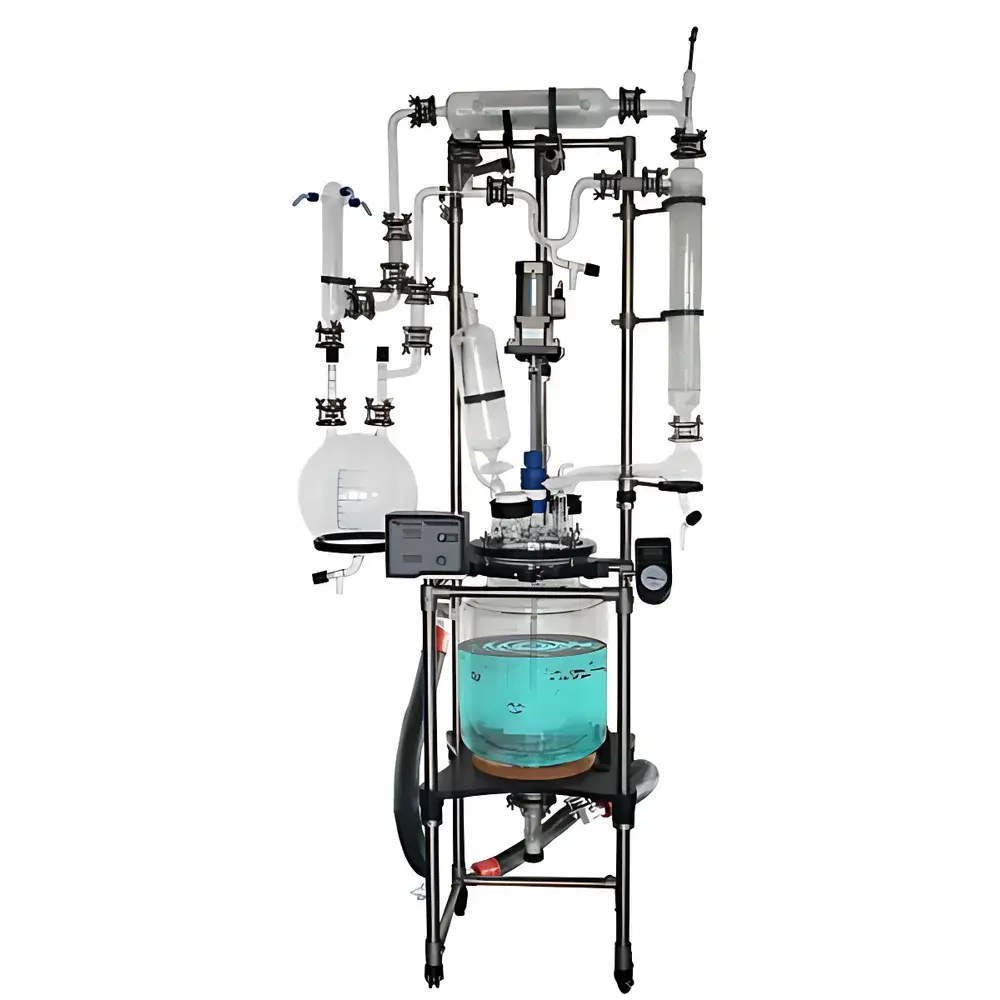
Zhengzhou Great Wall GR-20T Glass Jacketed Reactor
| Brand | The Great Wall |
|---|---|
| Origin | Henan, China |
| Manufacturer Type | Direct Manufacturer |
| Country of Origin | China |
| Model | GR-20T |
| Price Range | USD 2,800 – 7,000 (FOB) |
| Vessel Capacity | 20 L |
| Jacket Capacity | ~6 L |
| Operating Pressure Range | −0.1 to 0.0 MPa (gauge) |
| Vacuum Level | −0.098 MPa |
| Temperature Range | −80 °C to +200 °C |
| Temperature Sensor | Pt100 (±0.1 °C accuracy) |
| Stirring Speed | 50–500 rpm (variable-frequency control) |
| Motor Power | 90 W |
| Construction Material | Borosilicate Glass 3.3 (DIN ISO 3585), SUS304 stainless steel frame, PTFE-coated components |
| Condenser Heat Transfer Area | 0.249 m² |
| Reflux Column | Φ85 × 700 mm with Raschig ring packing |
| Constant-Pressure Dropping Funnel | 2000 mL |
| Number of Standard Ports on Lid | 6 |
| Floor Clearance for Bottom Valve | ~320 mm |
| Ambient Operating Conditions | 5–35 °C, ≤70% RH |
Overview
The Zhengzhou Great Wall GR-20T Glass Jacketed Reactor is an engineered laboratory-scale synthesis platform designed for controlled chemical reactions, distillation, reflux, and multi-step process development under variable temperature and pressure conditions. Built upon the principles of jacketed heat transfer and mechanical agitation, it enables precise thermal management via circulating media (e.g., silicone oil, ethylene glycol, or dry ice/acetone mixtures) through its integrated double-wall glass vessel. Its operating envelope—spanning −80 °C to +200 °C and −0.1 MPa to atmospheric pressure—supports cryogenic reductions, high-boiling solvent reactions, and vacuum-assisted dehydration or solvent removal. The reactor’s all-glass wetted path—fabricated from certified DIN ISO 3585 borosilicate glass 3.3—ensures optical clarity for real-time visual monitoring while delivering exceptional resistance to thermal shock, chemical corrosion, and mechanical stress.
Key Features
- Borosilicate glass 3.3 construction throughout all process-contact components—including vessel, condenser, reflux column (Φ85 × 700 mm), and constant-pressure dropping funnel (2000 mL)—guarantees long-term integrity in aggressive organic, acidic, and alkaline environments.
- Integrated SUS304 stainless steel support frame with locking casters ensures structural stability during operation and facilitates safe repositioning within fume hoods or dedicated synthesis bays.
- PTFE-coated paddle agitator with SUS304 shaft provides uniform mixing across heterogeneous reaction mixtures, minimizing dead zones and enabling reproducible mass transfer kinetics.
- High-precision Pt100 temperature sensor (±0.1 °C accuracy), housed in a dual-layer protective sheath (SUS304 outer tube + PTFE inner liner), delivers reliable in-situ temperature feedback for closed-loop jacket temperature control.
- Variable-frequency AC motor (90 W, 50–500 rpm) with digital speed display allows fine-tuned shear control—critical for sensitive catalytic systems, crystallization protocols, or viscous polymerizations.
- Stress-relieved jacket inlet/outlet ports connected via flexible stainless steel insulated hoses eliminate mechanical strain on glass joints during thermal cycling.
- Zero-residue bottom discharge valve with PTFE-sealed stem and elevated outlet (320 mm above floor level) supports quantitative transfer into collection vessels without cross-contamination or manual handling risks.
Sample Compatibility & Compliance
The GR-20T accommodates diverse sample types—including volatile solvents, moisture-sensitive organometallics, air-sensitive catalysts (when used under inert gas blanket), and thermally labile intermediates—without material compatibility concerns. Its design conforms to standard laboratory safety practices for Class I and II chemical synthesis. While not certified to specific international regulatory frameworks (e.g., ASME BPVC Section VIII or PED 2014/68/EU), the reactor meets foundational requirements for GLP-compliant method development and pilot-scale process optimization. All glass components comply with DIN ISO 3585 specifications for borosilicate glass 3.3; metallic parts satisfy ASTM A240/A240M for 304 stainless steel. Vacuum performance (−0.098 MPa) aligns with common rotary evaporation and thin-film distillation workflows per ASTM D1078.
Software & Data Management
The GR-20T operates as a stand-alone analog-digital hybrid system. Temperature and stirring parameters are monitored locally via front-panel digital displays; no embedded microcontroller or data logging capability is included. For integration into regulated environments, external recording devices (e.g., chart recorders or USB-connected DAQ systems) may be interfaced using standard 0–10 V or 4–20 mA analog outputs (available upon optional configuration). When deployed in GxP settings, users must implement procedural controls—including operator training records, equipment calibration logs (temperature sensor traceable to NIST standards), and maintenance documentation—to satisfy FDA 21 CFR Part 11 expectations for auditability and data integrity.
Applications
- Multi-stage organic synthesis requiring sequential addition, controlled exotherm management, and inline monitoring.
- Vacuum-assisted fractional distillation of heat-sensitive natural product extracts.
- Catalytic hydrogenation studies under inert atmosphere with precise temperature ramping.
- Polymerization initiation and propagation kinetics under isothermal or programmed heating profiles.
- Crystallization screening across supersaturation gradients using jacket-mediated cooling ramps.
- Extraction and concentration of active pharmaceutical ingredients (APIs) in early-phase process development.
FAQ
What is the maximum allowable temperature differential between the jacket and reactor interior?
The design limits the ΔT across the glass wall to ≤80 °C to prevent thermal stress fracture—e.g., if the internal reaction mass is at +150 °C, the jacket medium must remain ≥+70 °C.
Can the GR-20T be operated under positive pressure?
No. It is rated exclusively for vacuum-to-atmospheric operation (−0.1 to 0.0 MPa gauge); pressurized use voids warranty and violates safety certification boundaries.
Is the reflux ratio adjustable automatically?
No. Reflux control is manual via graduated valve adjustment on the side-arm condenser outlet; automated reflux ratio control requires third-party add-on modules.
What certifications accompany the unit upon shipment?
Each GR-20T ships with a Factory Acceptance Test (FAT) report verifying dimensional conformity, leak integrity (helium leak test at −0.1 MPa), and functional verification of motor, temperature sensor, and valve actuation.
How often should the PTFE-coated stirrer components be inspected?
Visual inspection is recommended before each use; replacement intervals depend on chemical exposure intensity but typically range from 6–24 months under continuous moderate-duty operation.



