
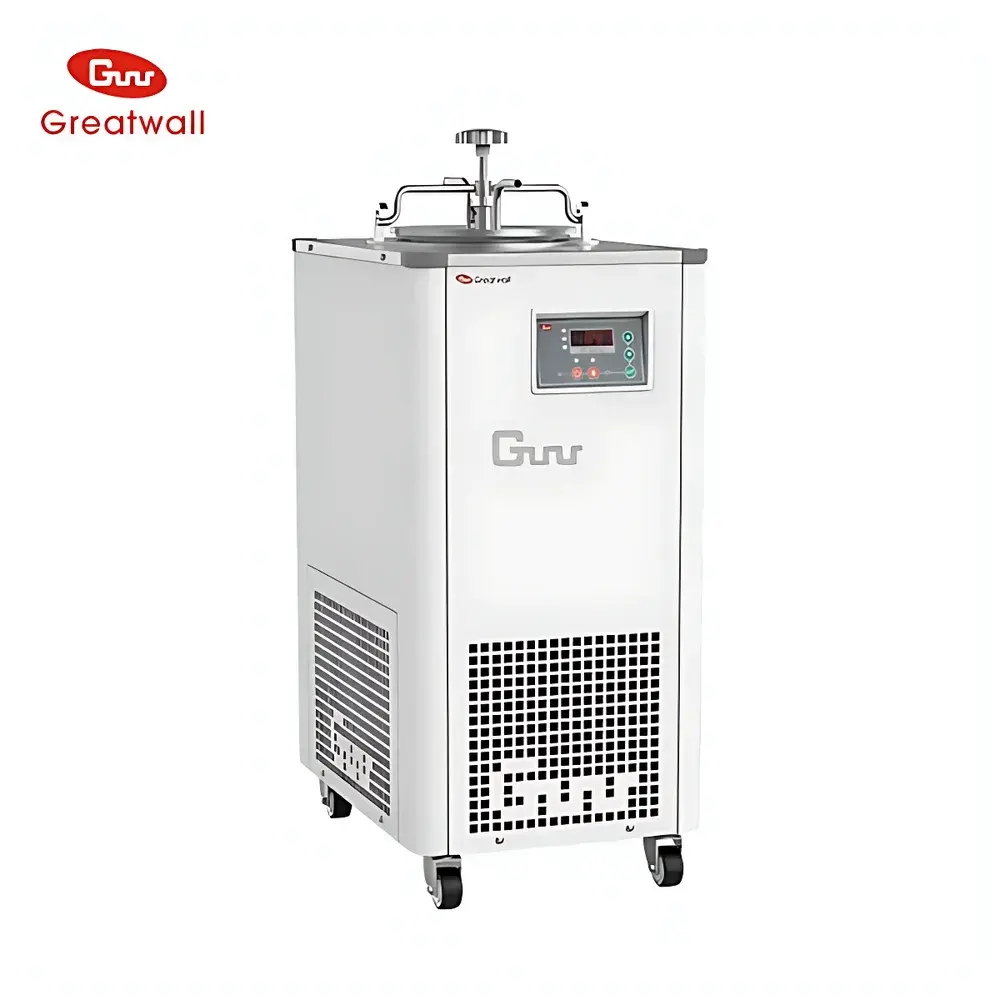
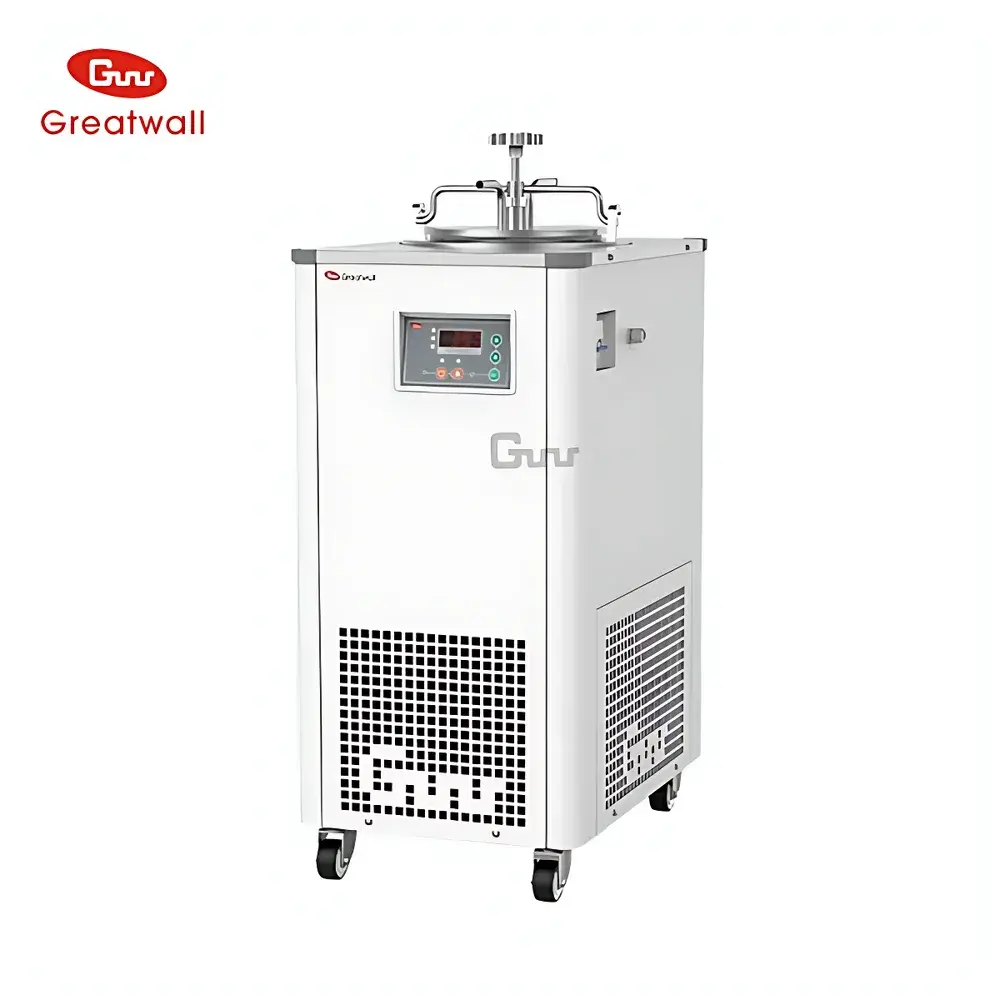
The Great Wall VT-2000H Water Vapor Trap
| Brand | The Great Wall |
|---|---|
| Origin | Henan, China |
| Manufacturer Type | Manufacturer |
| Model | VT-2000H |
| Cooling Method | Direct contact cooling |
| Minimum No-Load Temperature | −40 °C |
| Temperature Display | Digital, Pt100 sensor |
| Temperature Setting Range | Adjustable within operating range |
| Safety Protections | Delay start, overcurrent protection, overtemperature protection |
| Dehumidification Capacity | Max. 1 kg (water-based systems) |
| Refrigeration Capacity | 640 W at −10 °C |
| Refrigerant | R404A |
| Trap Chamber Dimensions | Ø160 × 240 mm |
| Chamber Material | 06Cr19Ni10 (AISI 304 stainless steel) |
| Vacuum Tubing Interface | Flexible hose connector, OD Ø12 mm |
| Ambient Operating Conditions | 5–35 °C, ≤70% RH |
| Power Input | 220–240 V~, 50 Hz |
| Total Power Consumption | 819 W |
| Rated Current | 3.7 A |
| Overall Dimensions (W×D×H) | 360 × 590 × 889 mm |
| Net Weight | 60 kg |
Overview
The Great Wall VT-2000H Water Vapor Trap is a purpose-engineered cryogenic condensation system designed to intercept and immobilize water vapor and volatile solvents generated during vacuum drying, lyophilization, rotary evaporation, and low-pressure thermal processing. Operating on the principle of direct-contact cryocondensation, the unit maintains a precisely regulated cold surface—down to −40 °C under no-load conditions—enabling efficient phase transition of gaseous effluents into solid or liquid condensate prior to reaching the primary vacuum pump. This not only extends pump service intervals and improves ultimate vacuum stability but also mitigates environmental release of hazardous vapors—including ethanol, acetone, dichloromethane, and low-molecular-weight organic acids—thereby supporting compliance with occupational health and emissions control requirements in academic, pharmaceutical, and industrial R&D environments.
Key Features
- Direct-contact cooling architecture with high-efficiency compressor-based refrigeration system using environmentally compliant R404A refrigerant
- Dual-mode condensation configuration: stainless-steel trap chamber (AISI 304 / 06Cr19Ni10) for aqueous and ethanol-based applications; optional borosilicate glass cold finger assembly for compatibility with acidic or aggressive organic solvents
- Real-time digital temperature monitoring via Pt100 resistance thermometer, with intuitive front-panel interface for precise setpoint adjustment across the full operational range (−40 °C to ambient)
- Integrated safety subsystems including compressor delay startup, thermal cut-off at critical junctions, and electronic overcurrent protection
- Robust mechanical design optimized for continuous duty: reinforced chamber geometry (Ø160 × 240 mm), sealed vacuum path with standardized Ø12 mm flexible hose interface, and vibration-damped mounting
- Energy-efficient operation validated at multiple thermal loads: 640 W refrigeration output at −10 °C, scaling to 20 W at −40 °C, enabling adaptive performance matching process demands
Sample Compatibility & Compliance
The VT-2000H accommodates diverse sample matrices and process chemistries without cross-contamination risk. Its 304 stainless-steel trap chamber meets ASTM A240 and ISO 8407 standards for corrosion resistance in neutral-to-mildly acidic aqueous environments, making it suitable for freeze-drying of biologicals, battery electrode drying (e.g., cathode/anode slurry solvent removal), and vacuum desiccation of hygroscopic compounds. When configured with the optional glass condenser, the system supports USP and ICH Q5C-compliant handling of volatile organic media used in API crystallization and electrochemical material synthesis. All electrical components conform to IEC 61010-1 for laboratory equipment safety, while the sealed refrigeration loop complies with EU F-Gas Regulation (No. 517/2014) regarding fluorinated greenhouse gas containment.
Software & Data Management
The VT-2000H operates as a standalone, hardware-controlled instrument with no embedded firmware or network connectivity. Temperature setpoints and real-time readings are managed locally via a calibrated digital display module traceable to NIST-traceable Pt100 reference standards. For integration into GLP- or GMP-regulated workflows, the unit supports external data logging through analog 0–5 V or 4–20 mA outputs (optional accessory). These signals may be captured by validated SCADA systems or LIMS platforms compliant with FDA 21 CFR Part 11 requirements when paired with appropriate audit-trail-enabled acquisition hardware. No proprietary software drivers or cloud services are required or provided.
Applications
- Vacuum drying of lithium-ion battery electrode coatings and separator films, where residual moisture control below 50 ppm is critical to cell cycle life and safety
- Cryo-trapping during high-vacuum thermal desorption (TV-TD) of environmental soil samples prior to GC-MS analysis
- Protection of oil-sealed or dry scroll vacuum pumps in rotary evaporators processing heat-labile natural product extracts
- Pre-freezing and low-temperature hold stages in pilot-scale lyophilization development, leveraging the unit’s stable sub-zero thermal mass
- Condensation capture in vacuum glovebox antechambers during solvent-intensive thin-film deposition processes
FAQ
Can the VT-2000H be used continuously at −40 °C?
Yes—provided ambient conditions remain within specification (5–35 °C, ≤70% RH) and the unit is installed with adequate ventilation clearance (≥150 mm on all sides). Continuous operation at minimum temperature requires periodic defrosting if condensate accumulation exceeds 1 kg.
Is the stainless-steel trap chamber compatible with hydrochloric acid vapor?
No—304 stainless steel is not resistant to HCl corrosion. For acidic vapors, the optional borosilicate glass condenser must be installed, and downstream vacuum lines should be chemically inert (e.g., PTFE-lined).
Does the unit include vacuum pump isolation valves?
No—the VT-2000H is a passive trapping device and does not incorporate pneumatic or manual isolation valves. Users must install external vacuum line valving per ASME BPE or ISO 28560 guidelines for maintenance safety.
What is the expected service life of the R404A refrigeration system?
Under normal laboratory use (≤8 h/day, clean ambient air), the sealed compressor and refrigerant circuit are rated for ≥15,000 operating hours, consistent with ISO 5141-2 lifetime validation protocols for Class II laboratory refrigeration units.



